- Latest
- Trending

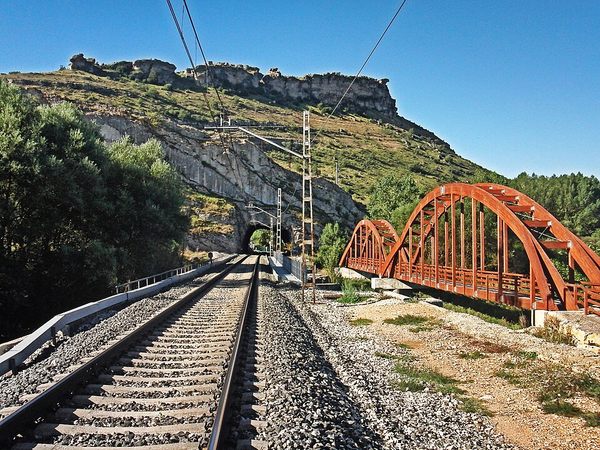
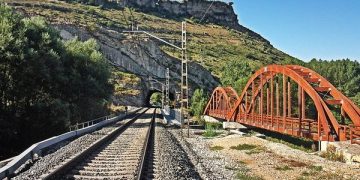
Whilst heritage railways are fairly frequent entries in Atlas Obscura rail lines that are still operating commercially are much rarer but not unknown. This, Iberian standard gauge, line is actually the the northern section, through the Cantabrian Mountains, in Spain, of a line which actually runs south as far as Palencia , which is northwest of Madrid. It is remarkable for its spectacular scenery, its marvellous railroad engineering and its historic value. Starting in the north, the line runs from Santander rail station, in Cantabria, quickly running out through the suburbs then is very soon into the mountains. The impressive mountain scenery (and much of the engineering difficulty) changes to much less interesting surroundings about 84 miles of track later as it enters the Meseta Central plains around Alar del Rey. It was constructed in the mid 19th century, with the section between Santander and Alar del Rey being opened in 1866. .
Travelling south on this, now fully electrified, line through some remarkable scenery one soon reaches the famous Rampe de Bárcena section of track. This is one of the most remarkable feats of railway engineering on any adhesion line in the world. Between Bárcena de Pie de Concha and Reinosa the line rises 560 metres over a distance of 21km but the Pesquera–Bárcena section has a height difference of 319 meters over only 7 km . The route is considered to be a, very rare, “triple horseshoe” and just looking at the plan on a map is very impressive. The convoluted route, involving three long and seriously curved tunnels was designed by English engineer Alfred S Gee as an alternative to the proposal of using wire hauled inclines on the steepest parts of the route by his Spanish competitor, Juan Rafo. Gee proposed maximum gradients requiring more powerful locomotives than originally intended. Of these some 14 2-4-0 steam locomotives were produced by Isaac Dodds and Son (of Rotherham, England) and , famously, were never paid for. In thinking about the Rampe we need to remember that the main aim was to take full waggons of wheat to the port, essentially a down hill trip, and the documents of the time often refer to the Rampe as a “descent”. Presumably hauling empty waggons back up was considered less of a problem. In any event electrification of the line in 1951 provided all the power needed.
The scenery around the “Rampe” is magnificent and alighting at stations along the line deposit you in the heart of the magnificent Cantabrian mountains. You will also cross over the stunning Viaducto de Celada Marlantes, at the time of building, the largest viaduct in Spain and still beautiful, if less impressive in a modern context. If road viaducts are your thing the line passes close to the highest road viaduct in Spain at Montabliz. Passing onwards south between Aguilar de Campoo and Mave the line passes through the natural grandeur of the Cañjón dela Hoadada with its massive cliffs reaching up to the, archaeologically important, Las Loras and Las Tuerces mountains to the left and right.
It is worth a stop off at Mave here to see the magnificent church attached to the Convento de Santa Maria just 50 feet from the station. South from Mave to Alar del Rey the scenery changes as mountains give way to the wide open arable land of the northern part of the Meseta Central. At Alar del Rey, of greatest historic interest, is the Canal de Castilla which originates in the town. The southward route of the railway and canal are very close. It was the building of this railway which terminated all ambitions to continue the canal north to the port of Santander and eventually caused the demise of the canal as a commercial navigation leaving it to serve as an important water supply channel and now very much a tourist attraction.
Overall a magnificent rail journey taking in both natural grandeur and some of the most significant civil engineering feats of the time. There may only be a few more years to experience it as the spectre of a new, high speed , line is looming.

🇺🇸 Airfare Is Up, AAdvantage Rates Aren’t 🤒 The antidote to high airfare might be sitting in your American AAdvantage...

Whilst heritage railways are fairly frequent entries in Atlas Obscura rail lines that are still operating commercially are much rarer...
Holiday getaways are about switching off, reconnecting and creating new memories. For many families, this means the joy of time...
Elon Musk has unveiled a promo video for the new financial service X Money, which turns the social network into a...
Discover Global News Panorama at news.mapworldnow.com — your universal gateway to comprehensive, international journalism. From politics and technology to culture and sports, we cover all news niches and all news categories from every corner of the world, all in one place.