- Latest
- Trending

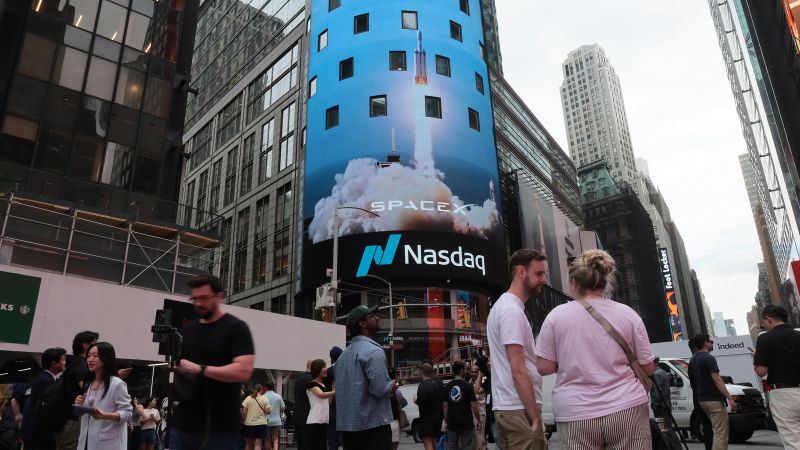
For more than a decade before SpaceX went public, CEO Elon Musk said it should not — for reasons that now feel keenly prescient.
Such a move, he warned, would make it too difficult to maintain a single-minded focus on the company’s audacious ultimate objective: colonizing Mars.
“Creating the technology needed to establish life on Mars is and always has been the fundamental goal of SpaceX,” Musk wrote in a 2013 email to SpaceX employees that also cautioned about the “irrational exuberance or depression” of the stock market.
“If being a public company diminishes that likelihood,” he wrote, “then we should not do so until Mars is secure.”
In the years since that email was sent, SpaceX has morphed from a rocketry underdog to the dominant force in the global space launch industry, returning astronaut flights to the United States after years of reliance on Russia and creating a multibillion-dollar business beaming internet from space.
Now, the company’s portfolio is expanding even more, and SpaceX is having perhaps its biggest identity crisis to date.
Ahead of its blockbuster IPO this month, SpaceX moved quickly to better position itself for the AI craze, acquiring Grok chatbot creator xAI, setting up a deal to buy the Cursor coding tool, and laying out new plans to put AI-processing data centers in space. That repositioning helped SpaceX make the largest stock market debut in history and raise more than $85 billion.
But the rapid transformation is raising questions for longtime fans and investors: Will SpaceX actually continue to pursue Mars colonization?
A clue may be buried in the company’s financial filings.
According to the SpaceX ’s S-1 prospectus, filed on May 20, Musk will only receive his entire $7.5 trillion pay package if SpaceX succeeds in establishing “a permanent human colony on Mars with at least one million inhabitants.”
It’s not clear how sincere this line is intended to be, according to Jay Ritter, a finance professor at the University of Florida and director of its market research program, the IPO Initiative.
“These are just jokes,” Ritter told CNN.
Including a quip in a financial prospectus would be quite out of the ordinary, Ritter acknowledged, saying “I can’t think of any other example.” But it wouldn’t be legally out of bounds, he added.
Not everyone believes, however, that the line is insincere.
People who follow SpaceX know — given the many hours over the course of a decade that Musk has dedicated to the expounding on the idea — how deeply engrained the goal of a Martian settlement is in the company’s culture and ethos.
Whether SpaceX remains dedicated to the pursuit could have sweeping implications for its financial outlook, its approach to developing new technologies and its public perception.

Already, SpaceX is facing an inquisition in the court of public opinion.
“It took people some time to get their head around what Musk was doing, like, ‘Wait a second — SpaceX is now an AI company? Is SpaceX chasing the next hot thing? Whatever happened to going to Mars?’” said Chad Anderson, the founder and managing partner of Space Capital, one of the first dedicated space investment firms.
SpaceX’s Mars ambitions are a galvanizing force for its fans, so including language about a red planet colony in its financial documents was, according to Anderson, “important messaging to show that there’s still a North Star, and the North Star is still to make humanity a multi-planetary species.”
And public perception is important for SpaceX. The company intentionally positioned itself to cash in on enthusiasm from individual investors, reserving a record-breaking number of shares — up to 30% — for members of the public to purchase during the IPO.
The response was zealous: “We’re running out of superlatives to describe retail enthusiasm for SpaceX,” research firm Vanda said in a recent report.
What’s not clear is how much the individual investors racing to purchase SpaceX stocks care about the company’s long-term goals or sending humans to Mars.
While the infamous r/WallStreetBets subreddit has been awash with users hyping the IPO and complaining they couldn’t purchase more shares, other corners of the internet show a fracturing SpaceX fanbase.
Reddit threads usually dedicated to analyzing and celebrating virtually every move the company makes have occasionally devolved into standoffs and arguments — pitting exploration enthusiasts against the meme-loving “stock bros.”
“Why do stock bros gotta ruin the best space sub?” one commenter recently lamented.
“The thing that set SpaceX separate from everyone else was that they were hyper focused on their goals…but now they’re getting distracted,” another comment reads.
One post on a prominent SpaceX subreddit with more than a thousand upvotes shows a four-stage progression of a person applying clown makeup, with the title: “My journey as a SpaceX fan the last 15 years.”

Musk openly touted his dedication to the red planet as recently as last summer.
But he has also given hardcore Mars advocates cause for consternation. In February, Musk took to his social media platform, X, to declare that SpaceX would shift its near-term focus to the moon.
“For those unaware, SpaceX has already shifted focus to building a self-growing city on the Moon, as we can potentially achieve that in less than 10 years, whereas Mars would take 20+ years,” Musk wrote.
Though the post did not mention NASA, Musk’s proclamation notably came as the space agency was publicly urging SpaceX to pick up the pace on its promise to deliver a lunar lander — part of a $2.9 billion contract signed in 2021. The need to complete that project has grown in urgency as NASA has faced increased competition with its space race rival, China, imbuing SpaceX’s sudden change in priorities with both financial and political stakes.
SpaceX could pivot back to focusing on Mars later down the line, Musk said, but “the overriding priority is securing the future of civilization and the Moon is faster.”

Perhaps, however, SpaceX’s stated end goal is less important than the technology the company develops along the way.
As it happens, the vehicle that the company is promising to use to ferry NASA astronauts to the moon’s surface — called Starship — is the same one Musk says will carry the first humans to Mars.
Notably, Starship is also slated to carry the next generation of Starlink internet satellites to orbit and deploy SpaceX’s envisioned AI-processing orbital data centers. No other rocket in the world would be capable of hauling satellites of the size and scale needed to make space-based data centers a reality.
As Musk has advertised numerous times in the past decade, Starship is also designed to drive down the cost of getting cargo to orbit by orders of magnitude — from a couple thousand dollars per kilogram to as little as $10 per kilogram. Only such cost savings, Musk has said, can make Mars travel sustainable.
“Starship is integral to the future of this business — that’s really clear,” Anderson said.
In other words, investing in SpaceX long term means betting on the idea that Starship will deliver on its promises. And through dozens of interviews with engineers, advisors and analysts in recent years, a common refrain has emerged: If any company is can do it, it’s SpaceX.
But the rocket is not yet operational. Starship is still in the midst of a lengthy flight test campaign. And though SpaceX has made substantial progress, many crucial features of the vehicle have yet to be tested — including reusing the upper Starship spacecraft and refueling the vehicle in orbit with super chilled, cryogenic propellants. Neither of those feats have ever been attempted before in the history of rocketry.
Musk has sought for more than a decade to get the public comfortable with SpaceX’s approach to rocket development, which emphasizes testing cheap prototypes in flight and embracing the occasional mishap rather than trying to guarantee perfection. The Starship program has been no exception, with uncrewed test flights occasionally ending with abrupt explosions over the Atlantic Ocean.
“SpaceX has done an incredible job, like an unprecedented job, of taking the public along for the ride,” Anderson said. “And I think that’s actually one of the things that builds a lot of trust in the public and in retail investors.”
But it remains to be seen how the stock market will react if SpaceX were to experience an explosive setback during trading hours.

When Musk swore he would never take SpaceX public, he was also weathering what were several grueling years for Tesla, his electric car company.
For the better part of the 2010s, Tesla was battered by analysts and short sellers that created a pressure cooker environment under which the company needed to scale up production of its mass market cars.
At one point in 2018, Musk said he was sleeping on the factory floor and became visibly emotional when describing the “excruciating” toll of trying to ensure the company could deliver on its promises. He also openly expressed a desire to delist Tesla from the stock market, and ran into legal trouble in the process.
Tesla, by most accounts, emerged victorious from those harrowing days. But it does raise questions about what prompted Musk to change his mind about taking SpaceX public, and how this company, with its even loftier goals, will fare now that it is faced with the daily push-and-pull of stock prices.
It’s possible the upsides of going public amid the AI craze — and the promise of an IPO raising tens of billions of dollars for SpaceX — were too great to pass up.
“I really view the SpaceX IPO as analogous to when Google went public for the tech sector,” said Andrew Rush, a longtime industry executive and cofounder of the startup Star Catcher. “SpaceX going public is, I think, the recognition that this is a company that is scaled and delivering on the potential of space — and just like Google and the hyperscalers that came after — that initial set of services is just going to grow and grow and grow.”
And Rush expects spillover benefits to the space industry at large: “Certainly the IPO, the value that’s generated, will drive capital into our market.”

Given SpaceX’s valuation, Wall Street is counting on a few things: SpaceX will begin regularly launching Starship on operational missions. This new rocket will deploy Starlink satellites that will expand the capacity of its global internet service. And the company will build out orbital data centers as it works on NASA’s moon base.
Even with Mars out of the question, that vision entails many long years of pouring billions of dollars into high-risk, profit-eating endeavors.
Orbital data centers, for example, present a slew of engineering challenges — such as how to keep the satellites cool. (Space is not actually cold, contrary to popular belief.)
Successes must support the struggles. At least, that has been the case so far: Even when SpaceX finishes a development program, and the funds come flooding in, it rapidly reinvests the money in the next bold ambition.
Briefly in the early 2020s, for example, SpaceX floated the idea of spinning off Starlink and taking just the internet service public as the venture was clearly showing its ability to net billions per year from a rapidly growing customer base.
But Starlink never spun off. And a look inside SpaceX’s books shows why: The company has been furiously reinvesting Starlink’s profits into other ventures, namely Starship.
If SpaceX’s ultimate goal is to colonize Mars, that tendency to divert extra cash into longshot development programs may never cease. An extraterrestrial settlement in an environment like Mars — with its lack of magnetic field and thin, toxic atmosphere — would likely necessitate the invention of numerous new technologies.

And it’s not clear what kind of return on investment establishing a Martian colony may offer.
There are no known resources on Mars that would be valuable enough to mine and sell back to Earthly businesses.
And while much of Wall Street has been hyping the IPO — it even turned the iconic Times Square New Year’s Eve ball into a Mars replica — some analysts are already expressing their hesitation.
Financial research firm Morningstar warned that SpaceX was overvalued.
“Only the most optimistic Moonshot scenario, which requires a rapidly reusable Starship and commercially competitive orbital data centers, approaches the IPO price,” the report reads. “The IPO price implies the Moonshot scenario is highly likely, but we think the outlook is very uncertain.”
And while the stalwart pursuit of establishing a Martian civilization may galvanize SpaceX’s exploration-focused fans, it may have the opposite effect on Wall Street.
Ritter, the finance professor, said that including language about Mars colonization in its IPO prospectus could be a way for Musk to make “fun of himself” and his “excessive” $7.5 trillion compensation package.
Even if SpaceX doesn’t pour untold billions into attempting to create a sprawling Martian settlement, Ritter added, he does not advise retail investors — the general public — to buy its stock right now.
Indeed, it may be a volatile investment: After surging during its debut, SpaceX’s stock briefly dipped below its $150 per share IPO price on Tuesday.
“SpaceX is a great company, but that doesn’t mean it’s a great investment,” he said. “The valuation is assuming that lots of great things are going to be happening — and things don’t always go according to plan.”

Former world champion Lizzie Deignan has returned to Great Britain's cycling team in a sporting director role which "will play...

For the first time since 1973, the New York Knicks are NBA champions.They defeated the San Antonio Spurs in five...
World Cup fans attend the FIFA’s Fan Fest, a sixteen day festival in Atlanta. CNN’s Rafael Romo talks to attendees....
During the 1996 Olympics in Atlanta, $100 could buy you a pair of shorts, a hat, a t-shirt and a...
Discover Global News Panorama at news.mapworldnow.com — your universal gateway to comprehensive, international journalism. From politics and technology to culture and sports, we cover all news niches and all news categories from every corner of the world, all in one place.