- Latest
- Trending
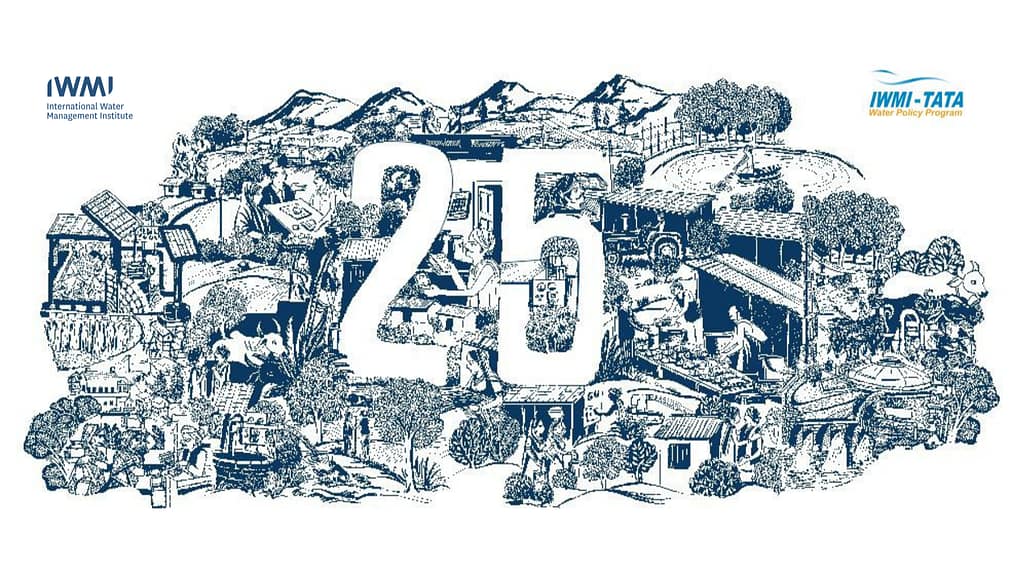
From India’s agriculture fields to its parliament, the IWMI-Tata Water Policy Research Program continues to shape programs and policies.
Since the turn of the century, the International Water Management Institute’s (IWMI) longest partnership — the IWMI-Tata Water Policy Research Program (ITP) — has played an integral role in shaping India’s water, energy, climate and agriculture policy discourse. Based in Anand, a small city in western India, ITP combines IWMI’s technical expertise with the strong field presence of Tata Trusts, India’s largest charitable foundation. In the last 25 years, the program has built a legacy of research and left an indelible mark on India’s development sector.
ITP research has helped shape key government programs like the Government of India’s flagship groundwater governance initiative, Atal Bhujal Yojana; Gujarat’s Jyotigram Yojana and the National Dugwell Recharge Program. ITP has also inspired and influenced key solar energy initiatives, including Gujarat’s Suryashakti Kisan Yojana and the world’s largest agri-solarization campaign, PM-KUSUM (Pradhan Mantri Kisan Urja Suraksha Evam Utthaan Mahabhiyan). The program also incubated Collectives for Integrated Livelihood Initiatives (CInI) — a Tata Trusts-supported resource organization committed to improving life in rural and tribal regions of Central India.

The IWMI-Tata Program has conceptualized, co-developed and jointly implemented multiple action research pilots and field experiments. ITP helped organize the world’s first solar pump irrigators’ cooperative, where farmers in Gujarat’s Dhundi village collectively operate grid-connected solar pumps to sell surplus energy to the grid. In the last decade, it has experimented with numerous solar irrigation models. For instance, a pilot for individual solar irrigation service providers was successfully tested in Bihar’s Chakhaji village, supplying affordable water to smallholder farmers. In Jharkhand, a Farmer Producer Organization (FPO) invested in solar pumps to offer irrigation as a service to member farmers driving affordable, diesel-free irrigation at scale.
In 2014, ITP won the UN-WATER Best Water Management Practices Award for its “groundbreaking research linking energy use, food production and water availability”. ITP’s research has been cited in parliamentary debates and referenced in pre-budget consultations. International development organizations — among them the World Bank, Swiss Agency for Development and Cooperation (SDC), and the Deutsche Gesellschaft für Internationale Zusammenarbeit (GIZ) — have drawn on ITP research in formulating their development interventions.

More than 250 development partners and practitioners have collaborated with ITP researchers, and hundreds of students who trained with the program now hold positions across India’s development sector. Within the CGIAR, ITP has been lauded as a model of publicly useful applied research, where knowledge generated close to the ground is translated into policy and field action.
IWMI-Tata Program’s mandate is to “convert science into policy action,” generating ideas and evidence to inform practical, scalable solutions to India’s most pressing developmental challenges. From “intelligent rationing of farm power” to delivering “har khet ko pani” (water to every farm) and training India’s next generation of water researchers and development practitioners, the following offers a glimpse into the lasting legacy of the Program.
ITP was among the first to argue that India’s water and energy economies were intricately connected, and that energy policies were among the most potent instruments for governing and managing groundwater. ITP research on the water-energy nexus laid the foundation for the separation of agricultural feeder lines, giving villages 24-hour quality power while introducing intelligent rationing of farm power supply.
In 2003, the government launched Jyotigram Yojana, aimed at revolutionizing the power sector in rural India. Implemented in mission mode and backed by an investment of Rs. 12.5 billion, the scheme was widely appreciated and replicated in several other states.


In 2016, ITP and the Aga Khan Rural Support Programme, India (AKRSP-I) launched an action research pilot in north Bihar’s Chakhaji village to catalyse buyer-friendly irrigation service markets. Farmers were equipped and trained as ‘solar irrigation entrepreneurs’ to sell water to nearby farms through buried pipeline networks.
“It is not difficult to convert [existing] diesel entrepreneurs into solar entrepreneurs: they already have customers they already know how to manage irrigation. You just change the source of power,” said Apoorva Oza, chief executive officer of AKRSP-I. The intervention was designed for entrepreneurs to cover nearly half the capital costs through water sales, and they were clustered around overlapping command areas to prevent monopoly conditions in local groundwater markets.

By 2019, irrigation costs had fallen to roughly a third of earlier rates, cropping intensity had risen from 1.90 to 2.22, and farm revenues were up 30% to 40%. AKRSP-I went on to establish numerous similar systems across north Bihar. Through continuous collaborative work between ITP and AKRSP-I over the years, the model has now evolved into the rapidly-scaling ‘Solar Didi’ model, with women members of Self-Help Groups taking up solar pumping systems as micro-enterprises.
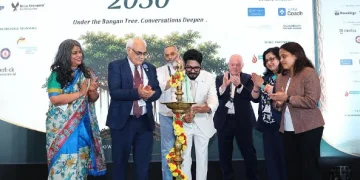
Over the years, ITP has developed a research portfolio spanning water, energy and rural livelihoods, led by young researchers pushed to conduct grounded inquiries into diverse water problems. The ITP Partners’ Meet, its flagship convention of water sector professionals, was a key avenue for these ideas: as founding leader Tushaar Shah wrote in his 2008 book Taming the Anarchy, the event “teemed with hundreds of eager participants, including dozens of policymakers, who came to it for the bold — at times seemingly reckless — ideas that ITP youngsters brought to the water policy discourse.” In December 2025, the program convened the silver jubilee edition of this gathering, bringing together researchers, policymakers and practitioners to discuss the program’s legacy and chart an agenda for the future.

The IWMI-Tata Program has been a launching pad for scores of young researchers and pre-doctoral fellows, and a training ground for hundreds of student interns who spent time with the program to conduct research into real problems relating to water, livelihoods and agriculture. As an institution, it propelled young researchers to the forefront, encouraged them to engage in debate and left an imprint on the generations that passed through it. Its ability to conduct wide-ranging research was due in part to the flexibility in partnership design which allowed the program to be exempt from donor cycles or limitations.
Many of these researchers have since carried ITP’s focus and approach into careers across academia, industry and development practice – in India and beyond. “I did not set out to become a researcher; I chose a career in research because I worked at ITP. Four years at ITP shaped the way I approach research and policy problems more than seven years of higher education in the US did,” says Avinash Kishore, senior research fellow at the International Food Policy Research Institute, reflecting on how his time at ITP shaped his career. “Higher education gave me skills; ITP gave me the audacity to ask big questions and not flinch from unorthodox answers.”

Twenty-five years on, ITP has proven to be a unique model for development research — operating at the intersection of science, policy and practice, with a central focus on practical solutions and encouragement to young researchers. Its influence ranges from shaping national government schemes to incubating scalable pilots to shaping India’s larger development discourse.
As the Program enters its next phase, the questions at the core of the ITP model — how to bridge research and development practice, how to make water and energy systems work for smallholder farmers — remain as relevant and central to its mission as before.


Like many U.S. airlines these days, Southwest's Rapid Rewards program uses dynamic award pricing to set redemption rates. Translation? The...

If you visit this small (about 10% of size of Central Park NY), triangular shaped park in the heart of...
Sovereign capital in travel has a coastline problem, and Albania’s Flamingo Revolution — more than three weeks of protests, the...
While retail investors are holding their breath as they watch XRP's psychological $1.00 threshold, higher timeframes point to an entirely different...

Discover Global News Panorama at news.mapworldnow.com — your universal gateway to comprehensive, international journalism. From politics and technology to culture and sports, we cover all news niches and all news categories from every corner of the world, all in one place.