- Latest
- Trending
Good morning! Today is Wednesday, the 24th of June, 2026 and this is the Wednesday Edition of GEORGE.
GEORGE reaches midweek with a clear look at the stories that matter, from major global developments to original reporting and analysis. Here is the context needed to understand the day ahead.
Let’s dive right in, shall we?
News from the World Cup and Iran negotiations and machinations dominates. The football world is still in the initial Group Stage and, because the tournament has expanded to 48 teams, a new Round of 32 has been introduced prior to the traditional single-elimination matches. GEORGE’s @On the Pitch reporter covers major Ronaldo news, why a player who covered is mouth got into big trouble, and how England stumbled to a 0-0 draw.
Right in the middle of this, our @Bartleby on Language reporter will explain exactly what a Trionda is and why this discovery is so important. GEORGE’s @The Sketch editorial cartoonist takes inspiration from this and it was all the other editorial staff could to to keep him from getting too carried away.
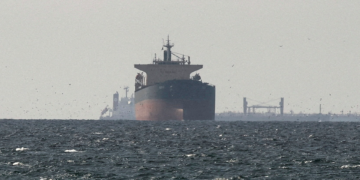
In @The War Room, instead of “He said/She said” it’s more “Trump said/Iran said” and, as always, the truth is somewhere in the middle, one would at least hope. Regardless of what Iran said about closing the Strait of Hormuz, the relatively heavy traffic transiting the Gulf tells otherwise, our correspondent tells us.
In today’s @World News Roundup, our correspondents report on the inadvertent execution of a suburban housewife by a runaway Tesla, the early season heat wave in western Europe that is bringing excruciatingly high temperatures to places without air conditioning and the tragic death of at least 40 young people who drowned swimming in unsupervised waters in France to escape the heat.
There is more exclusive reporting in today’s GEORGE – but don’t touch that dial. Scroll down for today’s editorial cartoon in @The Sketch, then continue with additional news, commentary, and stories readers will not find elsewhere.
GEORGE will return tomorrow with a new editorial cartoon and more original dispatches and reportage.
Until then, remain curious!

_________________________
VOLUME VI… № 1,746
@THE LEDE (above)
@THE SKETCH (above) The genus Trionda
IN THIS ISSUE
@INTERMEZZO I Snickers the Wonderdog on the beach
@ON THE PITCH World Cup 2026 Coverage
@INTERMEZZO II Car caught at dusk
@BARTLEBY ON LANGUAGE What in the world is a Trionda?
@INTERMEZZO III Ambrotype of a Kansas regulator gang
@THE WAR ROOM
@INTERMEZZO IV Spices on display at Grand Central Terminal shops
@WORLD NEWS ROUNDUP
@INTERMEZZO V Starry Night
@PASSINGS Alan Greenspan dies at 100
@RECENT DISPATCHES OF NOTE
@ABOUT GEORGE
____________________________________
 ____________________________________

Snickers the Wonderdog enjoying the beach several years ago
______________________________________
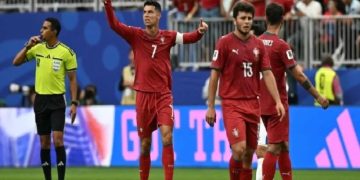
— Cristiano Ronaldo became on Tuesday the first man to score in six World Cups when he found the back of the net for Portugal against Uzbekistan. Mr. Ronaldo’s strike in the sixth minute was his ninth career World Cup goal. It was also his first since he converted a penalty kick against Ghana in Portugal’s 2022 opener. The goal came after the Portugal captain faced a torrent of criticism for his poor performance in Portugal’s opening 1-1 draw against Congo on 17 June.
— The Fédération Internationale de Football Association, or FIFA, the international, self-regulating body of association football and organizer of the 2026 World Cup, gave Paraguay’s Miguel Almirón a one-match ban for covering his mouth in a situation of confrontation. The ban means he will miss Paraguay’s final group-stage game against Australia next week. That match will determine whether or not Paraguay will progress to the knockout rounds.
— England stumbled to a 0-0 draw against Ghana in the team’s second match at this World Cup after wasting late chances at Boston Stadium. England performed well in its 4-2 win against Croatia in their opening match but Ghana’s defense was resolute and the only chance of the match came in the 86th minute when Nico O’Reilly’s header crashed against the crossbar before England captain Harry Kane missed a golden chance to secure the team’s place in the knockout stage.
______________________________________
 ______________________________________
— The United States became the second nation to reach the knockout stage of the 2026 World Cup, this on Friday, with a commanding 2-0 victory over Australia at Seattle Stadium. The win means that the team will follow fellow co-host Mexico into the Round of 32. The U.S. team made a lightning-quick start and took the lead when Cameron Burgess turned Folarin Balogun’s pass into his own net. Meanwhile, Alex Freeman’s 43rd-minute header – his first-ever World Cup goal –effectively put the game out of reach.
— Lionel Messi scored a brace against Austria, becoming the men’s all-time FIFA World Cup goalscoring leader and securing a 2-0 victory against Austria. The 2026 campaign is Mr. Messi’s sixth World Cup, making him the first men’s player in history to appear in six editions of the tournament.
____________________________________

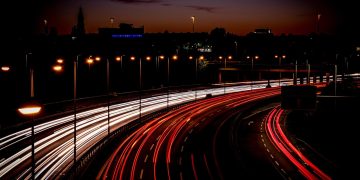
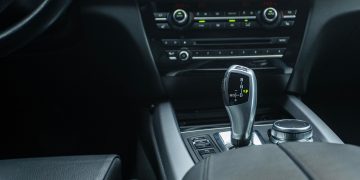
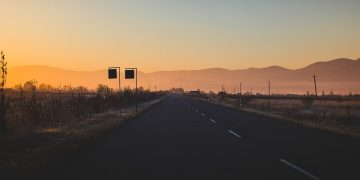
A vehicle proceeding southbound on I-295 at sundown on Friday
____________________________________
Astute readers of GEORGE may have noticed references in the @On the Pitch column covering the 2026 World Cup to an Trionda.
Trionda is a portmanteau created by sportswear manufacturer Adidas, which also created a product called the Trionda as Trionda is the name of the company’s high-tech connected football that was introduced last fall, is the official match ball of the 2026 World Cup.
The etymology of the name “Trionda” combines the prefix “tri,” a numerical prefix that stems from Proto-Germanic or Proto-European foots and functions as a combining form to denote “three,” “three times,? or “every three” in almost all languages of the Indo-European family including English, Spanish, French, German, and Russian, with the Spanish word “onda,” which means “wave,” hence “Triple Wave” or “Three Wave.”
Tri has also been heavily borrowed into many non-Indo-European languages worldwide through international scientific and numerical terminology.
Common words in English that use “tri” include triangle, tricycle, trilogy, triathlon, tripod, and trio, among others. In anatomy, the triceps is a muscle at the back of the upper arm with three points of attachment, and the tricuspid valve in the heart has three flaps. Common words in German that use the “tri” prefix versus “drei” – a dreieck is a triangle, for example – include Trilogie for trilogy, Trigonometrie for trigonometry, Triangel for a triangle instrument, Triathlet for triathlete, and Triathlon.
The Adidas Trionda, which is the official match ball of this tournament, is a fully “smart” ball — Adidas uses the term “connected” — which means the ball can transmit a record amount of near instantaneous data, assist in making offside decisions in a way never seen before, and offer more statistical insights than any team or fan could reasonably use.
The Trionda’s membrane is made of four thermally bonded polyurethane panels, the lowest number for any FIFA World Cup match ball so far, according to FIFA records. As with the Al Rihla in 2022, the Trionda’s surface is textured with debossed macro and micro patterns – specifically on the ball’s icons – meant to improve the ball’s flight stability, swerve, and grip in wet conditions.
Meanwhile, the ball’s color scheme of red, green, and blue and its symbols are inspired by the iconography of the three host nations of the 2026 World Cup, namely red with a maple leaf for Canada, green with a golden eagle’s head for Mexico, and blue with a five-pointed star for the United States.
The Trionda is the third World Cup ball with smart or connected technology, which goes back to the Telstar 18 in the 2018 match in Russia. This includes a side-mounted inertial measurement unit, or IMU, chip inside one of the four panels. This sensor tracks the ball’s movement 500 times per second and provides real-time data to referees including the video assistant referee, helping to quickly judge offsides, touches, and handballs. This technology was developed with FIFA and Kinexon based in Munich.
There is one thing that the Trionda requires, which other footballs do not: It needs to be charged for some 2.5 hours before a match. And copy editors will need to beware as it is quite easy, as your humble correspondent found out, to type “Triconda” – which would be a type of snake that doesn’t really exist – versus Trionda, so much so that – after it had accidentally been added by mistake (and there is no finger-pointing here) to GEORGE’s The Zoo content management system.
___________________________________

Ambrotype of a Kansas Regulator Gang, militant abolitionists during the Civil War
___________________________________
— Iran announced plans to “administer” the Strait of Hormuz and said it would set up a “telephone hotline” to coördinate the passage of ships through the strait as well as to “resolve any misunderstandings” with any country using the waterway.
— U.S. Vice President James David Vance put forth the suggestion that unfrozen Iranian assets be restricted in their use to U.S. agricultural products.
— The United States lifted sanctions on Iranian oil and petrochemical exports on Monday for a period of 60 days. The move paves the way for Iranian oil to reach U.S. shores for the first time since 1979. The temporary license does not authorize the sale of Iranian oil to Cuba, North Korea, or Russian-occupied sections of Ukraine.
— The U.S. Senate, the upper house of Congress in the United States, on Tuesday adopted a resolution instructing Mr. Trump to end the war in Iran or seek congressional authorization to continue it. The most was the significant bipartisan rebuke yet of the conflict, although it does not have the force of law. It does, however, mark a break by the Republican-led Congress with a Republican president who has faced little if any resistance on matters of war and national security.
— Both Mr. Trump and U.S. Vice President James David Vance that Iran had agreed to let U.S. inspectors back into its nuclear sites. Mr. Trump’s comment came hours after an Iranian official said there were “no detailed discussions on the nuclear issue,” while Mr. Vance made his comment on Monday, which was followed by a statement from Iranian officials on Tuesday that their country did not make any such commitment. Officials in Iran emphasized that the matter was barely discussed and Esmail Baghaei, spokesman for Iran’s foreign ministry, said there was no plan to invite inspectors to nuclear sites that were hit by U.S. and Israeli airstrikes in June 2025.
— After in some cases months of being stranded, the International Maritime Agency, a United Nations agency, said on Tuesday that it had started an effort to free hundreds of ships and thousands of mariners that have been trapped in the Persian Gulf during the war. The agency is moving them through the Strait of Hormuz along a route near Oman’s coastline. On Monday, 39 vessels moved through the Strait, a recent high figure.
— Fighting between Israel and Iran-backed terror group Hizbullah in Lebanon had eased in recent days, although an Israeli military attack in southern Lebanon on Tuesday killed two people, according to Lebanon’s state news agency and Hizbullah
____________________________________
— A dramatic explosion that caused the lid of an oil tanker to fly into the sky during a Ukrainian aerial assault on Moscow was not caused by a Ukrainian drone. Verified video shows it was caused by a Russian air defense missile. Footage shows a Russian air defense missile traveling toward the fuel silo. The friendly-fire incident illustrates the difficulties that Russian air defenses are facing as Ukraine increases the scale of its drone attacks to break through a layered shield of systems designed to protect the Russian capital.
— Russian forces have been concentrating on the “fortress belt” cities of Sloviansk, Kramatorsk, Druzhkivka and Kostiantynivka, part of the roughly 20% of Donetsk that Ukraine still controls. Moscow’s troops have fought their way into Kostiantynivka, and Druzhkivka is a wasteland after extensive Russian bombing. Sloviansk and Kramatorsk remain Ukraine’s last real strongholds in Donetsk, although the two cities are not in imminent danger of falling. Донеччина, or the Donetsk Oblast or region, is a province in southeastern Ukraine that has been a heavily contested, active frontline in the ongoing Russo-Ukrainian War. Prior to the Russian invasion, it served as Ukraine’s most populous, densely populated, and heavily industrialized hub, renowned for its major coal mining and steel production
— Scores of targeted attacks against fuel trucks on supply routes to the Автономна Республіка Крим, or Autonomous Republic of Crimea, as part of what Kyiv calls a “logistics lockdown,” has caused gasoline shortages in the occupied territory. The region, internationally recognized as part of Ukraine, has been under Russian occupation since 2014.
____________________________________

Spices on display at Spices and Tease at the Grand Central Terminal Market
______________________________________
At least 40 people have drowned in the last five days in France, according to the country’s prime minister, amid a scorching heat wave that has gripped much of Europe. Most of the victims were young people, some teenagers, swimming in unsupervised areas, officials said. During Monday’s historic European heatwave, the warmest regions exceeded 42° C (107.6° F), with southwestern France seeing the most severe spikes. Cazaux hit an intense 43.5° C (110.5° F), while Cognac reached 42.7° C (108.9° F). Meanwhile, parts of Spain and Portugal also experienced temperatures well into 40° C range, with Andujar in Spain reporting 43.9° C (111° F).
____________________________________
An historic letter that ended the American War of Independence against the British is featured as part of the “Revolution 250: America’s Independence Story, 1763–1783” exhibition at the National Archives. The letter, sent by General George Washington, accepted the British surrender at Yorktown and was sent on 17 October 1781. It was given to Charles Cornwallis, Britain’s lieutenant general, formally General The Most Honorable The Marquess Cornwallis, commanding the southern campaign, in Yorktown, Virginia, in response to his request to end hostilities. Driven by an “ardent desire to spare the further effusion of blood,” as the Continental Army’s commander wrote, General Washington agreed to review admissible terms, which effectively ended the war between Britain and its former colonies. The letter formally set a two-hour deadline for Lieutenant General Cornwallis to accept terms or face a renewal of hostilities, which then led to the drafting of the Articles of Capitulation. After the war, General Cornwallis, later Lord Cornwallis, took Washington’s letter home with him to Essex, where it remained in the family archive before being presented to the Public Record Office, a predecessor of the National Archives, in 1880. The National Archives is based in Kew in the London Borough of Richmond upon Thames in south-west London
____________________________________
A study that found that the SARS-CoV-2 vaccine reduced the risk of emergency department visits and hospitalizations among healthy adults by about half last winter and which had been blocked by Jay Bhattacharya, the Center for Disease Control and Prevention‘s interim director from publication last March in the CDC’s Morbidity and Mortality Weekly Report, has been published on Tuesday in JAMA Network Open, a leading peer-reviewed medical journal. The findings were consistent with what researchers have found in past years, namely that the vaccine helped reduce the risk of severe illness in adults even after accounting for immunity from prior vaccination or infection. Dr. Bhattacharya had had concerns about the methods used to calculate vaccine effectiveness, a Health and Human Services spokesman said at the time. Michelle Barron, one of the study’s authors and senior medical director of infection prevention and control for UCHealth, a nonprofit health system in Colorado, alleged that the paper was withheld because it conflicted with the administration’s vaccine agenda. Health Secretary Robert J. Kennedy Jr. has been an outspoken critic of covid shots, once referring to them as the “deadliest vaccine ever made.” To complete the study, researchers analyzed data from a CDC-funded surveillance network to compare data on adults who sought medical care for covid-like symptoms and compared outcomes between those who received the updated 2025-26 vaccine and those who had not, known as test negative design, has limitations but they are well understood. “This is not a controversial study design – this is [the] same design that has been churning out vaccine results for a long time,” Natalie Dean, associate professor of biostatistics and epidemiology at Emory University’s Rollins School of Public Health, told the Washington Post.
____________________________________
John Bouvier Kennedy “Jack” Schlossberg, the only grandson of the late President John F. Kennedy and Jacqueline Kennedy Onassis, and the son of the late president’s daughter Caroline Kennedy and Edwin Schlossberg, failed in his bid to write the beginnings of his own chapter in Camelot lore as he competed in a crowded field for a seat in the U.S. House of Representatives that is being vacated by retiring Congressman Jerry Nadler.
____________________________________
The driver of a Tesla Model 3 using Autopilot crashed into a house in Harris County, Texas, Friday night, killing a woman who lived there. The driver told investigators he was using the vehicle’s automated-driver system when it left the roadway and instigated the crash. The driver, Michael Butler, was in the vehicle at about 8 p.m. local time and operating the car “with an automated driving assistance system,” the Harris County Sheriff’s Office said in a statement on Saturday. The crash happened in Katy, Texas, about 30 miles west of Houston in Harris County. Mr. Butler “failed to drive in a single lane, left the roadway and struck the residence” as a result, authorities said. His vehicle “entered through the brick residence at a high rate of speed,” the sheriff’s office said.
____________________________________
On roughly the same day – 22 June 1973 – that U.S. President Richard Nixon and Soviet leader Leonid Brezhnevsigned a pledge to avoid military confrontations and threats of force that might trigger nuclear war, it was made known that Mr. Brezhnev’s great-grandson, Anton Milaev, 45, had been captured by Ukrainian soldiers and were holding him in custody in the Kherson region. A source in Ukraine’s main directorate of intelligence confirmed to GEORGE that Mr. Milaev had been taken into captivity. Serhii Sternenko, an adviser to the defense ministry, also posted about the capture. Leonid Ilyich Brezhnev, who was born on 19 December 1906 in Kamianske, an industrial city that is in what is now considered Ukraine, was a Soviet politician who served as General Secretary of the Communist Party of the Soviet Union from 1964 until his death in 1982. He also held office as Chairman of the Presidium of the Supreme Soviet (head of state) from 1960 to 1964 and later from 1977 to 1982. His tenure as General Secretary and leader of the Soviet Union was second only to Joseph Stalin’s in duration.
____________________________________

A horse-drawn carriage waits for passengers in New York City’s Central Park district
____________________________________
The 150-year-old New York City tradition of a horse-drawn carriage ride through Central Park may become something for the history books after the death of a young tourist who jumped from a runaway horse-drawn carriage after his mother was ejected from the same carriage. Now, horse-drawn carriage rides in New York on hold after the accident. “Our hearts go out to the family” of Romanch Mahajan, said Alexander Kemp, administrative vice president of Transport Workers Union Local 100, in a statement. Mr. Mahajan is believed to be the first person to die in a horse carriage accident since they were introduced in Central Park more than 150 years ago, according to the Central Park Conservancy. Rides will resume on Tuesday as new safety protocols go into effect.
____________________________________
Scientists believe that they have finally pinpointed the cause of Atlantic Ocean warming, and have discovered that a long-held belief that this was due to natural ocean circulation was incorrect. Long-term swings in ocean temperature have been caused by human activity which results in higher greenhouse gas emissions and air pollution. A new study led by Michael Diamond, an assistant professor of meteorology at Florida State University, and meteorology graduate Anthony Freveletti, who worked with Robert Wills, an assistant professor at the ETH Zürich Institute for Atmospheric and Climate Science, entitled “Multidecadal SST Variability Assessed as Primarily Forced in the Atlantic and Internal in the Pacific Using Rotated Low‐ Frequency Component Analysis” and published in the journal Geophysical Research Letters, found that long-term temperature changes in the Pacific Oceans are driven primarily by internal ocean variability, while those in the Atlantic are largely the result of human emissions. Long-term shifts between increasing and decreasing Atlantic sea-surface temperatures were typically thought to be driven by the Atlantic Meridional Overturning Circulation, or AMOC, a system of currents in the Atlantic Ocean that’s part of the network of natural ocean currents moving water around the world. While most variability in global oceanic sea-surface temperatures were often thought to be driven by natural causes, the team’s findings suggest that only the oscillations in the Pacific are primarily driven by natural climate processes. “Our findings contradict this theory, as we found that long-term changes in the Atlantic are more directly related to anthropogenic – human produced – causes such as greenhouse gases and aerosols,” Dr. Freveletti said in a statement.
____________________________________
In Washington, D.C., as the United States prepares to celebrate its 250th anniversary, efforts are underway to apply last-minute touches to monuments and buildings to put them in the best possible light for the millions of photographs visitors will be taking in the coming weeks. One monument, the Lincoln Memorial Reflecting Pool, which opened in 1922, the same year as the Lincoln Memorial, has been the subject of multiple unwanted headlines after Mr. Trump decided to hire a contractor to repair the pool’s leaks and rid it of the algae that obscures part of the reflecting-pool effect. It was Mr. Trump who decided to paint the 2,030-by-167-foot (619-by-51-meter) concrete-bottomed rectangular pool a deep shade of blue, “American Flag blue,” as the president called it and scientists now say that that decision has raised the water temperature and accelerated the growth of algae instead of retarding it. There remains yet another problem: The sealant at the bottom of the pool, which comprised the bulk of the $16.4 million renovation project, is beginning to peel off. By Friday evening, a large chunk of it was gone, and some pieces were even taken by tourists.
____________________________________
Japan’s government said that the fee for a tourist visa would quintuple starting in July. Entry into the country will now cost ¥15,000 ($93), up from the current ¥3,000. The increase represents the first rise since 1978. It comes at a time when Japanese are souring on tourists. Many Japanese locals and officials are indeed souring on the explosion of mass tourism. While welcoming overall, residents are increasingly frustrated by severe overcrowding, poor visitor etiquette, and the economic strain of the weak yen.
____________________________________

Starry night in New York City
____________________________________
Alan Greenspan, who in nearly two decades as chairman of the Federal Reserve who navigated almost as long a run of prosperity of prosperity as his term in office that was followed by powerful crises, died on Monday at his home in Washington. He was 100.
The cause of death was complications of Parkinson’s disease, his wife, Andrea Mitchell, ‘ the chief foreign affairs and chief Washington correspondent for NBC News, said in a statement.
Mr. Greenspace was first nominated to the Federal Reserve by President Ronald Reagan in August 1987, and he was reappointed at successive four-year intervals until retiring on January 31, 2006, after 18 years and five the second-longest tenure in the position, behind only William McChesney Martin, who served for 18 years and ten months in the period 1951 to 1970.
Mr. Greenspan was arguably the most recognizable economist of any era, as well as the pre-eminent economic policymaker of his time, leading the Federal Reserve under four presidents. His record remains the subject of debate, given the financial collapseof 2008, but he was clearly a powerful and a polarizing force in shaping market-friendly policies during his tenure. He was remarkably successful in keeping down inflation, a job he considered the central bank’s primary task, and he defly helped the United States deal and recover from numerous shocks including the “Black Monday” stock-market crash of 1987, when the market fell a record 22.6%, some 508.32 points, in a single trading session, a near-meltodwn of Asian financial markets that started in 1997, and the aftereffects of the 11 September 2001 terror attacks.
As the long-serving chairman of the U.S. Federal Reserve, Mr. Greenspan masterfully utilized a complex, deliberately ambiguous dialect of English dubbed Greenspeak or Fedspeak. With a goal of saying a lot without moving markets, using wordy, vague language intentionally so he could answer questions from Congress or the press without actually revealing any policy signals. He confessed to engaging in what he termed “syntax destruction,” which sounded profound but meant very little.
Alan Greenspan was born on 6 March 1926 in New York City. He was the only child of Herbert and Rose (née Goldsmith) Greenspan. When young Alan was 5, his parents divorced and he was raised by his mother in the home of her parents in the Washington Heigths section of Manhattan.
His mother encouraged him to pursue his intereset in music and, after graduating from George Washington High School, he was admitted to the Julliard School and spent several years playing saxophone in a swing band. He read books and articles on virtually every subject during breaks during the band’s gigs, and “got a book on business, finance or something on the stock market,” he told the New York Times Magazine and was hooked.
With that impetus, Mr. Greenspan left Julliard and enrolled at New York University, where he earned a bachelor’s degree in 1948 and a master’s in 1950, both in economics, folloed by a Ph.D. at Columbia, where he studied under Arthur F. Burns, who would later become chairman of the Federal Reserve. Mr. Greenspan completed his Ph.D. studies at New York University in 1977.
____________________________________
In Japan, six major ice cream makers were the subjects of an early dawn raid by the government fair trade watchdog authorities on suspicion of price fixing. Officials from the Japan Fair Trade Commission on Tuesday carried out searches of the corporate headquarters of Akagi Nyugyo, Ezaki Glico, Lotte, Meiji, Morinaga Milk Industry, and Morinaga & Co due to suspicions they had violated antimonopoly laws and had formed a cartel. In a statement, the JFTC said that it suspected that the six had colluded to fix the prices of popular ice cream treats, using inflation in food prices to raise the prices beyond the increase in raw material costs. Senior executives at the six companies face allegations they held meetings and exchanged emails for years to coördinate the price increases with their peers at other firms.
______________________________________
The move by Japanese authorities brought the 2024 rant of an eight-year-old girl in Burnley, England, back into focus. Eight-year-old Marnie, accompanied by her twin, Mylah, was enraged after seeing the price of a single-scoop ice creamcone at her local ice cream truck in a park. The ice cream van was “selling two ice creams for nine quid ($11.43 in 2024 U.S. dollars), bloody nine pounds for two of them,” Marnie says incredulously, in a thick northern accent. “Nine quid – he’s going to get nowhere with that, he should know,” the cute critic continued. “And he only does bloody card – [I] stood there with my cash, bloody hell,” she added before starting to walk away, tossing a furious “bet he can hear me” and a withering eyeroll in the ice-cream vendors direction.
_____________________________________
George delivers news for curious thinkers in a world of shortened attention spans.
Decades of research on how readers consume information when faced with Information Overload – led by George co-founder Jonathan Spira, one of the foremost authorities on the subject – ensures that each article gets straight to the point with no fluff and no bias.
George presents important news and events of the day clearly and concisely in a format better suited to the modern reader’s limited time and focus, without forsaking the founders’ traditional commitment to fact-driven news, commentary, and dispatches – all prepared by curious thinkers, for curious thinkers.
________________________________________________
Jonathan Spira, Alexander Khusid, Tim Perry, Christian Stampfer, Kurt Stolz, Anna Breuer, and Paul Riegler contributed to this issue of George.
The mark “George,” the tagline “A daily newspaper…,” and all of the newspaper’s content, images, photographs, and associated material are subject to copyright law.
Copyright © 2011-2026 Accura Media Group LLC

Opening on 26 June 2026, the store at 5 Earlham Street joins the brand’s existing location on Beak Street in...

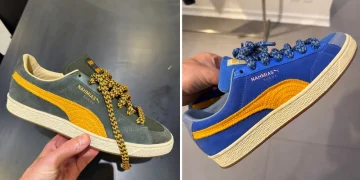
Nahmias have a glimpse at its newest creations for Puma ahead of its showroom residency during Paris men’s fashion week....
Summary Anish Kapoor returns to the Hayward Gallery at Southbank Centre in London for the first time in 28 years...
For the past few years, sports have seen a massive surge in popularity. But this June has been particularly sports-forward....

Discover Global News Panorama at news.mapworldnow.com — your universal gateway to comprehensive, international journalism. From politics and technology to culture and sports, we cover all news niches and all news categories from every corner of the world, all in one place.