






































































































Tomb Raider: Legacy of Atlantis is a reinvention of the very first Lara Croft adventure from 1996. Developers Crystal Dynamics and Flying Wild Hog have used Unreal Engine 5 – and controversially, an unknown amount of “AI-assisted tools,” according to the game’s Steam page – to recreate the title that solidified the intrepid explorer as a video game icon. I am walking away somewhat optimistic after spending an hour with the game; however, frustrating design choices and my general disdain of generative AI leave me conflicted.
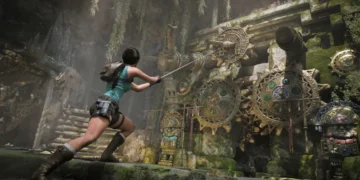
The demo starts as Lara emerges from a cave, revealing a large clearing host to a beautiful, flowing waterfall. The rainforest’s flora and fauna fill my headphones with lush audioscapes as I explore the cascade’s perimeter. Lacking proper context (as is the case with most demos), the user interface tasks me with damming the falls using a rope-and-pulley system currently in disrepair. The problem, of course, is that three missing gears are scattered amidst the ruins of an ancient water temple. To find the missing gears, I scour the reliquary high and low before finally assembling them in the water basin below. While some light exploration is necessary to dislodge the components from their resting places, the path to releasing them is straightforward.
As I climb higher up the ruins, I overcome several platforming challenges, most of which consist of leaping across the ledges above a rapidly-moving water flume feeding into the waterfall. Every unfortunate fall causes the strong current to push Lara back to the start of the lengthy section, resulting in a roughly 30-second backtrack – while this doesn’t sound long on paper, it’s a frustrating experience after multiple attempts. I take responsibility for a couple of her spills, but the majority were the result of a frustrating quirk of Lara’s rope swing mechanic. While it generally feels great to swing across large chasms, you can only use the skill after leaping off a ledge and pressing the top face button while mid-air. The only problem is that the engine does not seem to activate the button prompt unless the camera is aimed directly at the grapple point. This characteristic leads to awkward camera angles that detract from my enjoyment of an otherwise solid feature.
After reaching the top of the temple and unlocking the final puzzle piece, Lara interrupts the water flow and moves along to the demo’s final sequence featuring an iconic chase. Shortly after entering a densely forested arena, a pack of velociraptors corners Lara and requires her to pull out her signature dual pistols. Firing rounds into the dinosaurs feels excellent, and a new focus system gives meaning to the hero’s acrobatic dives and rolls. A focus bar slowly fills as Lara somersaults around, allowing her to enter a three-second bullet time window and everything slows down helping my aim. After a tense-but-exhilarating fight against the ferocious creatures, the famous T. Rex bounds onto the screen and quickly reminds me why I feared it so much as a child: one misstep, and you’re dinner.

The sequence tests me on everything I’ve learned as the terrifying, hulking beast chases me down a muddy ravine. While I’m once again faced with the rope swing’s awkward camera implementation (an issue the developers have time to address, in theory), the gauntlet is nonetheless thrilling. As the daring adventurer scrambles across fallen trees to make her final heroic leap to safety, I’m reminded why the Tomb Raider series still garners so much fandom: Lara Croft is cool as hell.

A former hospital director in northern China has dedicated over two decades to creating an educational sanctuary for children living...

We panned Stanley Kubrick’s 1980 horror classic. Boy, were we wrong. Source link
Judge Rules Wendy and Eddie Osefo Will Face Fraud Trial Together! It was a busy morning inside Maryland’s Carroll County...
By Robert Scucci | Published 1 hour ago One of the reasons I love watching Steven Seagal movies is because...

Discover Global News Panorama at news.mapworldnow.com — your universal gateway to comprehensive, international journalism. From politics and technology to culture and sports, we cover all news niches and all news categories from every corner of the world, all in one place.