- Latest
- Trending


The Grand Army Plaza Greenmarket.
Photo: Courtesy of GrowNYC
On a dreary Saturday morning this spring, the chef Peter Hoffman was giving out hugs. We’d arrived at the Union Square Greenmarket to shop, but Hoffman kept running into people he knew, embracing an employee at Deep Mountain Maple, saying “hi” to a book publisher he hadn’t seen in a while, checking in on a former neighbor’s daughter. Eventually, he started bagging up some wavy Romano beans at the Lani’s Farm stand while I checked out its collection of homemade soy sauce and kimchee. Then we hit some other stands, and within 15 minutes, I’d bought Chioggia beets, radishes, strawberries, cucumbers, a croissant made with local wheat, and blue-shelled tea eggs from a Finger Lakes–based wine-maker.
Hoffman, who helped jump-start this city’s farm-to-table, locavore era when he opened Savoy in Soho in 1990, doesn’t live in the city anymore — he moved to the Hudson Valley four years ago — but he still makes a point of shopping at the Greenmarket whenever he passes through. Why? “The diversity,” he says. Not only are the people shopping and selling food diverse, but the food is, too. Because the Greenmarket program extends to farmers within a 250-mile radius, it’s possible to buy produce from five or six different growing zones, Hoffman explains. That means, to give an example from this time of year, strawberries and asparagus from New Jersey may arrive in the city several weeks before upstate farms have them. “Could I have lived somewhere else and done my career?” he says. “It’s just, like, no.”
Of course, Union Square wasn’t always filled with overflowing displays of purple kale and Sungold tomatoes. The city’s first Greenmarket launched 50 years ago — July 17, 1976 — on 59th Street and Second Avenue. The market at Union Square, then a part of the city filled with drugs that most New Yorkers tried to avoid, came a month later.
The markets’ opening was part of a larger plan to revitalize urban spaces as European-style open-air food markets, says Angela Davis, the director of food access and agriculture at GrowNYC, the nonprofit that currently runs over 60 Greenmarkets. The urban planners Bob Lewis and Barry Benepe were behind the plan. Benepe, Davis explains, “had seen the disappearance of farmland, so he had this crazy idea: Let’s get farmers together and let’s find a profitable place for them to connect to customers and connect to New Yorkers.”
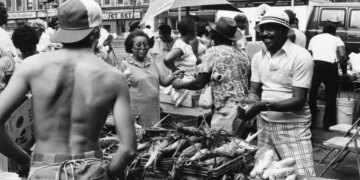
The city’s first Greenmarket — at 59th St and Second Ave. — in 1976.
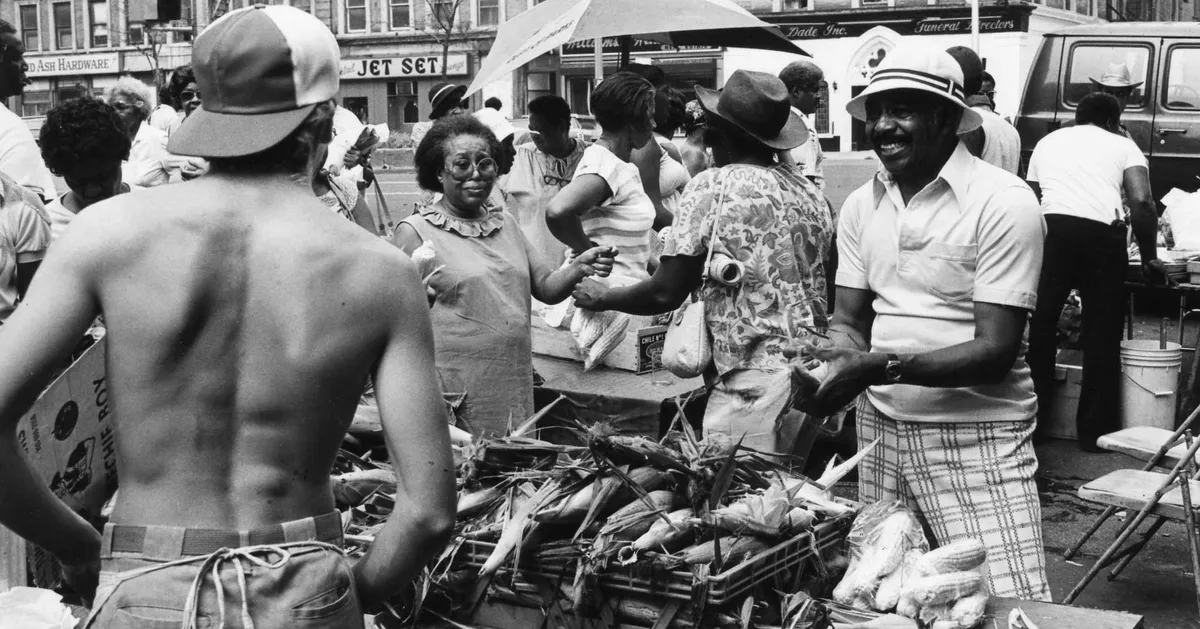
The arrival of the Greenmarket gave city residents easy access to fresh produce.
The Union Square Greenmarket opened a month after the first location proved the idea could be a success.
The ultimate goal for the markets was to create gathering spots where neighbors could connect.
Shopping during the Greenmarket’s earliest days.
Photographs Courtesy of GrowNYC
Benepe summed up the first day in a 1978 booklet called The Rebirth of Farmers Markets in New York City: “Farmers accustomed to small crowds at roadside stands were amazed and pleased to be surrounded by throngs of customers for hours on end, while the market customers were equally astonished to find farmers from the country selling a variety of fresh-picked seasonal produce right in the city.” The name Greenmarket was trademarked, Benepe writes in the book, to help distinguish the markets from “too many so-called ‘farmers markets’ which sell the usual Hunts Point wholesale produce imported from all over the U.S. and Mexico and the Caribbean.”
That first Midtown East location was chosen to prove the project’s viability in a highly visible, well-trafficked part of Manhattan. It opened with seven growers from Long Island, New Jersey, and upstate farms who sold early-summer sweet corn, lettuce, tomatoes, and ripe peaches. Many of the farms were barely scraping by. On the first day, Davis says, they’d sold out of everything by the early afternoon.
By all accounts, convincing New York to embrace these markets was not easy. From the early 19th century to the 1930s, New York City had been teeming with street vendors, particularly in immigrant enclaves like the Lower East Side. But increasing chaos and unsanitary, unregulated conditions led to Mayor Fiorello La Guardia’s “war on pushcarts,” which saw the formation of many indoor markets (including the still-open Essex Market). Even in the 1970s, three decades later, the idea of bringing outdoor food shopping back to New York had not been popular. To make it happen, Lewis handled farmer outreach, while Benepe worked to persuade city agencies to pass permits amid public outcry over the parking spaces that the proposed markets would engulf.
“Barry’s wheelhouse was very much tenacity — not taking ‘no’ for an answer — and he really battled through so much to change the way people thought about open-air markets,” says Liz Carollo, GrowNYC’s assistant director of food access and agriculture.
“They pushed and shoved and demanded the space, and it’s important to not take that for granted,” says Michael Anthony, a chef whose style at Gramercy Tavern has been defined by his devotion to the Greenmarket. “It wasn’t always here, and it won’t be here unless we keep supporting it.”
Even into the ’90s and early 2000s, getting great ingredients was a far more difficult job for chefs than it is now. “As a Swedish guy, it took me a while to get access to the best purveyors,” says Marcus Samuelsson, who moved to New York three decades ago to work at Aquavit. Even with the right contacts, success wasn’t guaranteed. “So much of sourcing was importing,” says Lena Ciardullo, the executive chef of Union Square Cafe, “which means ingredients that were great at one point in time, but by the time they got here, they weren’t.” The Greenmarket democratized the whole process, and even more than that, it allowed for a real dialogue between chefs and growers. Would ingredients like ramps, shishito peppers, or Tristar strawberries be coveted like they are today without these kinds of conversations? “I don’t think New York would be the culinary capital it is without the Greenmarket,” says Anita Lo, who ran the small restaurant Anisa from 2000 to 2017. “We’d be less connected to the land and our ingredients, and that would be very sad.”
We might also be less connected to one another. As Hoffman reminds me while we tour Union Square’s Greenmarket, a light drizzle beginning to pick up, the whole project was envisioned as a public gathering space. It wasn’t founded by chefs or activists; it was the result of urban planning. When we run into people we know at the markets, it’s because we share at least one interest: good food.
Everyone loves the Greenmarkets, right? But they are as vulnerable to economic hardship as anyone and saw their budget slashed after federal and local cuts last year. If the organization is going to survive another 50 years, it will need even more support. “I think it’s a miracle every time a market goes up,” says Andrina Sanchez, GrowNYC’s communications manager. Consider, she says, the farmers who have to plan and plant months in advance, who weather storms throughout the season, fight off blight and frost, and drive for hours to arrive in time to open at 8 a.m., selling their products in frigid cold or blazing heat. “The whole operation,” Sanchez says, “is insane.”

Serena Williams will play singles at Wimbledon after accepting a wild card invitation, the All England Club announced Sunday. The...

Sega says sales of its 2025 games, Sonic Racing: CrossWorlds and Shinobi: Art of Vengeance, failed to meet its expectations...
Hideo Kojima has slyly dropped a single, brand new screenshot for his upcoming horror game OD, and even though it’s...
Tomb Raider: Legacy of Atlantis is a reinvention of the very first Lara Croft adventure from 1996. Developers Crystal Dynamics...
Discover Global News Panorama at news.mapworldnow.com — your universal gateway to comprehensive, international journalism. From politics and technology to culture and sports, we cover all news niches and all news categories from every corner of the world, all in one place.