- Latest
- Trending

Growing up in Jamestown, R.I., Cotton Estes got a very early education in architecture: Her father, Jim Estes, was a founder of the firm that is now Estes Twombly + Titrington Architects, and he was always designing modernist homes in the Northeast.
“Monkeying around on construction sites when I was little, with my dad, made a big impression on me,” said Ms. Estes, 41, who now lives in San Antonio, Texas. “And I got to spend my sick days in the office, watching them make models.”
Ms. Estes couldn’t resist following in her father’s footsteps. She studied architecture at Yale and went to work for Lake Flato Architects in San Antonio before founding her own firm in 2018. She developed her own design interests, including repurposing old industrial buildings and building on small urban lots.
Her father and mother, Darcy Magratten, 72, still lived in Jamestown, so she and Mr. Estes had never gotten a chance to collaborate on a project until 2020, when Mr. Estes and Ms. Magratten decided they wanted to live in San Antonio for roughly half of the year, during Rhode Island’s coldest months, and possibly relocate there full-time in the future.
Ms. Estes suggested a novel solution: Rather than having her parents find a separate home of their own in San Antonio, she proposed building a stand-alone structure for them in her backyard.
She and her life partner, Mike Long, who runs the contracting company Long House Builders, had renovated their own 1,090-square-foot house in 2014, on a lot with enough space for a small accessory dwelling unit, or A.D.U. Creating a multigenerational compound would allow them all to enjoy each other’s company and make it easier for Mr. Estes and Ms. Magratten to age in place. It would also give the father-and-daughter architects a project to tackle together.
Mr. Estes and Ms. Magratten loved the idea. To kick things off, Ms. Estes interviewed her parents about what they wanted in the home, like they were regular clients. The answer: a single bedroom, an open kitchen and an art studio, since they both enjoy painting.
“It’s a radical downsize from their house, the house that I grew up in,” Ms. Estes said. “So it was about finding the right priority of dedicated space for their passions.”
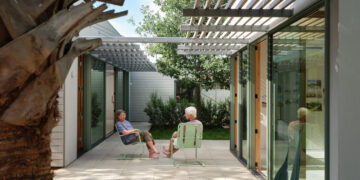
Working together, she and Mr. Estes conceived a 932-square-foot living unit separated from a stand-alone, 228-square-foot art studio by a patio. Prioritizing light, air and easy maintenance over fussy materials, the buildings are simple boxes clad in stucco and thermally treated pine siding. Each has an integrated pergola made from galvanized steel brackets and wood slats above generous sliding glass doors.
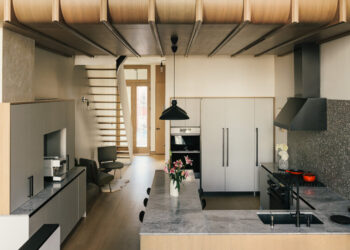
“We have full-height, full-width glazing facing the inside courtyard,” Ms. Estes said, while solid walls face neighboring properties for privacy. Long, linear skylights run above the rear wall of each unit, bringing in sunlight that creates a play of shadow with exposed rafters (concealed linear LEDs provide the same effect at night).
To create visual warmth on a budget, they clad ceilings in radiata pine plywood, which has an undulating grain, and designed cabinetry for the simple kitchen and bathroom from the same material.
For the patio, Mr. Estes shared a thrifty trick with his daughter, which he has employed in some of his projects. “They are two-by-two-foot concrete pavers from Home Depot,” he said, with a texture and fake joint. “We flip them so you get a clean side. They can even be mistaken for limestone — we’ve had that happen.”
In the art studio, they covered walls with recycled paper-fiber sound board, which they mounted with exposed screws. The inexpensive material makes it possible to pin up artwork while eliminating the need for drywall tape and mud.
A pair of exterior sliding barn doors allows the family to adjust privacy levels. One door conceals a parking spot from an alley behind the property. The other can separate the living unit and patio from the main house.
“If things get too close, we can always just close the north barn door and we’re in our own little world,” Mr. Estes said. Of course, he added, “we hope it never comes to that.”
Mr. Long began building the structures at the end of 2023, and they were complete in November 2025, at a cost of about $500 per square foot.
As soon as they were complete, Mr. Estes and Ms. Magratten moved in for five months, before returning to Jamestown this past spring. The verdict? Their compact San Antonio home worked just as well as they hoped it would.
“We could spend the whole year there. That would not be a problem,” Mr. Estes said. “And we probably will, eventually.”
Living Small is a biweekly column exploring what it takes to lead a simpler, more sustainable or more compact life.
For weekly email updates on residential real estate news, sign up here.

Nearly five years after an atmospheric river devastated large sections of southern British Columbia, communities along the historic Kettle Valley...

New York, never a stranger to political drama, is back in the spotlight this month, as candidates, billionaires and ideological...
The DC Water authority said on Monday that it issued a permit to drain the pool, according to Reuters news...
The new channel will help resolve incidents in the strategic waterway amid conflicting guidance for shipowners Iran has agreed to...

Discover Global News Panorama at news.mapworldnow.com — your universal gateway to comprehensive, international journalism. From politics and technology to culture and sports, we cover all news niches and all news categories from every corner of the world, all in one place.