- Latest
- Trending
IWMI announces winners of National Water Innovation Hackathon.

From AI-powered flood forecasting to women-led spring rejuvenation, innovators in India demonstrate pathways to a water-secure future. Team AquaAdapt Pro from the Symbiosis Institute of Geoinformatics in Pune won the Youth Innovators category for their AI-enabled irrigation advisory platform, while the Kashyone Multipurpose Women Primary Cooperative Society from West Bengal took top honors in the Community Innovators category for restoring 11 natural springs.
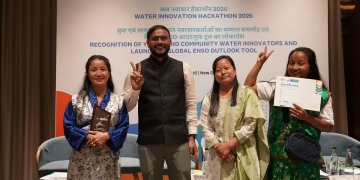
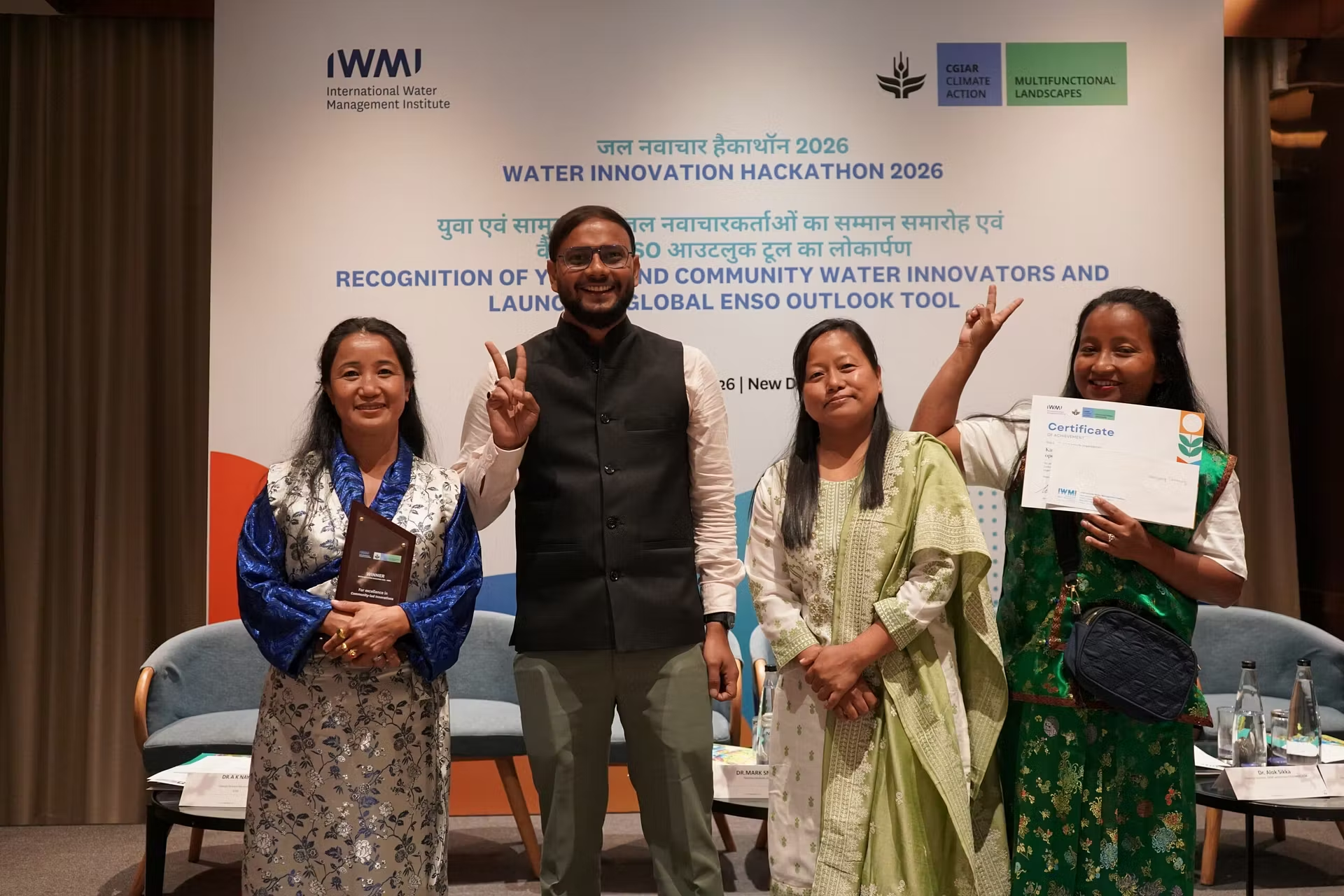
On June 18, 2026, the International Water Management Institute (IWMI) felicitated outstanding youth and community innovators for their contributions to water security and climate. Held in in New Delhi, India, the event, “Recognition of Youth and Community Water Innovators,” marked the culmination of the Water Innovation Hackathon 2026. The hackathon was a national initiative to identify, promote and support innovative, scalable and inclusive solutions for water security challenges across the country.
“Innovation, technology and community participation will play a critical role in strengthening India’s water security. At a time when climate change is intensifying water challenges, we need solutions that are locally relevant, scalable and inclusive. The innovations recognized today demonstrate the immense potential of youth and local communities in shaping India’s water future,” said Raj Bhushan Choudhary, Minister of State for Jal Shakti, Government of India.

The Hackathon focused on five priority themes: data-driven innovations for smarter water solutions, wastewater and circular economy innovations, AI for disaster preparedness and early action, climate-smart water management, and inclusive and community-led water governance.
Meet the Youth Innovators
The winners under the Youth Innovators category, were team AquaAdapt Pro. Theydeveloped an AI-enabled irrigation advisory platform that combines satellite information weather intelligence and low-cost communication channels to help smallholder farmers optimize water use, improve productivity and strengthen climate resilience. The platform was developed by Devansh Negi, Bhavya Mangla and Ishan Singh from the Symbiosis Institute of Geoinformatic in Pune.

Team AquaAlert + NadiBot came insecond for developing a platform that leverages artificial intelligence to improve flood preparedness and last-mile dissemination of water-related warnings through SMS, WhatsApp, voice alerts and community reporting mechanisms. The platform was developed by Saksham Kaushish and Samiksha Khaire from the National Institute of Technology in Jalandhar.
By enabling communities to share real-time inputs while simultaneously facilitating the dissemination of government advisories, the solution strengthens participatory governance and ensures that information flows in both directions. This makes the innovation not only technically effective but also socially meaningful and responsive to local needs. I am grateful to the IWMI team for their mentorship and guidance in helping refine and strengthen this solution.”
Saksham Kaushish
FloodSense AI, developed by Shyam Shankaran R from the Indian Renewable Energy Development Agency in New Delhi was awarded third place for developing an AI platform for disaster preparedness and early action.The platform integrates satellite data, flood forecasts, reservoir telemetry, Internet of Things, sensors and community reports to deliver hyperlocal flood predictions and multilingual alerts. Its goal is supporting proactive flood management and disaster response for governments, organizations and communities.
Meet the Community-led Innovators
In the Community-led Innovation category, the Kashyone Multipurpose Women Primary Cooperative Society Ltd. from Kalimpong, West Bengal, was recognized for their initiative, “Women Bring Water and Dignity at Namchelekha.” Led by local women, the initiative has successfully rejuvenated 11 springs over the past four years, improving access to safe drinking water, strengthening livelihoods and enhancing climate resilience in spring-dependent communities.
“Four years ago, we never thought we could revive a drying spring. Today, receiving recognition on a national platform is a proud moment for our entire community, whose collective efforts made this achievement possible,” said Dilkumari Tamang, member of the Kashyone Women Cooperative. “This recognition motivates us to expand our work, raise awareness among our children, and strengthen spring rejuvenation efforts. We also look forward to partnering with IWMI to scientifically evaluate our work and explore more effective approaches for restoring springs,” she added.

Through collective action, local stewardship and sustainable water management practices, the cooperative has demonstrated a scalable model for community-managed water security in hill ecosystems, highlighting the transformative role of women’s leadership in addressing water challenges and building resilient communities.
“From AI-enabled tools for climate-smart water management and disaster preparedness to women-led spring rejuvenation efforts, the innovations recognized today show that effective solutions often emerge closest to the challenges themselves. At IWMI, we are committed to supporting, strengthening and scaling such innovations through science, partnerships and knowledge exchange to build a more water-secure and climate-resilient future,” said Mark Smith, IWMI’s director general.
The initiative received nearly 100 applications from across India, representing youth innovators, researchers, start-ups, self-help groups, community-based organizations and development practitioners. Entries were assessed through a rigorous multi-stage evaluation process involving IWMI experts and independent external reviewers.
Gopal Kumar, Interim Country Representative for IWMI in India and Bangladesh emphasized, “the future of water security will be shaped not only in laboratories and policy forums but also in villages, communities, and classrooms. The innovators recognized today have shown that practical, scalable, and locally rooted solutions can address some of our most pressing water challenges. IWMI is proud to support and amplify these efforts as part of our broader mission to build climate-resilient and water-secure societies.”

Police said he had been working at the factory for the past one month. A Bangladeshi national allegedly working without...

In recent days, there has been a dispute between the US and Iran over the issue of UN nuclear inspectors...
Access Denied You don't have permission to access "http://news.sky.com/story/body-found-in-river-in-search-for-missing-15-year-old-boy-in-devon-13557641" on this server. Reference #18.520ed217.1782386744.45cd42da https://errors.edgesuite.net/18.520ed217.1782386744.45cd42da Source link
Canada, with its brutal winters and generations of tradition, may be a hockey nation. But for nearly six weeks this...

Discover Global News Panorama at news.mapworldnow.com — your universal gateway to comprehensive, international journalism. From politics and technology to culture and sports, we cover all news niches and all news categories from every corner of the world, all in one place.