- Latest
- Trending
This article is part of Food Tank’s primer series, “Food Tank Explains.” Each installment unpacks the ideas, innovations, and challenges shaping today’s food and agriculture systems, offering clear insights into complex topics. To explore more articles in the series, click here.
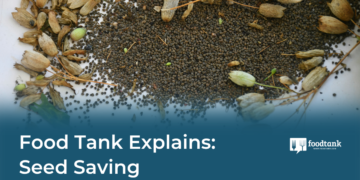
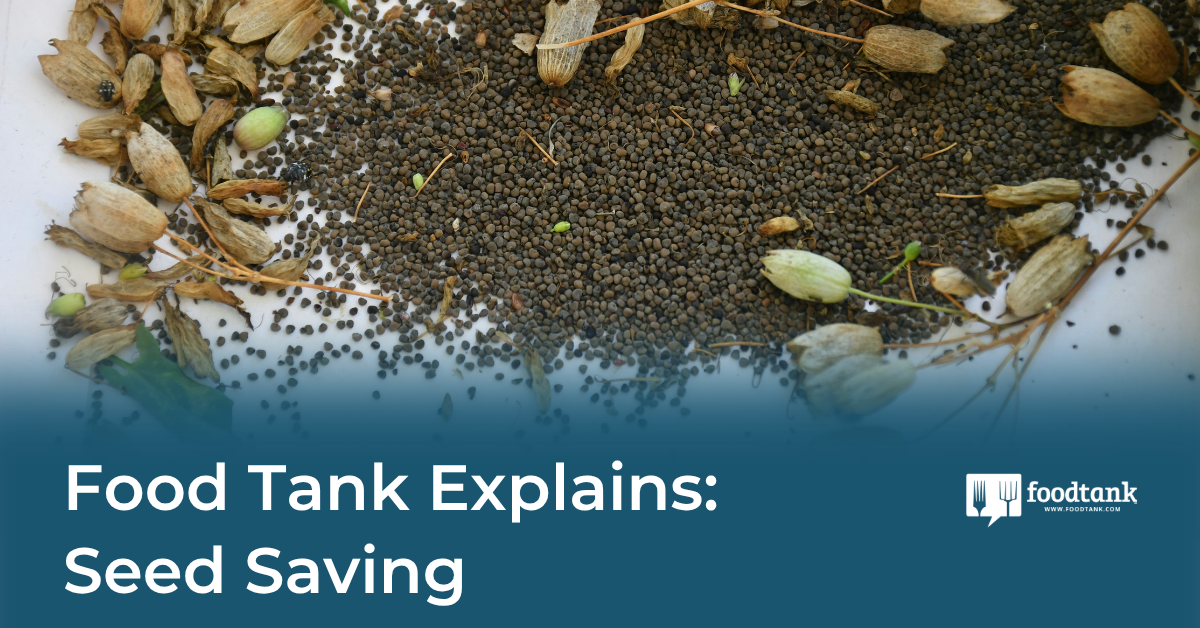
Seed saving is the practice of collecting and preserving seeds to produce future crops from past harvests, creating a cycle of cultivation that has sustained agricultural communities for millennia. For thousands of years, farmers and gardeners have saved seeds, preserving biodiversity, strengthening food-system resilience, and maintaining cultural traditions.
By continually selecting and replanting seeds, farmers developed crops adapted to local conditions while maintaining genetic diversity that can improve resilience to pests, disease. Seed saving can also help farmers recover from storms, droughts, and other extreme weather.
For many communities, saving seeds is deeply connected to culture, identity, and community life. Many developed sophisticated traditions for collecting, storing, exchanging, and stewarding seeds. “We cannot separate culture and identity from the art, act, and love of growing food,” Sherry Manning, Founder and CEO of Global Seed Savers, tells Food Tank
Seeds can also serve as living records of history. Accounts collected by seed-saving organizations tell of a Holocaust survivor who smuggled bean seeds out of Auschwitz in the folds of her clothing, and gardens cultivated by internees at Germany’s Ruhleben camp during World War I. Refugees fleeing the city of Daraa in Syria carried eggplant and pepper seeds across the border to Jordan and replanted them in exile.
In her essay “Black Land Matters,” Leah Penniman, Soul Fire Farm cofounder, activist, farmer, and author of Farming While Black, describes West African women who braided seeds into their hair before being forced onto transatlantic slave ships. “The seed was their most precious legacy,” Penniman writes, “and they believed against odds in a future of tilling and reaping the earth.”
There is evidence that hunter-gatherer communities collected and cultivated wild seeds as early as 30,000 years ago. During the emergence of agriculture around 12,000 years ago, communities around the world began selecting and replanting seeds. They gradually transformed wild species into domesticated crops that remain central to global diets today, like wheat, lentils, chickpeas, rice, and sorghum.
Farmers remained at the center of selecting and improving seed varieties for most of agricultural history. “But about 100 years ago, that began to change,” Ira Wallace, Co-owner of Southern Exposure Seed Exchange, tells Food Tank.
During the 20th century, mechanization, advances in plant breeding, and the growth of commercial seed companies profoundly reshaped agriculture. As food production became more centralized and food processing more prevalent, many farmers and gardeners shifted from saving seeds to purchasing them each season, and from local varieties to genetically uniform, high-yielding varieties.
A series of court decisions and regulatory changes in the 1980s and 1990s accelerated this shift by expanding intellectual property protections for seeds. Companies gained the ability to patent genetically engineered seeds, plant varieties, breeding methods, and genetic traits, transforming many seeds from a renewable and reusable resource for farmers into proprietary products governed by licensing agreements.
As seed companies consolidated, four firms came to control more than half of global seed sales. Supporters argue consolidation has increased investment in breeding and research, while critics contend it has contributed to the loss of locally adapted varieties. Roughly 75 percent of global crop genetic diversity has disappeared over the past century, according to the U.N. Food and Agriculture Organization.
Patent protections generally prevent farmers from saving patented seeds, increasing reliance on commercial suppliers and narrow farmers’ options. Some researchers have also linked consolidation to rising costs; according to U.S. Department of Agriculture data, soybean seed prices increased by more than 200 percent between 2000 and 2020, while consumer prices rose 57 percent during the same period.
In recent decades, concerns about biodiversity loss, climate change, and consolidation in the seed industry have renewed broader interest in seed saving. That resurgence has helped fuel a broader movement centered on seed sovereignty, the idea that farmers and communities should have the right to control over the seeds they grow, save, exchange, and develop.
In Kenya, the Seed Savers Network advocates for stronger protections for Indigenous seeds while partnering with smallholder farmers to identify, preserve, and reintroduce local varieties at risk of disappearing. In the Philippines, Global Seed Savers works with farmers to establish community-owned seed libraries stocked with regionally adapted varieties.
Other initiatives focus on returning seeds to the communities that stewarded them. Nonprofits including Seed Savers Exchange have worked to rematriate heritage seed varieties to Indigenous seed keepers, while Native Seeds/SEARCH conserves thousands of traditional Indigenous crops.
Seed banks and seed exchanges have also expanded worldwide. In Norway, the Svalbard Global Seed Vault safeguards more than 1.3 million seed samples representing over 6,000 plant species. In eastern India, Vrihi maintains one of the region’s largest folk rice seed banks and promotes the practice of non-commercial seed exchange. The Crop Trust is dedicated to making crop diversity for use globally, forever and for the benefit of everyone, and operates genebanks worldwide.
Policymakers have also begun revisiting seed laws. In 2021, Maine became the first U.S. state to enshrine a right to food in its constitution, including the right to save and exchange seeds. And in 2025, Kenya’s High Court struck down provisions of the country’s seed law that penalized farmers for saving and sharing Indigenous seeds, a decision advocates described as a major victory for food sovereignty.
Articles like the one you just read are made possible through the generosity of Food Tank members. Can we please count on you to be part of our growing movement? Become a member today by clicking here.
Photo courtesy of Vincenzo Tabaglio, Unsplash

Epic Games has detailed some of the features in its next generation Unreal Engine - Unreal Engine 6 - and...

Epic Games has detailed some of the features in its next generation Unreal Engine - Unreal Engine 6 - and...
Summary Michelle Obama wore a custom Acne Studios skirt featuring a portrait of her late mother while speaking on stage...
Your support helps us to tell the storyFrom reproductive rights to climate change to Big Tech, The Independent is on...

Discover Global News Panorama at news.mapworldnow.com — your universal gateway to comprehensive, international journalism. From politics and technology to culture and sports, we cover all news niches and all news categories from every corner of the world, all in one place.