- Latest
- Trending
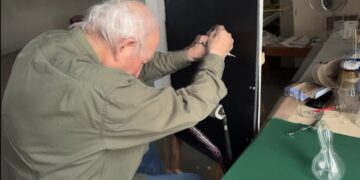


A 3-D high-definition video on the wall shows the artist Bruce Nauman, 84, drawing with a stylus in each hand. Viewed through special glasses, the artist’s hunched back and wispy hair, seem to press into the room, and his untidy studio recedes into the distance.
His eyes are closed, and one arm rests on a cane. The image and sound are slowed down drastically, and each scratch and clunk resonates like a creaking ship in the Konrad Fischer pop-up gallery in TriBeCa, where 42 videos and 16 of the resulting “blind drawings” are on view for the first time.
Some of the kinky, sinuous pictures are self-portraits, while others depict simple still lifes. Sometimes, Nauman’s assistant, the artist Ellen Babcock, draws in the videos. Mostly she is behind the cameras, a pair of iPhones. (They also engage in the odd bout of thumb wrestling.)
Nauman was born in Indiana, made his name in San Francisco, then settled in New Mexico in 1979. He moved to a ranch near Santa Fe in 1989 with his wife, the painter Susan Rothenberg, who died in 2020. As idiosyncratic as he is influential, Nauman consistently produces surprising work, ranging from absurdist and pornographic neon signs to a fountain made with 97 whole fish cast in bronze. In 2009, his U.S. pavilion at the 53rd Venice Biennale won the Golden Lion.
Dry and affable, Nauman doesn’t give many interviews, and he doesn’t like to say what his work means. But his oblique, koanlike anecdotes offer insight into a method based on chance, repetition and play.
He chose the order of the 15 videos playing in this room by printing their descriptions on strips of paper and pulling them out of his hat. “Ellen said, ‘But wear the hat on your head so they’re close to your brain for a while,’” he said. “And so I did. Actually I cheated once. I switched two.”
These are edited excerpts from a conversation from May, which took place in front of Nauman’s new videos.
Where were these filmed?
In New Mexico. This is Susan’s studio. To film this stuff in slow motion and 3-D, I had to have natural light. Not incandescent light. We’re using iPhone 15s. Two of them. To get the eye spacing correct. And Susan’s studio still had natural light, so I moved over there for these drawings. It took me a couple years to go in there. It’s tough.
Yeah, I’m sure.
Anyway.
How much are you thinking about the backgrounds? The studio clutter is fascinating, but I don’t know if you feel that way.
I like it. When we first started doing them, they were pretty boring, because we were concentrating so much on the drawing and not moving the cameras around very much. And one day Ellen got bored with that, and she started looking at other stuff. I had a piece of snot coming out of my nose, and she thought she couldn’t say anything, but the sound is slowed down as well as the image. She could’ve said something, but I’d have had to wipe my nose on my sleeve or something. So she just took my head off. She took me out of the picture.
Throughout your work, there’s this idea of not being afraid to look silly, or to have a body, basically. Are you afraid to look silly?
Apparently not.
How do you get to that enlightened state?
Zen mind, beginner’s mind. I’m not a practitioner. I knew people who were.
When I was much younger, I used to try to control everything. And I realized that, no matter what, people would assign stories and values. I said, I didn’t mean that. It doesn’t matter.
You say you’re not a practicing Buddhist. But thinking about exercises — some of them are very physical, repetitive, even difficult physical exercises, but then there’s also meditative, mental exercise.
They’re similar things. Thinking about John Cage and simple activities, and Merce Cunningham. Something you repeat, and then there’s a tension in that because you get tired. But you have to pick the right activity.
I had a great horse teacher. To work with horses, you have to give up your ego. You can make them do stuff, but it’s not a good idea. Because you’re just going to get in trouble. The horse teacher always said, ‘Make it the horse’s mind. The horse’s idea.’ So, I don’t know. Giving up your ego. Then you can be a fool.
How did you arrive at this exercise, the double drawing?
I can’t remember exactly. My right arm doesn’t work very well, and they can’t do surgery on it. I couldn’t do this — [Nauman lifts his arm]. I couldn’t lift my arm like that. And so my doctor, he said, if you just leave it alone, one day your body will figure out how to do it. But if you think about it, you can’t do it. So I was in the shower one night, and I put it up there. And then I tried to do it and I couldn’t do it. I started thinking about it.
I went to the University of Wisconsin. I had to take a philosophy course. We spent one semester on Gilbert Ryle. The question was: What’s the difference between raising your arm and your arm going up? I don’t think anybody ever figured out how to answer that. I can raise my arm now. But the first time, when I was in the shower, it went up.
I was talking to a friend who’s a painter; he’s been in the studio making all these paintings and he doesn’t want to show anybody. He’s like, “Just painting is enough.” I wonder if you feel that way.
No, I want it to get out. I want it to go away.
Does that mean you don’t want to see it again?
Mostly I’d rather not. Especially some of them that I wish I would never have made.
What makes you regret making something?
It was going somewhere I didn’t want to go. Sometimes, fairly often, I look at old work and I see things there that I didn’t know were there and that could be another place to go. Or I’ll do something and later I think, well, that was just a stupid idea.
It could be a dumb idea, but still go somewhere. I’m curious about that drive to keep making … something. Where does that come from?
I don’t know, but I guess I call myself a studio artist because I go to a studio. Even if I don’t do anything else, I go to the studio, read or fall asleep in the chair. I played classical guitar and bass violin, made my way through college playing bass, because everybody needed a bass player. I also played for dinner parties and Polish weddings. But my failing was that I didn’t practice. When I somehow decided that I could be an artist, it didn’t come up. I just did it.
It didn’t feel like ——
Something to practice.
[In the video, Nauman clacks together two green fountain pens. This serves as the “clapper” used to synchronize sound in films.] These are intense pens. Are you into pens?
Yes. I have one in my pocket right now. It writes the first time every time, which is amazing.
Actually I always carry one. It reminds me that I’m an artist. Usually I just sign checks or whatever I have to sign. This is really the first time I’ve made a drawing with the pens. So the idea of reminding me I’m an artist is wrong.
But there’s something about having a serious tool.
Yeah. And then because my eyes are closed, I got it twisted in my hand, so it’s sideways. It quit writing. My eyes were closed, so I didn’t know.
These are the only ones where the catfish skull is on the table.
Oh, that’s a catfish. OK.
A catfish skull. Left over from when I did the “One Hundred Fish Fountain.” Ellen came up to my studio and cast all the fish. We made the molds for all of them. I had Donald Young go. He’s a sailor, really good, sailed across the ocean a couple times. He’s living in Chicago. I sent him down to the dock. I said I’ve got to find a fisherman that whatever they catch will bring it back without gutting it, without cutting the head off.
He shipped them to me overnight, so I’d have whole fish to make the molds. So I hauled the fish way out away from the house. We always had a lot of dogs, and Susan walked the dogs out there and they smelled it and they started rolling in these rotting fish and boy, I was in trouble. Anyway I picked the skull up and brought it back.
What is it like being married to another artist?
Well, she was a painter and that was her life, was painting. And I was not a painter. We did not go freely back and forth between our studios. I mean it was OK, but it was better not to interrupt her when she was working. But sometimes she would ask me to have an opinion about something, and I could usually tell when something was going to go somewhere and when it wasn’t. And she could tell about my work the same way.
But what are you going to do about it? Often I would tell her, well, you’re finished. It’s great, leave it alone. She never left it. And I’m the same way. I have to try everything out.

The Major oak, one of Europe’s oldest, largest and most celebrated ancient trees, has died.The huge tree, which has grown...

There is an invisible thread that binds every nation together - a subtle, yet powerful echo that defines the very...
Earlier this month, a familiar name re-entered the ongoing push for a negotiated settlement to Russia’s war in Ukraine: sanctioned...

Discover Global News Panorama at news.mapworldnow.com — your universal gateway to comprehensive, international journalism. From politics and technology to culture and sports, we cover all news niches and all news categories from every corner of the world, all in one place.































































![‘[It] is going to change a lot about how games are made’: Epic merges Unreal Engine 5 with Unreal Engine for Fortnite to give game devs around the world Unreal Engine 6](https://news.mapworldnow.com/wp-content/uploads/2026/06/w8LJ6ZcQ5oGa6kMkT8VBzY-1920-80-360x180.jpg)