- Latest
- Trending


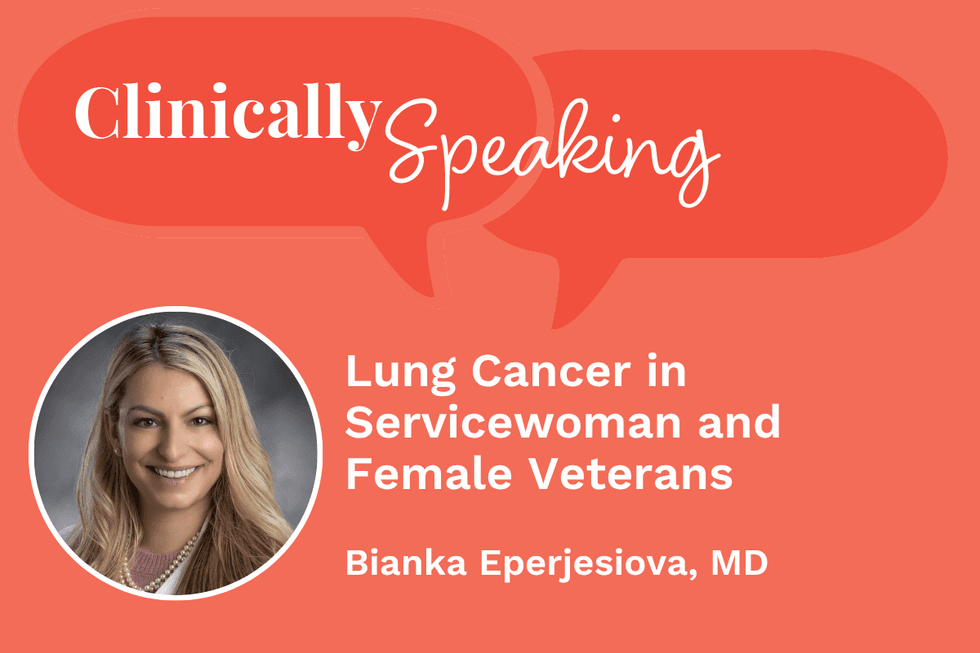
Lung cancer is the deadliest and second-most diagnosed cancer in the U.S. And many lung tumors start in the far reaches of the lung, where they don’t cause symptoms until the cancer has spread.
HealthyWomen spoke with Bianka Eperjesiova, M.D., the director of interventional pulmonology at Corewell Health and former director of interventional pulmonology at the Veterans Health Administration (VHA), about the risks specific to servicewomen and veterans. Eperjesiova wants all veterans to know they’re at high risk for lung cancer and entitled to preventive care to catch lung cancer in its early treatable stages.
Many factors play into the development of lung cancer. While women are generally less likely to smoke, we know that all service members have had significant exposure to hazardous chemicals causing all veterans to be at high risk for lung cancer. The PACT Act legislation passed in 2022 promised to address this in a meaningful way by identifying conditions related to exposure, increasing access to healthcare, and encouraging veterans to reach out and get early lung cancer screening.
While service members no longer receive cigarettes with their rations — true story — exposure to other hazardous chemicals is also known to cause lung cancer. All service members are exposed to risk, whether it’s through burn pits, agent orange, asbestos, radon or uranium from munitions. Those are just a few examples. It doesn’t matter if you’re not genetically predisposed to cancer or don’t smoke: Exposure to these chemicals alters our genetics to allow lung cancer to form. There is no such thing as a low-risk veteran.
How is lung cancer diagnosed?
We recommend regular screening for all eligible veterans through CT scans. If these tests show something that concerns us, we’ll offer a biopsy. We can now use a robot-assisted bronchoscopy tool called Ion or Monarch that can help surgeons sample the lung from the inside in a minimally invasive approach. Then we sample the lymph nodes that let us know how far the cancer has gone to determine what we’re going to do for treatment.
If the cancer is early stage and treatable with surgery, we’ll use the daVinci or Mako surgical system, which can help the surgeon cut out part of the lung. If the patient cannot undergo surgery safely, we can offer radiation. If the cancer has spread, we can treat it with chemotherapy or immunotherapy, or we’ll do a combination of some or all of these treatments. The wonderful thing about the VHA is that it’s the largest health system in the world, and we have access to the newest cutting-edge equipment and clinical trials.
I know it might sound crazy: a robot doing surgery. But surgery is robot-assisted, and we guide the robotic arms. Robotic surgery can reach places human surgeons can’t: We’re limited by how much our wrists can bend, for instance. These tools allow us to remove the least amount of tissue needed to conquer lung cancer.
In the general population, the Black population is more likely to present with more advanced lung cancer. In the veteran population, we see geographic disparities. Veterans in rural areas, far away from a medical center of excellence, are less likely to come in and seek preventive screenings. Spreading risk awareness matters: It can be the difference between treating early lung cancer or diagnosing it at a later stage.
This educational resource was created with support from Intuitive.
From Your Site Articles
Related Articles Around the Web

Just as people are left- or right-handed, some brands tend more toward fall, others to spring. Arnar Már Jónsson and...

Lung cancer is the deadliest and second-most diagnosed cancer in the U.S. And many lung tumors start in the far...
A Canadian technology company based in Edmonton has officially opened an office in downtown Vancouver. Founded in 2011, Jobber remains...
The car-maker found AI quality checks failed to match the skill of veteran technicians. Source link
Discover Global News Panorama at news.mapworldnow.com — your universal gateway to comprehensive, international journalism. From politics and technology to culture and sports, we cover all news niches and all news categories from every corner of the world, all in one place.

































































![Ebola in the DRC: At least 300 positive cases unaccounted for [Africanews Today]](https://news.mapworldnow.com/wp-content/uploads/2026/06/1024x538_cmsv2_25f7c4fa-db68-5802-982d-f4c1ab52755b-9817196-360x180.jpg)