- Latest
- Trending
Canada, with its brutal winters and generations of tradition, may be a hockey nation. But for nearly six weeks this summer, Vancouver, a British Columbia city nestled between forests, mountain ranges and a bay, is in a soccer frenzy as a World Cup host.
For Vancouver sports fans, the tournament has come at exactly the right time.
The Canucks finished with the worst record in the National Hockey League last season. And the city is in jeopardy of losing its Major League Soccer team, the Whitecaps, in a standoff between billionaires and the government of British Columbia.
Jessie Adcock, the local executive who led Vancouver’s preparations to host seven World Cup games, joining Toronto as the only Canadian host cities, said the event had provided visibility to larger issues while also serving as a release.
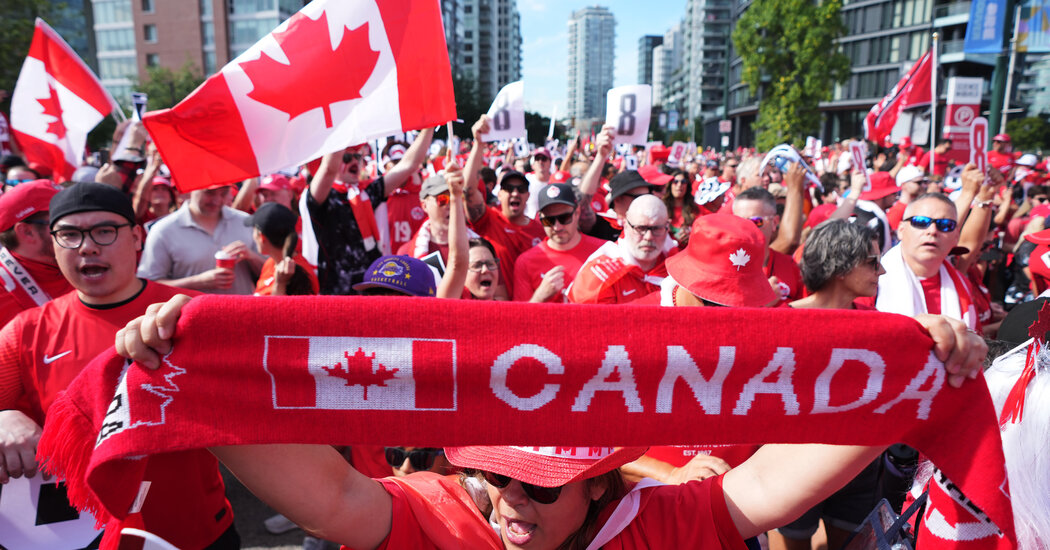
Last week, Vancouver was the site of Canada’s first win in the men’s World Cup, a 6-0 rout of Qatar in front of Mark Carney, the prime minister. The city became the center of a nationwide celebration, with fans flooding the streets outside BC Place in euphoria.
“Right now, people are enjoying and celebrating and sharing a collective moment as opposed to debating or challenging,” Adcock said.
Fans eager for a second consecutive win marched to Wednesday’s game between Canada and Switzerland while drenched in red apparel, the Canadian flag draped across shoulders and maple leaves branded on top hats. Before kickoff, the stadium roared as they sang lyrics to their national anthem: “O Canada! Our home and native land!” In the game’s closing minutes, gasps erupted from the crowd as Canada sought a tying goal.
As he stood in the stadium concourse while fans bustled to concessions, Shaun Layton said he hoped the energy would translate to Vancouver’s sports leaders.
“The fan base is there, the passion is there, and Vancouver needs this,” said Layton, who owns a Spanish restaurant in the city where the bathrooms are plastered with pictures of players in European soccer leagues.
Canada ultimately lost to Switzerland, 2-1, but still advanced out of group play. It would have remained in Vancouver with a win but must now travel to Inglewood, Calif.
BC Place, which is also hosting World Cup matches featuring Egypt, Australia and New Zealand, has been the home field of the Whitecaps since 2011. It is owned by the government of British Columbia, and the team’s ownership group has criticized the current revenue-sharing plan and lease terms.
The team was valued at more than $400 million when it was put up for sale in 2024, but no local buyer emerged. The strongest pitch came from a Las Vegas investment group that offered to buy the team and build a new stadium in Nevada.
No timeline for a decision has been set, but the Whitecaps said in a statement that the ownership group’s preference was to “find a solution in Vancouver.” The team’s temporary lease in BC Place expires at the end of the year.
The situation has galvanized Vancouver fans, who are scarred from watching their National Basketball Association team, the Grizzlies, relocate to Memphis in 2001. They have publicly pleaded for Ryan Reynolds, the Canadian actor who co-owns a European soccer team, to purchase the Whitecaps.
Despite the turmoil, the Whitecaps are one of the best teams in Major League Soccer. They appeared in last season’s championship game and are currently first in their conference. Soccer fever was already high when the World Cup came to Vancouver.
“We’re in a situation where the profile of the club couldn’t be higher, the profile of the game couldn’t be higher, and the hope is that can transition into ideally the team staying in Vancouver,” said Bob Lenarduzzi, who played for Vancouver’s North American Soccer League team and the Canadian national team in the 1970s and 1980s.
Kevin Kerr, a member of the Vancouver Southsiders, a fan group that started the social media campaign #SaveTheCaps, said the World Cup had brought global exposure to the relocation issue. In April, the group protested outside FIFA’s annual congress in Vancouver.
Kerr said he had talked with World Cup visitors from other countries who were unaware that such a conflict was even possible.
“They’re astonished that you can just move a club in North America,” Kerr said. “They’re like, ‘You can just do that?’ Unfortunately, that’s American sports culture.”

Ohm YoungmisukJun 25, 2026, 09:35 AM ETCloseOhm Youngmisuk has covered the Giants, Jets and the NFL since 2006. Prior to...

On Saturday, Jaron Ennis attempts to become a unified world champion in a second division as he collides with Puerto...
Oil prices fell on Thursday, testing levels not seen since the war in Iran started in February.After surging over the...
A German doctor admitted to having killed 12 patients nearly a year since the start of his high-profile trial at...

Discover Global News Panorama at news.mapworldnow.com — your universal gateway to comprehensive, international journalism. From politics and technology to culture and sports, we cover all news niches and all news categories from every corner of the world, all in one place.