- Latest
- Trending

I am not a Tomb Raider expert – my memories go about as far back as playing the bulk of the original and its sequel at a friend’s house, aged something like seven to 10 years old, and attempting to break free of the same demo disc level for a few too many hours on end. But what I’ve always taken from my fuzzy recollections of late-90s Lara is that one of classic Tomb Raider’s defining traits is its precision. Jump exactly here. Land exactly there. Manually press a button to grab the ledge. If you miss you die – or at least get very frustrated.
After completing a roughly 40-minute demo out at Summer Game Fest, this is not my immediate impression of Tomb Raider: Legacy of Atlantis, the upcoming remake of the original, coming from the layoff-stricken Crystal Dynamics and its partner Flying Wild Hog, and published by a somewhat infamous Amazon Games.
What Tomb Raider: Legacy of Atlantis does feel like is a kind of lighter-weight, lower-budget Uncharted – a strangely circuitous moment for the series. There are some mostly telegraphed, simple-to-solve environmental puzzles, there are prominent ledges and hand-holds in its ruined walls, there are little things to pick up from vases and grappling hooks and quips and a bit of light gunplay. And most notably, rather than exacting, Lara’s movement is a curious mix of wafty and rigid.
Crucially, this is not to say it’s a disaster – although some passionate Tomb Raider fans with more precise memories than my own might understandably offer a different opinion. Instead, it’s more a recalibration of what this version of Lara Croft seems to be. Legacy of Atlantis might appear to be an Uncharted-tier blockbuster at a quick glance from a trailer, and that might be the expectation from some, if only going from how prominent a character Croft was back in her heyday. But this is a double-A game if I’ve ever played one. And with that, at least, comes some charm.
The demo here was set in some classic jungle ruins, with Croft approaching a gushing waterfall and interpreting a wall mural with three golden cogs on it to mean that, naturally, we needed to find a missing cog to get a crucial mechanism working and progress through the jungle. Enter: light platforming and mild environmental puzzles.
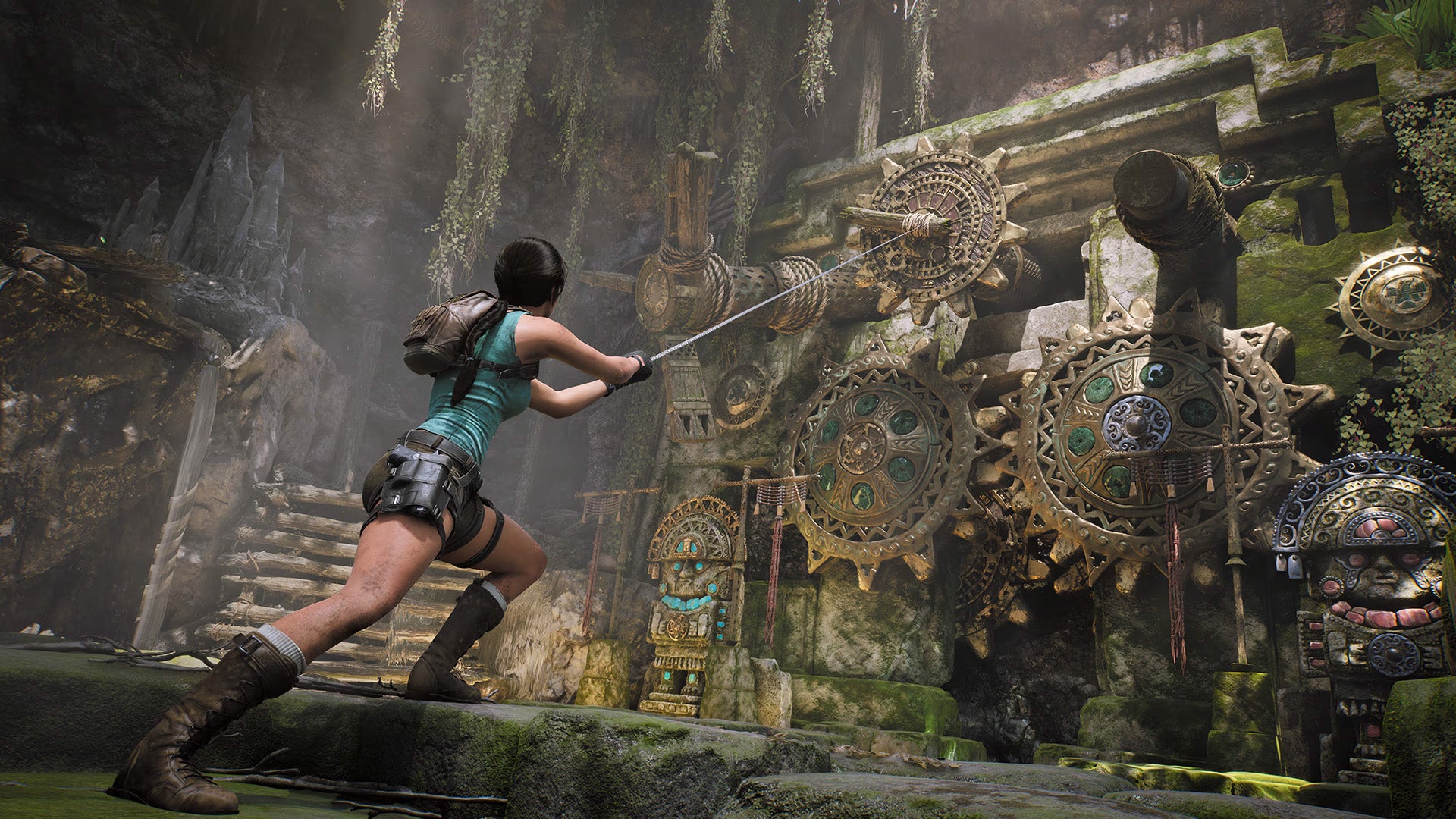
Climbing up to the side of the ruin, via some faintly telegraphed hand-holds (no yellow paint, but you know the sort, and lightly highlighted with a dash of “I could probably climb that”-like commentary), I found the usual. Collectible gubbins in some ancient pots, a small, secret, looping area with an ancient creature’s tooth, which gave me a pop-up to note that collecting several will grant me an upgrade point of some kind (though this part of the menu was blocked off in the demo). Pressing on via a linear path of more gentle problem-solving – grab this crate and pull it out of the way, look in the right direction to get an on-screen prompt to grapple something and swing across a river – and eventually we reached the summit.
In there: more big cogs, including one that looked, to Croft, to be a little loose. More linear platforming up the side and a jump, then a button-prompted kick to the loose cog and it fell down into a pool of water (Croft commented at least three times on how this ancient civilisation “bent water to its will”, so it’s safe to call that one a common theme of the level). Grabbing it with the grappling hook to pull it over to one side, then clearing a bit of debris with another prompt, got it moving down the waterfall to the original pool down at ground level. So we go back down via a different platforming route, Croft flipping acrobatically – including appropriately poised loop-de-loops around horizontal poles, and a classic swan dive – until I was back at the lower pool and again dragging the loose cogs into place.
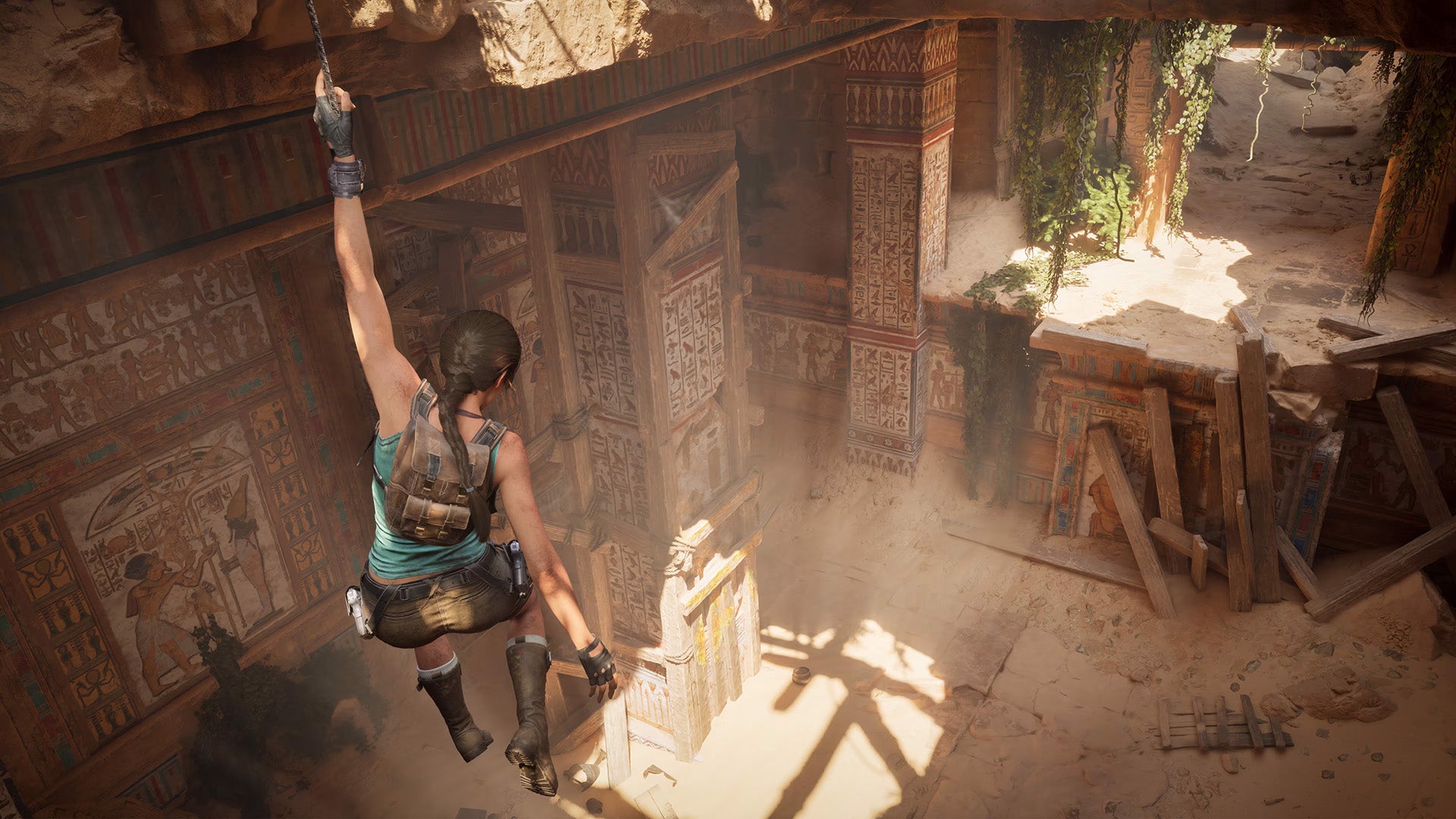
After that: combat! A quick encounter with some velociraptors showed off a new mechanic here to compliment your classic dual pistols, which in all their booming power continue to feature one of video games’ great sound effects, though there was no classic auto-lock-on here. This new feature is a kind of focus gauge, where building up enough by successfully dodging – your dodge is still a backflip or, when sideways, a kind of cartwheel, which is great – grants you an ability to use in combat. Activating it turns on a kind of slow-motion bullet time, where you start flipping about once again and can far more easily home in on your dino-foes.
Then, one of the great PS1-era gimmicks: a run-towards-the-camera level. Only this time it only lasted a couple of seconds, during a maybe 30-second-long chase sequence featuring a T-Rex. It was also another case of a slightly strange mix of eras, part late-00s cinematic bombast, with a slow-mo slide between the dinosaur’s legs, and part 90s idiosyncraticity, where suddenly pivoting to the run-at-the-camera point of view from a cutscene might lead you to get caught and die, simply because you didn’t realise you immediately needed to start running manually. In Legacy of Atlantis you’ll find a lot of distant Crash Bandicoot experience, buried in the darker corners of your mind, might suddenly come in handy.
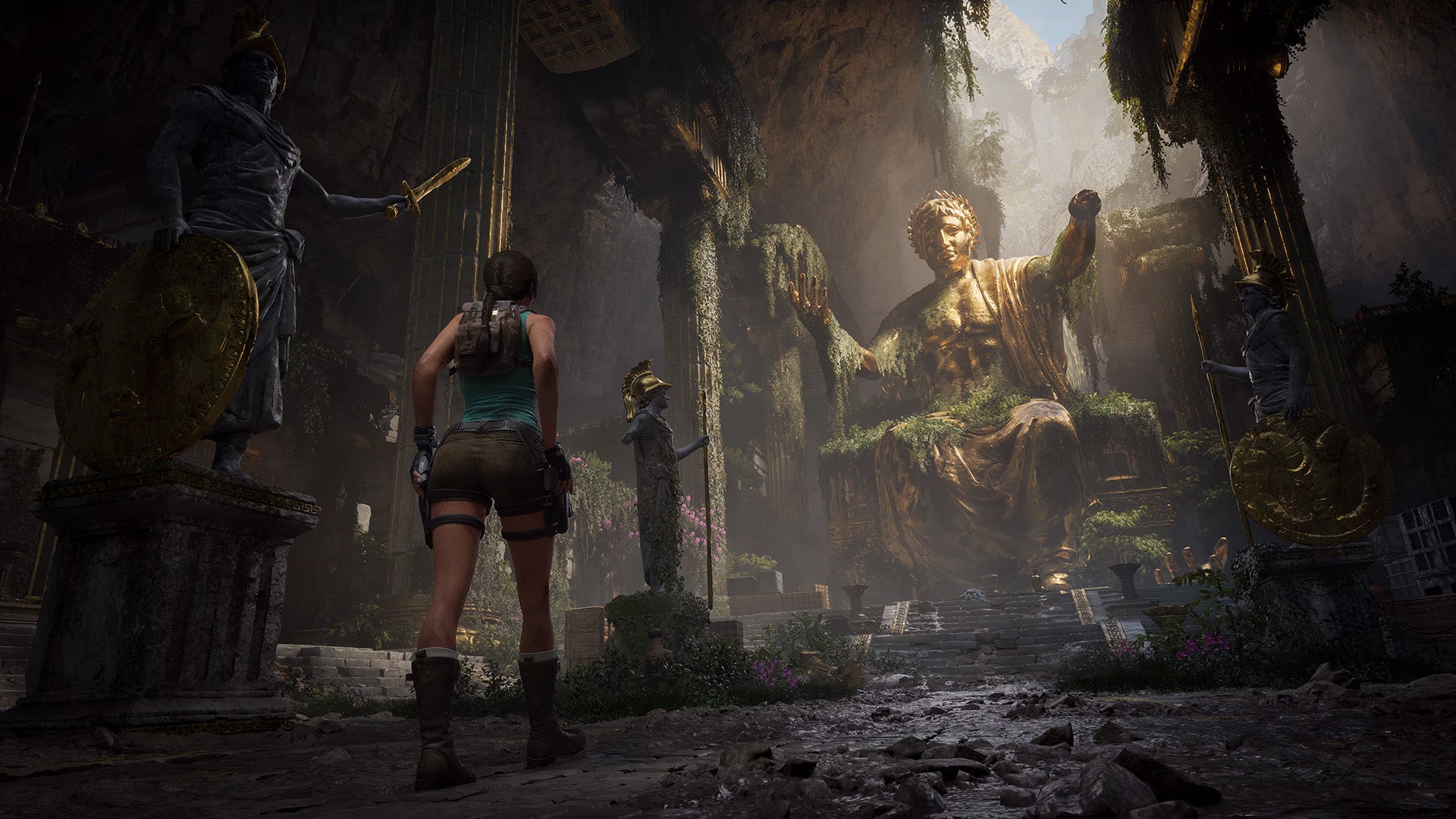
All in all it made for a curious demo of what seems to be a curious game. In part, its breeziness – certainly compared to the originals – might be an asset. If you miss Uncharted because you miss gently bobbing down the lazy river of lightly guided environmental puzzles and mostly linear jungle level design, you’ll be happy here. In fact, amongst a hectic weekend of sprinting between demos in the searing Los Angeles sun, I could’ve spent all afternoon in the nostalgic comfort of playing Tomb Raider: Legacy of Atlantis. On the other hand, that might have been helped by the fact its booth, an appropriate call-back of its own to the age of E3, was set up with fake plants and misters to be a kind of steamy jungle, and so being sat by the door meant a light spritzing of cool, aerated water amidst the heat.
Either way, I would maybe just gently temper your expectations for this one. Tomb Raider: Legacy of Atlantis is breezy and enjoyable enough, its new voiceover for Lara Craft is pleasantly posh, its design dappled with moments that feel lovably old-school. But a prestige, properly modern remake this is not. There are strange decisions and strange approaches to movement (that new jump, equally lightweight but linear at once, really took me a moment to grasp), campy dialogue and light mechanics I recognise from elsewhere. This is pure, cold, double-A, baby. But within that framing, it could still be a blast.

When the Boston Symphony Orchestra announced in March that it would not renew the contract of its music director, Andris...

In an email interview, the author of “The Typing Lady: And Other Fictions” shared details of human anatomy she learned...
By Sean Thiessen | Published 27 seconds ago Tom Cruise’s name is nearly synonymous with stunts. These days, he is...
The federal government on Thursday condemned Russia’s threats against Canada and any companies participating in a recently signed drone production...
Discover Global News Panorama at news.mapworldnow.com — your universal gateway to comprehensive, international journalism. From politics and technology to culture and sports, we cover all news niches and all news categories from every corner of the world, all in one place.