- Latest
- Trending

Each week, Food Tank is rounding up a few news stories that inspire excitement, infuriation, or curiosity.
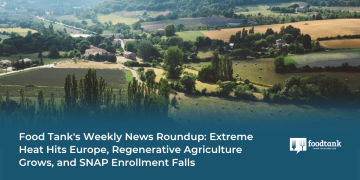
Europe Hit by Extreme Heat
Europe’s extreme heatwave has led to at least 1,300 excess deaths linked to high temperatures since June 21, according to the World Health Organization. A few days ago, Germany recorded record-breaking temperatures of 41.7 °C — over 107 °F. Similar temperatures were reported in Poland and the Czech Republic. It was so hot that an event focused on the impacts of extreme heat in the UK had to be cancelled because temperatures were too high.
“The phenomenon of the ‘once-in-a-generation’ heatwave is now occurring nearly annually,” writes the WHO’s Director-General, Tedros Adhanom Ghebreyesus. He warns that Europe is heating at twice the global average.
Helen Clarkson, CEO of Climate Group, who recently joined us for our London Climate Action Week programming, said that this last week proves “science has come to life, and reality is clearly showing there is more of this to come.”
Farmers are struggling in the face of high temperatures. France has reported the deaths of several hundred thousand poultry at indoor and outdoor farms. And the country’s dairy farmers are seeing milk production drop. Spain is warning that potato farmers are likely to see slowed crop development and reduced growth.
But many farmers are responding with creativity, BBC reports. Chickens are being fed at night and receiving vitamins to breathe better. One Spanish farmer is putting wool over her crops to keep the soil moist. And a British dairy farmer added misters and fans to keep her cows cool.
Regenerative Agriculture Is Not an Experiment
In a new op-ed by Sara Farley, Vice President for the Food Team at The Rockefeller Foundation, she writes “Climate volatility is turning drought and flooding into chronic risks, making crucial crops maladapted to their historic environments. The question is no longer whether agriculture must change, but how fast it can.”
Fortunately, the world is changing. Regenerative agriculture has been called niche or an experiment, Farley says. But she sees a different reality as regenerative gains momentum globally. As it scales, the definition is becoming more diverse. While that isn’t an issue, there is something missing: shared outcomes.
Farley argues that there needs to be clearer alignment on what regenerative agriculture is trying to achieve and without that, it “risks fragmentation, confusion, and the loss of trust.” That’s why she’s excited about the new and emerging systems to support regenerative agriculture.
The World Bank Group’s International Finance Corporation is setting standards that must be met to flow into regenerative agriculture systems. The Sustainable Agriculture Initiative is translating into practice how companies measure and implement these practices. And now, a new framework from Regen10 outlines what regenerative food systems should result in without prescribing a single model or set of practices.
Farley believes that this is what will help us deploy finance at the speed and scale that’s needed. This will build what she says is “not an experiment, but a new operating system for agriculture already taking shape.”
4.7 Million People Pushed Off SNAP Since H.R.1
A new analysis from the Food Research and Action Center (FRAC) finds that 4.7 million people have lost access to the Supplemental Nutrition Assistance Program (SNAP) since President Trump signed his tax and spending bill into law last year. In total, there are now 5.5 million fewer people enrolled in SNAP since Trump’s first days in office.
FRAC says the legislative package has “created instability for families, communities, local economies, and weakened state budgets” by “shifting program costs to states, expanding time limits, and putting a cap on future benefit adjustments.” They and other anti-hunger advocacy groups are urging Congress to reverse the funding cuts for the program, but lawmakers haven’t shown signs of action yet.
Last week, the Senate released the Agricultural Act of 2026, their version of the Farm Bill, which fails to tackle rising hunger rates. In a statement released by Democratic members of the Agriculture Committee, they said that the bill must meet the needs of both farmers and families, and right now it “does not address the devastating cuts to SNAP.”
Investing in Food and Agriculture Can Create Millions of Jobs in MENAAP
In the Middle East, North Africa, Afghanistan and Pakistan (MENAAP), investments and climate reforms can lead to the creation of millions of new jobs by 2050, according to a new World Bank report.
The region’s agrifood systems provide three in every 10 jobs, and the number of off-farm jobs—like processing, transport, and logistics—in the sector is growing quickly.
Many believe that jobs in food and agriculture are unappealing. But a new survey shows that, across six countries in the MENAAP, the majority of respondents believe that the sector offers opportunities to earn a stable income.
If the right finance is invested and reforms are put in place to boost private sector engagement and boost yields, it’s possible to create 5 million jobs on-farm and off. Food security could grow as well—a benefit much needed in the region. Around 18 percent of the population are food insecure and 40 percent can’t afford a healthy diet today. And in the next 25 years, food demand is expected to rise by 67 percent.
The World Bank estimates that an investment of US$12 billion a year in water-efficient irrigation and agricultural innovation, supported by policy reforms, can dramatically increase the domestic food supply. They project that fruit and vegetable production could double and cereal yields could increase by over 70 percent.
Articles like the one you just read are made possible through the generosity of Food Tank members. Can we please count on you to be part of our growing movement? Become a member today by clicking here.
Photo courtesy of Freddie Marriage, Unsplash

A couple of weeks ago I went to a Pop-up by “Colored Girls Hustle” in Brooklyn. At the event I...

Announced June 15, Balenciaga becomes the first fashion house to join Substack’s native sponsorship program. Image credit: Balenciaga French fashion...
Summary Basel Exclusive debuts with first-look artwork unveilings Strong sales and standout Unlimited, Parcours and digital presentations throughout the fair...
A structural reset is underway in the global fashion system. Artificial intelligence is no longer operating at the edges of...
Discover Global News Panorama at news.mapworldnow.com — your universal gateway to comprehensive, international journalism. From politics and technology to culture and sports, we cover all news niches and all news categories from every corner of the world, all in one place.