- Latest
- Trending

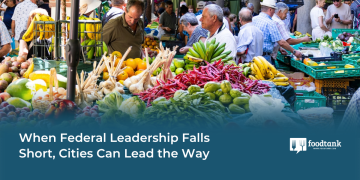
The United States federal government continues to backtrack on climate action at a time when it’s more urgent than ever. But urban centers are showing a different way forward, promoting human and environmental health.
“I’m deeply worried,” Jessica Fanzo, Professor of Food Policy & Climate at the Johns Hopkins School of Advanced International Studies Europe, tells Food Tank. She believes that decision makers in the U.S. understand the connection between food, agriculture, and the climate crisis, yet publicly deny it.
“There’s this backtracking on the wealth of information we know about systems approaches,” Fanzo says. “We know this. Politicians know this. We’re backtracking because it doesn’t fit within certain political narratives. It’s really worrisome because I think we’re losing time.”
Fanzo is quick to point out that this isn’t the reality everywhere. “There are a lot of policymakers who are deeply concerned. They see the connections between conflict, crisis, food, water, climate, environment.” The problem, she says, is the world still lacks the scale of innovations and solutions that are needed.
But cities hold great promise, Fanzo believes. “You’re hitting huge swaths of the population when you’re hitting urban centers, particularly big cities.” She finds hope in New York City, which has prioritized food policy in different ways under the last three administrations. She also sees similar action being taken in urban areas around the world.
To have the greatest impact, Fanzo calls on city governments to merge food and climate policies. “I think there needs to be more of that…You have a climate strategy and maybe the dietary guidelines, but how do you start marrying those policy instruments and creating action plans for cities around that?” she asks. “That’s a first natural step.”
Listen to or watch the full conversation with Jessica Fanzo on “Food Talk with Dani Nierenberg” to hear more about how to translate research into policy action, the big questions raised by the dismantling of the U.S. Agency for International Development, and where to put our energy now that we have the evidence base for food systems transformation.
Articles like the one you just read are made possible through the generosity of Food Tank members. Can we please count on you to be part of our growing movement? Become a member today by clicking here.
Photo courtesy of Mick Kirchman, Unsplash

The first wave of Steam Machines have arrived in the hands of eager early adopters. But while some are celebrating...

Frictional Games - the Swedish developer behind Soma and Amnesia: The Dark Descent - has announced its upcoming release Ontos...
Russian-born billionaire Dmitry Bukhman, co-founder of mobile gaming company Playrix, has become the new sponsor of the International Booker Prize,...
Your support helps us to tell the storyFrom reproductive rights to climate change to Big Tech, The Independent is on...

Discover Global News Panorama at news.mapworldnow.com — your universal gateway to comprehensive, international journalism. From politics and technology to culture and sports, we cover all news niches and all news categories from every corner of the world, all in one place.