- Latest
- Trending

Government’s plan to expand area
under irrigation has received a boost following the signing of a partnership
between the Ministry of Water, Sanitation and Irrigation and International
Water Management Institute (IWMI).
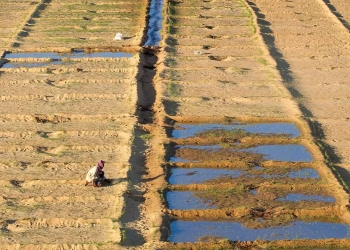
Kenya seeks to increase irrigated
land from last year’s 747,000 acres to 1.2 million acres by 2027 and ultimately
to about 2.5 million acres by 2030.
The collaboration between the State
Department for Irrigation and IWMI is inclusive of economic growth.
Principal Secretary Ephantus
Kimotho said the partnership aligns with the government’s Bottom-Up Economic
Transformation Agenda (Beta) and will play a central role in boosting
agricultural productivity.
“The State Department for
Irrigation acknowledges and appreciates the capacity of IWMI in supporting
various initiatives in the irrigation sector and we are honoured to partner
with IWMI in furthering the national irrigation development agenda,” he said.
The development comes when the
Kenya Red Cross is warning of worsening drought conditions across the country,
with nearly two million people now facing acute food insecurity.
The humanitarian agency said severe
water shortage, rising cases of malnutrition and long treks to the few
remaining water points are placing immense pressure on already vulnerable
communities.
Kimotho said the ministry and IWMI
have already identified key priority areas through joint consultations and will
begin fast-tracking interventions.
These priorities include conducting
a comprehensive baseline study to guide the prioritisation of National
Irrigation Sector Investment Plan (NISIP) projects, mapping existing irrigation
schemes, assessing land suitability and developing water tariff structures that
promote cost recovery, equity and sustainability.
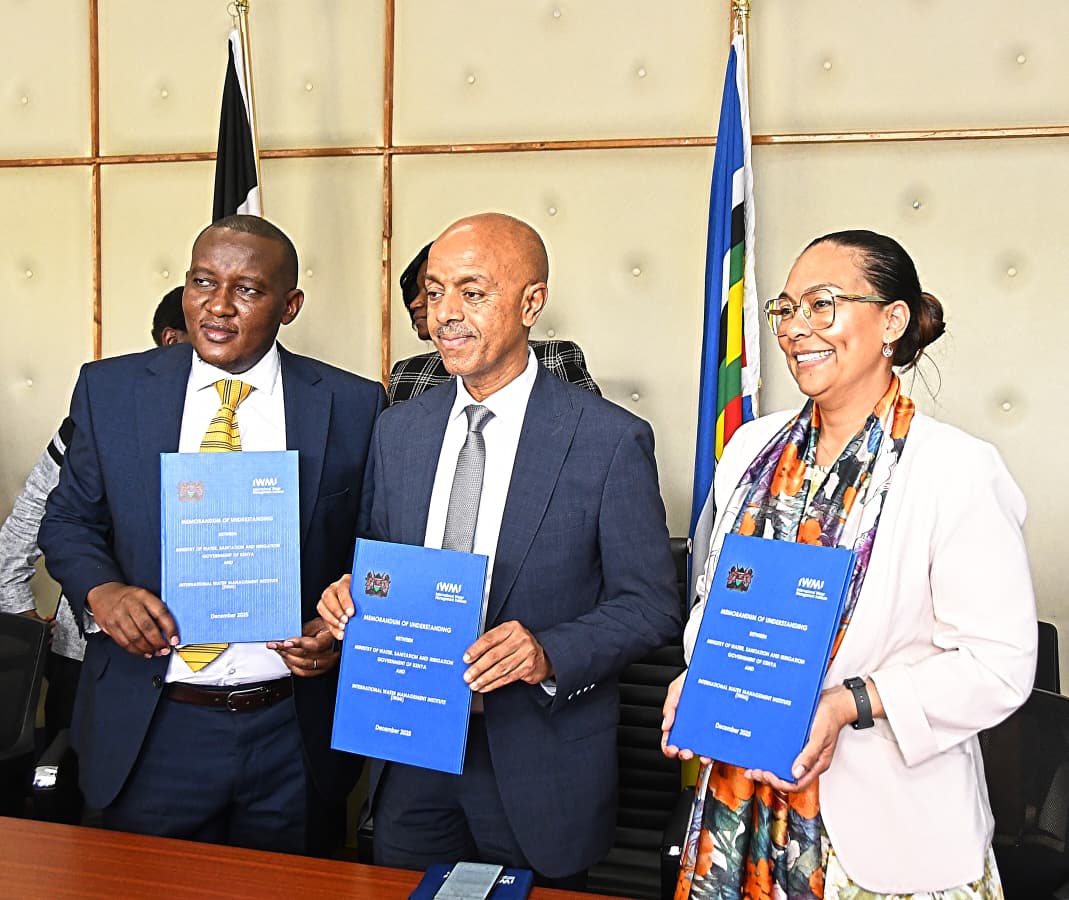
Kimotho and IWMI’s representative
for Ethiopia and East Africa, Abdulkarim Seid and witnessed by Inga Mata,
director of water, growth and inclusion at IWMI signed the MoU.
The agreement provides a structured
framework to deepen collaboration in several critical areas, including mobilising
resources for research and development of climate-smart irrigation; building
capacity in scheme governance, water-energy efficiency and soil and water
conservation; supporting policy reforms and inclusive governance; promoting
innovative financing models; and scaling sustainable irrigation solutions such
as solar-powered systems and nature-based water harvesting technologies.
“This MoU provides the cornerstone
for collaboration to create an enabling policy and institutional environment,
enhance investment in irrigation development, improve efficiency, equity and
sustainability and strengthen climate resilience and natural resource
management in Kenya,” Kimotho said.
The ministry expects the
partnership to play a pivotal role in accelerating irrigation expansion in line
with Vision 2030, ultimately contributing to improved food security and
socio-economic development.
IWMI, an international
research-for-development organisation headquartered in Colombo, Sri Lanka,
brings decades of experience in sustainable water and land management.
Through partnerships, research,
capacity building and policy analysis, the organisation supports the
implementation of water management solutions for agriculture, ecosystems,
climate adaptation and inclusive growth.
Its work aligns with the Sustainable
Development Goals, particularly those focused on reducing poverty, ending
hunger and protecting the environment.
The MoU clarifies that the
agreement carries no financial obligations for either party at this stage.
Should financial commitments arise
in the future, they will be governed by separate supplementary agreements to be
negotiated and signed by both sides.
Both parties affirmed that the
partnership will create a strong institutional foundation for scaling irrigation
development and improving the performance of existing schemes.
By integrating research,
technology, governance support, and inclusive policy reforms, the collaboration
is expected to provide long-term solutions to persistent challenges facing the
irrigation sector and strengthen Kenya’s resilience to climate shocks.

Lindsay GAAP EPS of $1.53 beats by $0.32, revenue of $160.8M beats by $3M Source link

Analysis-Britain’s Paramount-Warner review may be aimed at commitments, not a veto Source link
Pretty much everyone agrees that artificial intelligence has the potential to reshape the economy in the coming decades. But no...
Fairfield | 56 Prospect Street, Greenwich, Conn.Condo in an 1876 House$1.275 millionThis three-bedroom, two-and-a-half-bath, 2,128-square-foot renovated home is part of...

Discover Global News Panorama at news.mapworldnow.com — your universal gateway to comprehensive, international journalism. From politics and technology to culture and sports, we cover all news niches and all news categories from every corner of the world, all in one place.