- Latest
- Trending

By Shannon Winkler, National Sales Manager, Compact Automation Products
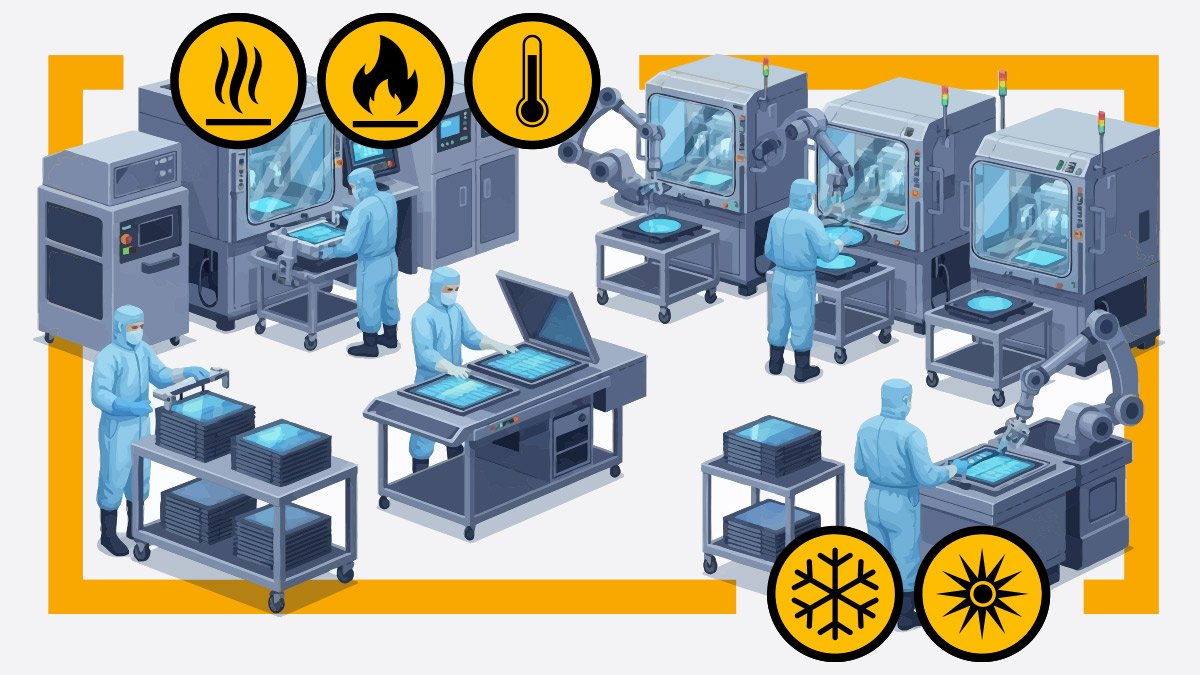
Environments that are controlled, harsh, or both can be among the most technically rigorous types of industrial manufacturing spaces. Medical equipment, clean rooms, food processing, and pharmaceuticals are examples of manufacturing spaces that are often both controlled and harsh environments. Controlled environments in industrial manufacturing are tightly governed spaces designed to prevent contamination, ensure product quality, achieve regulatory compliance, support worker safety, and maintain process consistency. These manufacturing areas operate within precise parameters for variables such as temperature, humidity, air quality, air flow patterns, lighting, vibration, cleanliness, and more. Harsh conditions are often present within these controlled environments. Characteristics may include extreme temperatures, abrasion, particulate loading, high vibration or mechanical stress, corrosive chemicals, and washdown processes.
When controlled and harsh environments co-exist, intricate manufacturing systems and solutions that can withstand harsh conditions and maintain precise environmental tolerances are necessary. A vital subsystem within this multifaceted manufacturing system is one that delivers precise motion control. Because some of the most regulated industries, environments, and applications can also be among the harshest on equipment and materials, motion control subsystems that operate within them must perform at extremely high levels. In environments marked by challenging manufacturing conditions, motion control systems need to deliver precision, repeatability, cleanability, and reliability, minimize contamination risk, maximize equipment uptime, and support regulatory compliance.
Applications of motion control subsystems in these hybrid controlled/harsh spaces include automated surgical instrument and imaging equipment assembly systems in medical equipment manufacturing, pick-and-place chip placement systems in clean room manufacturing, packaging and cutting systems in food processing manufacturing, and vial filling and table pressing systems in pharmaceutical manufacturing. If motion is inconsistent in these or related applications, quality and compliance can be compromised.
The right hydraulic and pneumatic automation components are essential in enabling motion control subsystems to perform at high levels within controlled and harsh environments. Several types of these components are described below, including many common applications.
All stainless-steel round line cylinders are designed for use in a broad range of applications, including those in washdown and caustic environments. These cylinders include a nitrile rod wiper to keep potential contaminants from penetrating inside the cylinder. Corrosion-resistant stainless steel round line cylinders are suited for applications where equipment cleanliness is critical. With their corrosion resistance characteristics, these cylinders boast a Delrin® head and can withstand harsh environments that require frequent use of hot water and chemicals.
Composite cylinders are designed for medical and food-grade applications where lightweight, washdown, or corrosion-resistant features are required. Stainless steel inch cylinders are designed for extremely tough and limited space applications. They’re used in harsh environments found in industries such as chemical and petroleum, pharmaceutical, nuclear, medical equipment, and food processing.
Corrosion-resistant stainless steel non-adjustable shock absorbers (CRS Series) are suited for wash down and various harsh environment applications, including medical equipment, food processing, packaging, electronics, chemical, and marine. The shock absorber is comprised of a 17-4PH stainless steel cylinder, piston rod, and piston cap.
Automation and motion control components for the food and beverage industry, where clean and sterile conditions must be maintained for food safety, include PET blow molding shock absorbers for plastic bottle production as well as custom double-acting grippers for pick-and-place robotic operations, case packing and palletizing, harsh area washdown applications, and more. Custom motion control components for packaging applications include indexing cylinder arrays for use in equipment that performs filling, capping, sealing, labeling, and high-load guided actuators used primarily for end-of-line production activities.
An OEM for semiconductor manufacturing needed an actuator to gently and quickly lift a wafer pedestal in and out of a process chamber to serve as a sealed conduit for cooling lines. The lines run into the chamber and cool the pedestal. There were many challenges with designing this product.
First, the cylinder needed to handle a 5-pound, off-center load as well as maintain a vibration-free stroke and tight tolerance of the rod alignment. Next, the cylinder required a hollow rod for a pass-through and a stationary conduit for the pedestal cooling lines. Additionally, it had to accommodate a rod-mounted bellows to seal the chamber. And the unit had to be competitively priced.
Compact Automation modified an ARFHD 3×12 cylinder with the addition of an oversized hollow rod and piston and internal stroke cushioning. The design included chrome plating for clean room compliance, a “windows” pattern cut into the frame that enabled access to attach the sealing bellows, and a stroke clearance tolerance of .001” – .003” between the bushing and rod.
Since the initial application, the customer has produced more than 1,000 similar tools.
A medical manufacturer of various supplies had equipment that would bond different materials together through a combination of heat and pressure. The manufacturer’s products include monitor patches, sterile devices, surgical film, medical tape, and product packaging, among others.
They were using air springs in the heat-sealing area to apply pressure to the materials. However, the air springs were failing due to the high-temperature environment. Compact provided the manufacturer with a custom stainless-steel linear actuator with high-temperature grease, along with Viton seals, to withstand the high heat of the application.
The OEM maintenance costs were reduced by 50%, and the equipment throughput for the end user was improved by 20%.

Knowing a town’s motivation can help residents understand how to engage constructively. Source link

Watching SpaceX stock trade in its infancy as a public company has been like viewing a successful rocket launch. The...
Summary Archaeologists have discovered a 5,000-year-old wooden structure in England that may have been a prototype for Stonehenge. The two...
NEWYou can now listen to Fox News articles! For years, two women in Bremerton, Washington, opened credit cards and lines...

Discover Global News Panorama at news.mapworldnow.com — your universal gateway to comprehensive, international journalism. From politics and technology to culture and sports, we cover all news niches and all news categories from every corner of the world, all in one place.