- Latest
- Trending
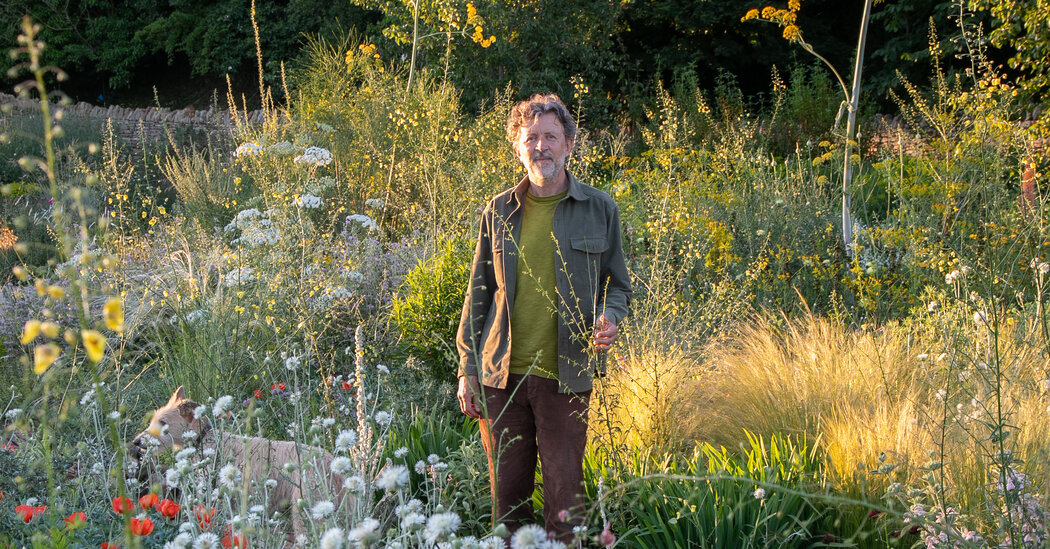
The celebrated English landscape designer Dan Pearson really knows how to read the room — the outdoor room — drawing on an uncanny instinct for divining what goes where and a depth of patience many of us gardeners might well be wise to cultivate.
He was already a leader in the naturalistic movement with an impressive global portfolio of projects when he came to Hillside, the place he now calls home, in Somerset, England. Before making his first design move there, though, he nevertheless allowed himself six years to “start a dialogue” with the place (his words, and a key to his process). A more practical timeline — one year — is what he typically suggests to clients.
“You need to grow a garden, don’t you?” he said. “And even just the ideas — you need to grow those ideas. So there’s much to be said, I think, for taking the time to understand something.”
Mr. Pearson’s landscapes are immersive, existing in a magical borderline between control and abandon, what he calls “the teetering point” between a maintained space and one where nature holds sway. He draws on intuition and hands-on practice honed since childhood, when he helped his parents uncover the Arts and Crafts home they’d bought that was positively engulfed by the wildness of a long-neglected garden.
For gardeners experimenting with pivoting to a looser landscaping style, that delicious teetering point may prove an elusive destination. Where does he take his cues from that gradually alert him to what it can become?
He shared some of his thinking:
Mr. Pearson never hurries toward design decisions. At Hillside, which is also the backdrop of the online magazine “Dig Delve” that he and his partner, Huw Morgan, publish, he had the luxury of indulging in those six years of getting acquainted with the land, “to look, and plan my first move,” he said.
He didn’t undertake any garden-making on the 20-acre former farm before that, beyond growing vegetables and trialing some plants — the start of his knowledge-gathering about the soil and climate — and reseeding old pasture.
By the time he started 10 years ago on what are now 1.5 acres of gardens that intimately anchor the house and other buildings, all but a handful of “the 50 options I had when I had first looked at the site had fallen away,” he said. Only those really worth pursuing stuck.
Even a year offers a chance to observe and listen to each season, he said: “Is there a wind we need to shelter from in March? Where does the light reach in the darkest month? Where do you need shade in the hottest month? Is there something that happens on the site that’s a magical moment that you want to be part of or have more of — and then you build from that.”
Important: Make notes of your first impressions, but resist analyzing.
“It’s like meeting a new person and getting a feeling from that person, but not judging,” he said.
This “observational research,” as he describes it, is the foundation of everything to come.
It’s no coincidence that Mr. Pearson uses terms like “informal” and “led by asymmetry rather than symmetry” and “layered” to describe his naturalistic compositions, for those are among nature’s foundational design principles (and key concepts to keep in mind).
Go stand at the edge of the woods, he said, and look at how the adjacent habitats coexist. You will not see symmetry, but lots of layers.
“You’ve got the trees which form the shade,” he said, “and then the layering of sub-shrubs or shrubs underneath the trees, which are more kind of human scale. And then you’ve got the perennials which come and go throughout the course of that relatively short season underneath the shade.”
The layering continues out into the sunnier areas, enacted by a different cast of plants. Even in a relatively narrow palette, they’re all working together, each performing in its time before the next one takes a turn, creating a succession through the seasons.
“They’re all interdependent,” Mr. Pearson said, “and the layering allows you to have miniature ecologies. It allows you to have moments where things are happening and then they can dim. It allows you to have continuity, ephemerality.”
Views, whether borrowed or created, enlarge the experience of a landscape, and Mr. Pearson’s home at Hillside, as its name hints at, is long on them.
Robin Hill, a residential project in Norfolk, Conn., for instance, initially felt claustrophobic to him, walled in by trees.
“I knew we were on top of a hill, more or less, but you just couldn’t see out,” he said.
Creating long views was impractical, but editing to make some clearings “that let the light fall to the forest floor,” he said, meant it “felt magical and sparkling. So you then had a mood that changed by simply removing two or three trees.”
Although his work is always “underpinned by informality,” Mr. Pearson said, there is always also an aspect of formality figured in that contrasts it, “because you’ve got to keep tension.”
At Hillside, the solidity of a brick path and a stretch of stone wall provide defining contrast for airy, effusive plantings in the area called the sand garden.
Among the simplest examples: what happens when you just mow a path through a meadow.
“It’s like the piping on a garment that makes the garment special rather than too plain,” he said. “It’s something that just allows you to see that actually you have had some input”
Pathway edges might lose their sharpness if self-sown seedlings or certain perennials’ expanding summertime circumference are left to have their way. Knowing your tolerance for such effusiveness — from none (clean edges only, thank you) to an openness to wandering a fuzzy path where volunteers caress your legs — is essential. Establishing a protocol that delivers your vision is equally so.
Mr. Pearson specified some paths at Hillside to be two meters (or about six feet) wide, for instance, to accommodate key plants’ fullest moments without allowing the walkway they flank to feel closed-in.
What each of us needs, he said, is to “know that you’ve got a set of rules that you can apply, your own rules that might say, ‘I’m going to cut that down once a year, every year.’ And you need to find the right time to do it, but it just might make all the difference.”
The gardener’s learning curve is never completed, any more than the garden is. The ongoing silent conversation with a space signals what interventions to contemplate as you both evolve.
“You learn to do those things in a garden as you garden a place,” Mr. Pearson said. “And then there are other things that are like keeping the terraces swept — just very simple stuff that allows it to feel intentional.”
And one more thing: However small or large any effort under consideration may seem, it is always best approached from a place of humility, Mr. Pearson said. Just as at the beginning of the relationship, don’t rush.
“You have to just keep on stepping back,” he said, “and saying, ‘Do we need to do that? How can we do it more lightly? Is it the right thing?’”
Margaret Roach is the creator of the website and podcast A Way to Garden, and a book of the same name.

Your support helps us to tell the storyFrom reproductive rights to climate change to Big Tech, The Independent is on...

NewsFeedAnti-migrant groups have taken to the streets in Johannesburg as the unofficial June 30 deadline for foreigners to leave South...
IAATO's new Geofenced Whale Area around South Orkney Islands Tuesday, June 9th 2026 - 14:20 UTC Full article ...
Crown and structural management • Guidelines and techniques for maintaining a tree's crown form, including pruning towards a target form, crown...

Discover Global News Panorama at news.mapworldnow.com — your universal gateway to comprehensive, international journalism. From politics and technology to culture and sports, we cover all news niches and all news categories from every corner of the world, all in one place.






























































![Ebola in the DRC: At least 300 positive cases unaccounted for [Africanews Today]](https://news.mapworldnow.com/wp-content/uploads/2026/06/1024x538_cmsv2_25f7c4fa-db68-5802-982d-f4c1ab52755b-9817196-360x180.jpg)