- Latest
- Trending

With women’s earnings up 50%, lower salinity levels and nearly 500 villagers managing water systems, Egypt’s results point to scalable solutions for the MENA region.
As one of the driest countries in the world, Egypt lives in the gaps: gaps between water supply and demand; rising costs and declining productivity; national strategies and local realities. Climate change and regional instability are widening those gaps, making them more urgent to address.
Identifying a gap requires a clear understanding of an existing system and where it falls short. This is why Al Murunah’s approach is systemic. The International Water Management Institute’s (IWMI) Al Murunah project aims to increase water security in the Middle East and North Africa (MENA) region through resilient nature-based water solutions. The project employs a development model that traces pressure points across biophysical, social, economic and institutional systems to identify where they intersect and/or break down. Using this deeper systemic understanding of pressure points, the project seeks to ease these constraints with solutions integrated across the four systems. The pilot in Egypt’s Izbat Al Hamra village shows how this model works in practice and makes a case for scaling the Al Murunah approach within Egypt and throughout the MENA region.
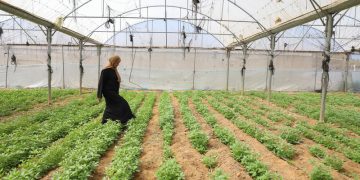
In Egypt’s rural areas, gaps are easily listed off the cuff because farmers live them every day. When Salem Mahmoud, board member of the Izbat Al Hamra Agricultural Cooperative Society, was asked to describe the challenges he faces, his answers were immediate. Uneven land leads to poor drainage. Water is lost through inefficient irrigation. Diesel pumps increase costs while adding environmental strain. Soil salinity steadily reduces productivity. These are interconnected gaps that shape how the overall agricultural system performs.
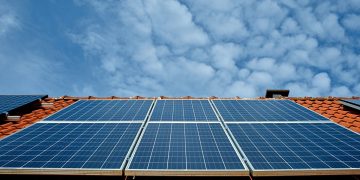
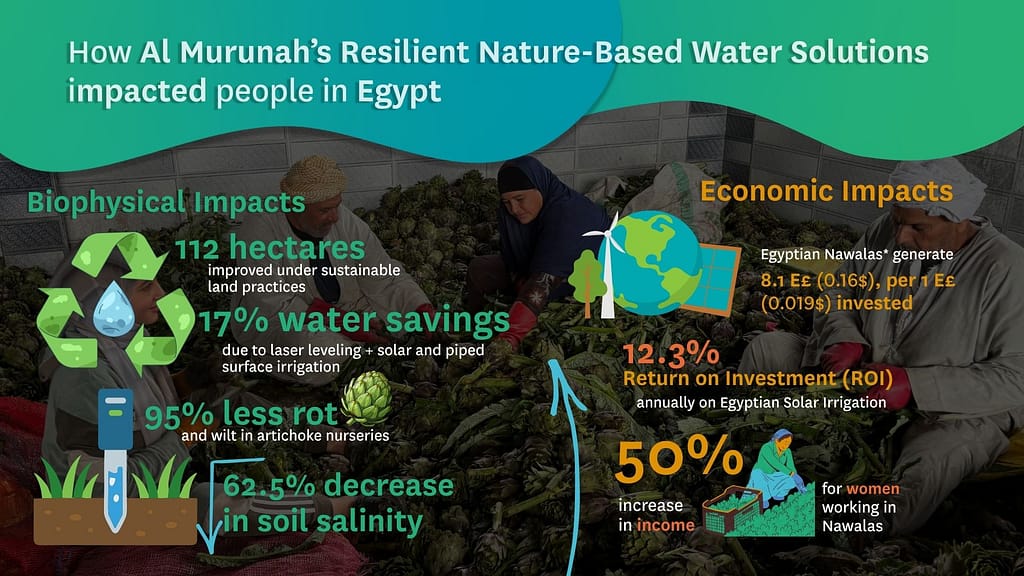
Through the project’s co-creation and implementation processes, Al Murunah responded across more than 110 hectares of smallholders’ farmlands to the gaps described by Mahmoud and others. Laser land leveling improved drainage and reduced water loss. Solar-powered irrigation reduced water use and reliance on diesel. Soil treatments restored productivity by addressing salinity. Farmer field schools supported these changes by offering training sessions that introduced and taught climate-smart practices for artichoke and sugar beet cultivation.
When these gaps were addressed together, conditions across the field became more consistent, improving overall field uniformity. “Soil salinity at 4,000 millimhos is a verdict, but Izbat Al Hamra appealed it and won, drawing that intensity down to 1,500 millimhos. This didn’t happen through a single intervention, but by being intentional about not treating connected problems as separate ones. I really think this distinction matters, especially if you want results that last,” said Stephen Fragaszy, Researcher and Al Murunah Project Lead.
More consistent practices across plots led to better irrigation distribution, reducing waterlogging and dry patches, improving seed germination, and generating water savings of 10% to 25%. Taken together, these shifts narrowed the gap between resource use and plentiful harvests and therefore improved the overall performance of the agricultural system.
Closing physical gaps creates conditions to close economic ones as well. Declining soil quality reduced outputs, while limited market access constrained incomes. Through training, implementing solar irrigation systems, and addressing salinity, the pilot interventions cut rot and wilt in artichoke nurseries by 95% and increased crop productivity by around 15%, increasing the amount of produce that could be sold.
At the same time, two women-led and women-run artichoke processing facilities increased earnings for women in the facility by around 50%. To support business expansion, five women at each facility received a shared economic asset package including goats, a rice whitening machine, an animal feed press, a tricycle and a tahini production machine for collective use, helping to extend benefits across the community.
These interventions did more than improve livelihoods. They demonstrated strong financial performance. The solar irrigation systems deliver annual returns of 12.3%, and the processing facilities generate eight Egyptian Pounds ($0.16) for every pound ($0.02) invested. Together, these results show how targeted interventions can close the gap between sustainability and profitability.
Many natural resource management interventions focus on biophysical and economic gaps but fall short because they leave social dynamics untouched. In the village of Izbat Al Hamra, women were largely excluded from financial decision-making and economic participation, which limited how families could respond to climate-related stress.
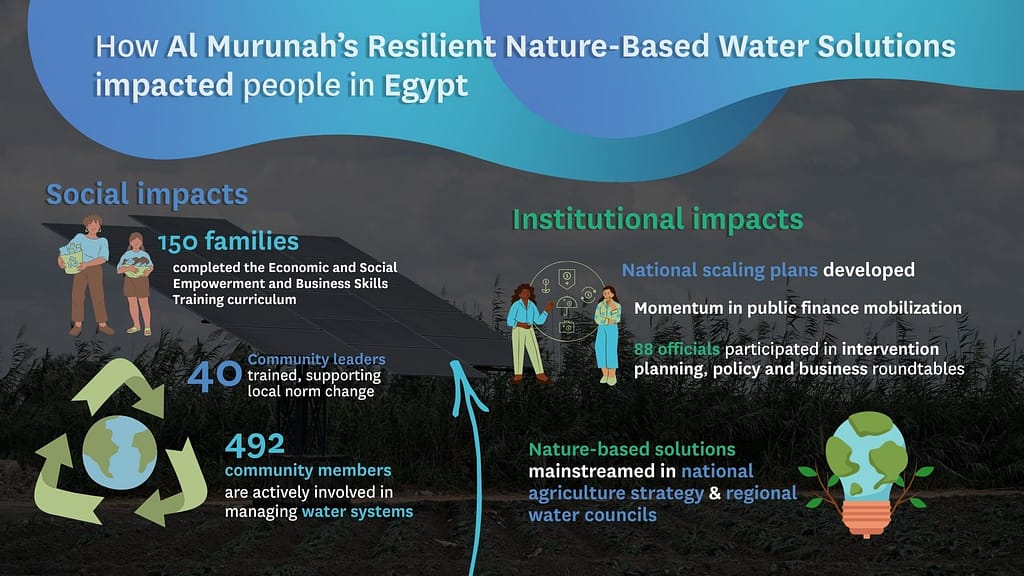
Using the Economic and Social Empowerment (EA$E) curriculum, which combines tested economic interventions and business skills training with targeted discussion groups, Al Murunah worked directly within this social norms space. So far, 150 couples have taken part in a shared learning process focused on financial management, communication, business skills and joint decision-making. Also, 40 local opinion leaders learnt about gender equality and inclusive leadership, helping to reinforce these changes at the community level and beyond individual households.
Participants described practical shifts in how they made decisions. As Asmaa Ahmed Ibrahim from Troji village explained, “the workshops brought families together to learn from one another and discuss together how to arrange priorities, how to save money and how to divide income based on priorities.”
“The workshops brought families together to learn from one another and discuss together how to arrange priorities, how to save money and how to divide income based on priorities.”
As Namaa Rakha of the National Council for Childhood and Motherhood noted, these processes help women recognize their value and act on it. These changes reflect a closing of the gap in who participates in decisions that shape household resilience.
Even the strongest biophysical, economic and social interventions can stall when the gap between policy and practice remains. National strategies set direction, but local implementation often lacks the structures or resources to carry them forward effectively.
Al Murunah has worked directly in this space by analyzing institutional readiness, supporting local agencies to fill gaps, and is now focusing on embedding resilient nature-based water solutions into Egyptian agricultural policy and regional water council implementation.
At the farm and community levels, IWMI has supported the creation of a water user association and increased the capacity of the Agricultural Cooperative to bridge communities and institutions for more coordinated and responsive water management. Today, around 500 community members are actively involved in managing water systems, reflecting growing ownership and a stronger foundation for long-term sustainability.
This alignment between local activities and national priorities is intentional. As Minister of Water Resources and Irrigation Hani Sewilam noted, “Al Murunah is directly targeting the governance pillar of our Irrigation System 2.0.” In practice, this approach closes the gap between national strategy and local action and linking policy ambition with systems on the ground that ministries can adopt and scale.
In Egypt, Jordan, Lebanon and Palestine, IWMI relied on this integrated development model and adapted it to each context. In each case, the project team identified the most critical gaps across biophysical, economic, social and institutional dimensions and delivered targeted responses that work across these systems simultaneously.
In Jordan, this meant rehabilitating degraded springs and 650 meters of irrigation canals and supporting long-term stewardship and improved agricultural systems through establishment of a cooperative; whereas in Palestine, the pilot involved spring and wadi channel rehabilitation to improve agricultural water delivery and reduce contamination from wastewater that a water user association and village council will maintain over time, while also developing a community agrobiodiversity garden.
The approach helps shift mindsets and reshape how systems respond, building the capacity to adapt and remain resilient as conditions continue to change.
This is also what the name reflects: Al Murunah means flexibility (or resilience) in Arabic, and flexibility here is not a concession to complexity, rather it is a core principle for project design. It allows the approach to stay grounded in context while remaining consistent across time and space.
The most pressing gap now is between proven success and scaled impact. Al Murunah’s Impact Celebration and Scaling Roundtable, hosted by the British Embassy Cairo in Egypt, alongside a national workshop organized by the Centre for Environment and Development for the Arab Region and Europe (CEDARE), brought together key actors across the system in March, 2026. Together, these moments helped progress from providing pilot evidence to real opportunities for scaling.
For example, Sewilam identified water user associations as an immediate priority for expansion. These locally grounded governance structures can be extended into new communities to close the gap between national strategy and local implementation.
Finance is another key lever. The United Kingdom (UK), which funds Al Murunah through the Foreign, Commonwealth & Development Office (FCDO), is actively working to channel capital into emerging markets through well-structured project pipelines that support green growth, noted UK Special Representative for Climate Rachel Kyte. Kyte described Al Murunah as evidence of resilient nature-based water solutions successfully improving biophysical, economic, social and institutional priorities. She posited that this evidence positions the project, and others like it, to attract investment and move toward scale. Figures from this project make the case for blended finance, combining public, private and multilateral funding to scale climate-smart approaches. This momentum is reinforced by alignment with broader frameworks, including the UK-Egypt Green Growth Partnership.
With the evidence base in place and political will present, investment interest is growing.
What makes Al Murunah effective is not any single intervention, but the integrated approach itself, and its ability to respond to systems under strain in a targeted and connected way. IWMI will apply this same approach in new places, with new communities and with the confidence that it works.

For years, World of Hyatt was hands down our favorite hotel loyalty program … but a series of recent changes has...

After watching the reactions of these fans, I sought out Charlotte Russell, a clinical psychologist and the founder of The...
As travellers seek adventure without compromising on comfort, flashpacking is putting a luxurious spin on the backpacking spirit – hiking...
In brief Billionaire Jeremy Grantham is skeptical about crypto's place in the financial world, calling it "useless" and a "speculative...
Discover Global News Panorama at news.mapworldnow.com — your universal gateway to comprehensive, international journalism. From politics and technology to culture and sports, we cover all news niches and all news categories from every corner of the world, all in one place.