- Latest
- Trending

How many countries can you visit without needing a visa with your passport? If yours is a bright-red-colored passport book that has the words “Republic of Singapore” on the cover, you can visit more nations without a visa – a total of 193 out of 227 – than holders of any other passport in the world.
For years, global payment technology company Visa, which assumed its current name in the 1970s, replacing the BankAmericard brand in order to connote universal acceptance, has tried to convince people that its credit cards are accepted in “more places than American Express.” In a somewhat parallel vein, this underscores the importance of visa-free travel as the world increasingly becomes a global village.
The Henley and Partners Visa Restriction Index, sometimes referred to as a list of the world’s most “powerful” passports, is published each year in coöperation with the International Air Transport Association.
For 2025, following Singapore’s now dominant position after four years in the top slot is South Korea in the Nr. 2 position with 190 countries, and Japan in the Nr. 3 position with 189. Five European nations are tied in the Nr. 4 spot, namely Germany, Italy, Luxembourg, Spain, and Switzerland, and seven are tied in the Nr. 5 position, to wit Austria, Belgium, Denmark, Finland, France, Ireland, and the Netherlands, with their passport holders able to visit 188 and 187 countries, respectively.

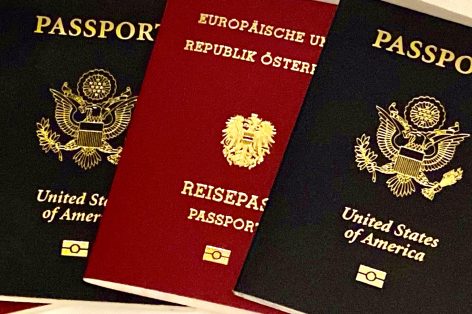
A current Austrian EU passport in the center surrounded by two current U.S. passports
Mere numbers don’t, however, tell the entire story. Henley describes the United States’ drop from the Nr. 1 position ten years ago to most recently Nr. 10 and then, in 2024, Nr. 12, as the “decline of the U.S. passport” and a loss of passport power. It is true that the country’s move down the list is due to a series of access changes, to wit with Brazil due to a lack of reciprocity, non-inclusion in China’s rapidly expanding visa-free list, and Vietnam’s decision to exclude the United States from its latest round of visa-free additions, but as these and other adjustments have been made, there were other factors at play.
“Even before Donald Trump had been elected to the presidency in 2016, the United States had started to become increasingly insular, and its policies had turned inward,” said Dr. Jonathan Spira, a member of the GEORGE staff and the former chief analyst at a think tank whose corpus of research included an investigation of early 20th century European trade wars. “That isolationist mindset is now being reflected in the country’s loss of passport power. One might be tempted to borrow from King David and lament, ‘How the mighty have fallen,’ but that would be a mischaracterization of the numbers.”
In a telephone interview, Dr. Spira noted that, just nine years ago, Germany led the pack but its Bürger could only enter 178 countries visa-free and the once-top-ranked United States came in as Nr. 4, sharing the position with Belgium, Denmark, and the Netherlands, with its citizens able to visit 174 foreign lands. He pointed out that the United States may very well have landed in the Nr. 12 slot this year, but its passport does in fact grant admission to 180 countries, a 16% increase in foreign-admission power when compared to the 2016 figures and a rate of increase that most nations in the top 20 experienced. Raw figures can be misleading, as can rankings.
Meanwhile, six European nations are tied in the Nr. 6 position – Greece, Hungary, New Zealand, Norway, Portugal, and Sweden, and – while four nations are in the Nr. 7 position, namely Australia, Czechia, Malta, and Poland, and their passports permit their citizens to enter 185 countries without a visa. Six countries occupy the Nr. 8 slot, which grants admission to 184 countries and these are Croatia, Estonia, Slovakia, Slovenia, United Arab Emirates, and the United Kingdom; Canada is all alone in the Nr. 9 position, with gate-opening privileges to 183 countries; and Latvia and Liechtenstein share the Nr. 10 position, with 182.
Visaless citizens of some countries are simply unwelcome in a good part of the world, albeit for good reason. The bottom three countries occupying the last three positions in the ranking are Iraq, Syria, and Afghanistan, and their citizens can visit 29, 26, and 24 countries, respectively. Perhaps notably, these countries – along with two other perennial bottom feeders, Pakistan, and Yemen – have been at the very bottom of this list and many others since time immemorial.
The list includes 219 destination countries and the maximum any country could score would be 218 as a visa is not required to return home. The number of passport countries that were scored was 199 and include the 93 Member States of the United Nations plus Hong Kong, Kosovo, Macao, Palestinian Territory, Taiwan, and Vatican City.
Henley & Partners, which helps individuals with citizenship and residence planning, has published the index for the past 11 years and says that the only change to the Top 10 (which is really the Top 28) is the addition of Hungary (tied for tenth) and the loss of Malaysia, which dropped to the number 12 position.
“No country dropped more than three positions, indicating that overall, visa-free access is improving around the world,” the company said in a statement. Several countries did, however, see their standing improve dramatically. Palau moved ahead 20 spots, Colombia climbed 25, and Timor-Leste, also known as East Timor, moved from 89th last year to 57th for 2016.
(Photos: Accura Media Group)

Usually, they get eaten by birds due to their inability to camouflage, making them a rare sight. Source link

CNN asked two space investment insiders — Phil Scully, general partner with Balerion Space Ventures, and Andrew Chanin, CEO of...
NEWYou can now listen to Fox News articles! A strange email lands in your inbox, and at first, it sounds...
From the autumn a new Water Safety Forum is being introduced to primary and secondary schools. Source link
Discover Global News Panorama at news.mapworldnow.com — your universal gateway to comprehensive, international journalism. From politics and technology to culture and sports, we cover all news niches and all news categories from every corner of the world, all in one place.