- Latest
- Trending

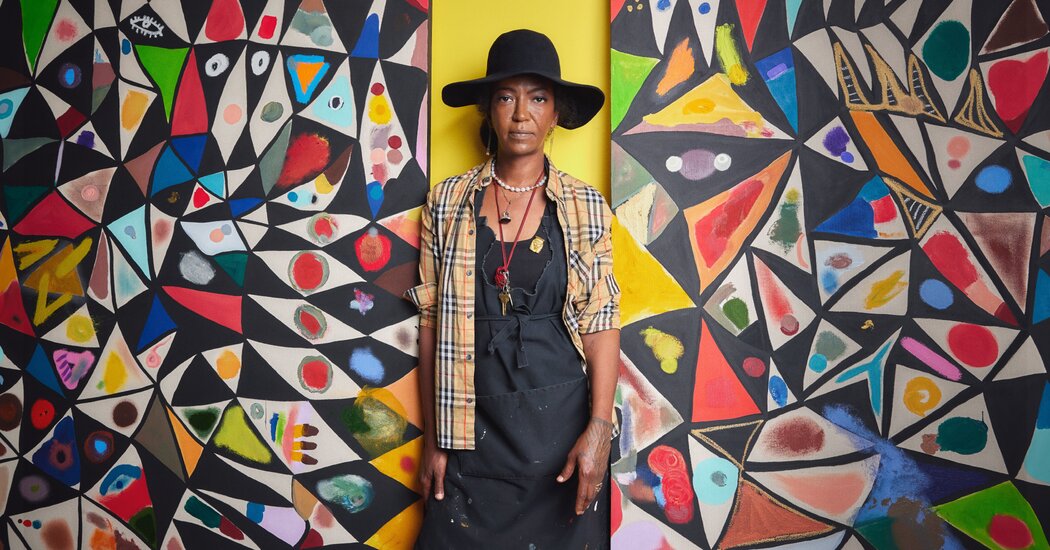
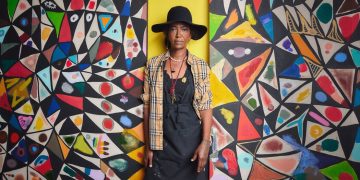
One of the self-taught artist Uman’s first introductions to color, line and form were the vibrantly patterned dirac and baati dresses worn by the women in her hometown, Mogadishu, Somalia. She also took inspiration from the international fashion magazines that she found — and secretly ripped pages from — at hair salons, doctors’ offices and hotels. During this period, when the mononymous artist, now 45, wasn’t with family or playing outside — her uncles and grandparents owned camels and goats — she was often drawing. And she knew three things for certain: the gender she’d been assigned at birth was incorrect, her life would follow an artistic path and someday, she’d live in New York City.
When Uman was nine, her family fled the Somali civil war and moved to Mombasa, Kenya. Four years later, she went to live with relatives in Aarhus, Denmark, as her parents worried that, in the conservative Kenyan society, her trans identity put her at risk. After spending her teenage years in Europe, she arrived in New York in the early 2000s. Soon after, she embraced an intuitive and densely patterned style of painting, using bright, saturated hues of acrylic and spray paint that she sometimes applied to found objects such as furniture, fabric and carpet. To get by, she worked odd jobs — as a dishwasher, a barista and a seamstress at a Uniqlo store — and sold her pieces in Union Square. Eventually, the art world took note: In 2015, she mounted a debut solo show at the alternative nonprofit White Columns, and in 2022, her work adorned Nicola Vassell Gallery’s booth at the Independent art fair.
For the past six years, Uman has worked out of a nearly 8,000-square-foot former storefront in Albany. Having traded Manhattan for the type of nature that shaped her childhood, she lives in a small town an hour away, on a farm where there’s room for her animals, which include chickens, cats and dogs. She often references rural life in her abstracted and grid-like landscapes. In her large-scale painting “Sumac Tree in Roseboom” (2022-23), which will be on view in a survey exhibition of her work opening Saturday at Bard College’s Hessel Museum, a black tree limb reaches across the center of the canvas, its branches ending in ruby-red squashy bubbles that are surrounded by seemingly thousands of small, multicolored dots.
Earlier this month, for T’s Artist’s Questionnaire, I visited Uman at her studio, where her signature swirls, dots, triangles and diamonds spill, here and there, from the canvases and onto the walls, rolling chairs and doorknobs.
What’s your day like? How much do you sleep and what’s your work schedule?
It’s a full day. I love waking up early, around 6 a.m. I have my tea and come to the studio, and I usually work on and off until 8 or 9 p.m. The first few years here, I worked later into the night, and then I’d sleep upstairs at this studio. I now have a small apartment in town, and I’d rather get up in the morning and do something, like bike, before I come to the studio.
I sleep four hours on average, even now, which is not good at my age. I eat very little when I’m working because when I eat, I become tired and want to nap.
How many hours of creative work do you think you do in a day?
Let’s say an average of six good hours, minus interruptions for admin. I get my peace when I’m home — I’ve managed to make a little space there to work. When everybody’s away, when it’s off business hours and I don’t expect someone to call or email me, I tend to be more creative.
What’s the worst studio you ever had?
I wouldn’t call it the worst, but when I lived in Crown Heights, Brooklyn [from 2006 to 2008], I had one room, and that was both my studio and my living space. It was what I could afford.
What’s the first work you ever sold? For how much?
I’m not sure what the first work was but around 2011, I sold [the poet, art critic and painter] Rene Ricard a collage painting of sheep for $80. It’ll be in the Bard show, in the main entrance vitrine. I’d met him at the Chelsea Hotel, and the first thing he did was give me a painting. He had a second apartment downstairs that he’d converted into a studio, and so, he went and got a white canvas and a red oil stick and made one brand-new for me. I had to walk home with this wet painting sticking out.
When you start a new piece, where do you begin?
I love working on the floor. I start with a mood, a color, and I determine the size of the canvas or linen or whatever I’m using. Then I do a rough drawing with charcoal, and that’ll be the foundation. In the past, I just started with acrylic. I never liked white gesso [which is used to prime surfaces before painting]; I always wanted the color to go straight onto the canvas and that will probably be a problem for restorers in the future.
When I do geometric paintings, I have more of a plan. But I’m not a conceptual artist. I think about ideas, but I’m just more of an emotional artist.
How do you know when you’re done?
When I never want to touch it again. I physically can’t touch it. If I do, I have a very off day. Because if I go deeper into the work, then it becomes unresolved. Thank God I have this space; I can just move the painting somewhere else. I had a harder time when I was in a tiny room.
I’ve stopped doing this, but I also used to love sending pictures of a work to one or two of my closest, truest friends to see what they think. They’d say to me, “This is good” or “This needs more work.”
How many assistants do you have?
Two. They’re both M.F.A.s at University of Albany. I didn’t go to art school, so it’s good to have Annabelle, who’s so great with colors and mixing. Christian’s well organized and very good with administrative stuff. I technically can only afford one, but I liked them both and they knew each other. I had three people on my payroll at one point, and I had to cut down and just be reasonable. I’m not doing five shows a year. I’m doing one or two. I like the idea of not trying to be everywhere or be part of the machine, this art world machine.
Do you play music when you’re making art?
Oh, yes. I’m a house-music aficionado. But I also listen to Mozart and Chopin. I’ve listened to Philip Glass for years now; there’s something about that quietness I like. And I go to podcasts, like The Daily. Sometimes I don’t have anything on. I love that, too. I’ve realized in my later years that I can just sit in silence.
When did you first feel comfortable saying you’re a professional artist?
I don’t feel comfortable saying it even now. I also think that a lot of people don’t understand it, including my family. There’s no place where I’d really say that and I’m not a very social person; I don’t go to functions.
It’s not one of those careers where you have a pension or a 401(k). You could be an artist today and a nobody tomorrow. Very few people have an art career where they’re successful to their old age. There’s always that question: When is the other shoe going to drop? I know an artist who’s 84 and has never had that type of attention, but they do great work in hopes that maybe people will see it.
Is there a meal you eat on repeat when you’re working?
A banana. A funny thing is that a lot of Somalis grew up having bananas as a staple in our meals. So, no matter how much I’ve left the culture and moved on, I love a banana. I have a tattoo of one.
Are you bingeing any TV shows right now?
“90 Day Fiancé.” I find it so endearing and sweet and raw — people looking for love.
What’s the weirdest object in your studio?
I have a whole sheep’s shear that I painted. It’s somewhere in a box. And I have animal teeth and skeletons, deer antlers. People give me little camels — all those stuffed animals you saw [in a storage area] were gifts.
Why camels?
I grew up with camels. I used to drink camel milk and eat camel meat. It was just part of my culture. My sister got married and then she had a camel farm. I love them as animals. They’re gentle and sweet, and they have this resilience. I’ve always made camel paintings. As a matter of fact, I want to put some kind of camel sculpture in a show.
How often do you talk to other artists?
Every few days. I have one hour in the car to go back home from the studio, and I call people. One of my friends is a writer, and she goes to the art previews and openings in Manhattan, and we speak twice a week so I can get all the gossip. I think the cure for my isolation has always been phone calls. I’ve now mastered when I need to stop the conversation — five minutes before I’m going to be in a dead zone.
What’s the last thing that made you cry?
Oh, my dog, Rolfie. [The artist’s elderly pet passed away after this interview occurred.] He fell trying to come inside the house while my hands were busy cleaning something, and I had to run and help him in. He broke my heart because he just sat there helpless. I also still read the news; everything’s so bleak. What’s there not to cry about?
What do you usually wear when you work?
What I’m wearing now, which is all black. And an apron, which I wear at home, too. I have a uniform.
If you have windows, what do they look out on?
My old studio had windows that looked out on the town Cherry Valley — nothing but trees and hills. What I sacrificed to move here was windows. I do have a backyard that I love to sit in when the weather is good, though.
Do the fluorescent lights affect your work?
They do, yes. I painted under a dim light in the past. Now everything looks very bright. Also, I have bad vision, and I wear glasses. Sometimes I wear tinted ones while I’m painting so I see a little bit darker. Other times I take my glasses off, as I like the idea of not seeing clearly — that way I can have a different perspective.
What’s your worst habit?
I leave the water running — like if I’m brushing my teeth and then decide to do something with my hair. I’ve had this problem for years. I grew up in a place where we sometimes had to go fetch water. We’d fill these big drums with it and that’s what we’d use to bathe and cook until we had to refill them. There might now be a part of me that’s a bit wasteful because I have a well, so I think I can run the water forever.
What are you reading?
I’m listening to an audiobook of “Black AF History” (2023) by Michael Harriot [a nonfiction book that reassesses American history, placing Black Americans at its center]. It’s very good. There are many things in it that I didn’t know about.
What’s your favorite artwork by someone else?
There are two. I’ve always been drawn to Brancusi’s “Bird in Space” (1928). Whenever I go to MoMA [the Museum of Modern Art in New York], I look for it. I also love the six Caryatids [female statues, dated 420 to 415 BC, which supported the south porch of the Erechtheion, a temple dedicated to the goddess Athena] at the Acropolis Museum in Athens. I’ve never stopped thinking about them since seeing them in 2022.
Whose work makes you most jealous?
No one’s.
What embarrasses you?
Sharing too much of my life. I go on and off Instagram. I was so naïve back in the day, so proud to share my paintings. Now, I think, Why do I need to share that? I know people like to see them, but posting online doesn’t do the work justice. It’s better to see it in person.
This interview has been edited and condensed.

Credit where it's due for listening, even if this one is long overdue. Source link

People in Europe will soon lose access to Studio Canal movies they paid for on the PlayStation Store. ...
Anthropic recently told its growth team to hire more product managers, not fewer. The reason, as reported in industry coverage,...
SpaceX, via Starlink, is an internet service provider. In fact, that’s the only profitable division at SpaceX. But it doesn’t,...
Discover Global News Panorama at news.mapworldnow.com — your universal gateway to comprehensive, international journalism. From politics and technology to culture and sports, we cover all news niches and all news categories from every corner of the world, all in one place.