- Latest
- Trending
Emergent properties are our biggest climate threat, yet could also be the key to making significant progress against climate change.
The climate crisis is most often thought of as a science problem; but what if I told you it could be better understood as a game.
When floods, droughts, and storms hit with growing unpredictability, it’s worth examining the climate crisis through the lens of a high-stakes game of Uno to reveal why our collective response continues to fall short.
Climate change keeps playing one card on top of another dealing damage by flooding infrastructure, scorching harvests, and scything through the planet’s biodiversity as we keep hesitating over which card we can play in reaction to the one laid just before us. Our game plan is reactive, not strategic.
And yet the climate crisis isn’t winning because it’s smarter or holding a better hand. It’s winning because of an advantage that multiplies at every turn – that advantage is something called emergence. Emergence is when individual parts of a system interact to create effects that are bigger than any one part alone.
Without creating the properties that can support emergence in our favor, we risk losing every round to a more aligned and compounding system.
Uno, like the climate system, is built from simple pieces. Uno has players, cards and a physical rulebook, whereas the climate system has elements, ecosystems and the laws of physics. Players play cards according to a set of rules, just like elements interact with ecosystems according to the rules of physics. The interaction of these pieces creates the foundations of an engaging game, or in our case, a climate crisis.
Before we can recognize how emergence can create a climate crisis, let’s start with understanding how an emergent property can materialize through an example from Uno. Imagine you are engaged in an intense game and someone has one card left, indicating they are about to win. You all have reason to believe they have a red card left, and so, without discussing it, you and the rest of the players start throwing down other colors and wild cards to stall them. No one planned it, the rules didn’t require it, and you might even have skipped a move that would have made you individually better off. That spontaneous coordination is what we call an emergent property. In our case, small, individual, and independent decisions layered on top of each other to create a group behavior none of you could have produced alone. In the end, the dynamic formed by these interactions upended the anticipated outcome, allowing the group to thwart the likely winner and shift the course of the game.
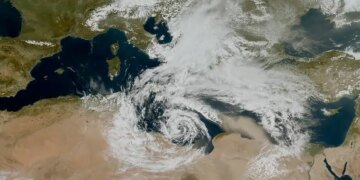
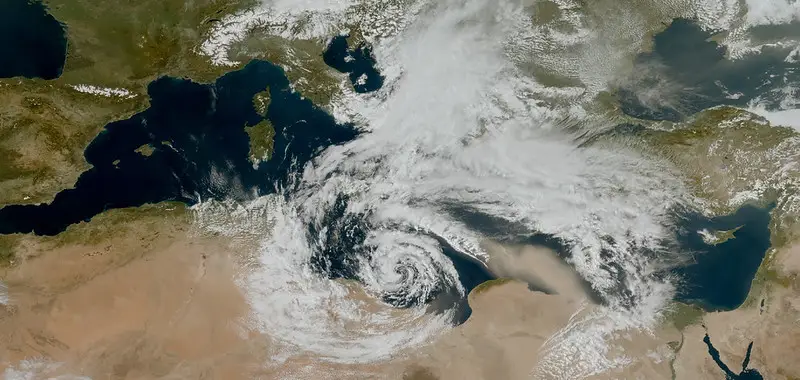
But emergent properties become far more perilous when the players are natural forces. Take for example three “cards” like carbon dioxide (CO₂), heat, and water vapor strategically layering together like our wild cards did above. These “cards” don’t follow a rulebook but instead follow simple physics. CO₂ plays “trap heat,” heat plays “evaporate water,” and water vapor plays “condense into more extreme rainfall.” When played in sequence, we see dangerous climate behaviors like that in Pakistan several years ago.
Over the past 50 years especially, CO₂ concentrations have steadily trapped more heat and loaded up the atmosphere with water vapor; when monsoon winds push this supercharged moisture into the Himalayan massif, as happened in late 2022, rapid cooling condensed the vapor into extreme rainfall episodes. Resulting flooding downstream covered one-third of Pakistan, killing 1,700 people and causing $30 billion dollars-worth of damage. This otherwise simplified example is further intensified by the fact that there weren’t just three cards; hundreds of cards representing various conditions pulled from across multiple natural systems – topography, gravity, velocity, mass and volume came together to not just produce rain (as could happen any regular day with this hand of cards), but an unexpected disastrous flooding event (as happened because these cards were played in perfect time and sequence).
And that’s just one round in the game. The larger the system in which we find ourselves, the greater the complexity, and thus the more opportunities for complex dynamics between components to translate into multiple, and often cascading, risks. On a global scale, the “players” now include entire economic, political, social and environmental systems.
What makes complex emergent outcomes fascinating (and dangerous) is their unpredictability within a disordered system, especially one with many smaller, nested systems. In Uno, a single “Yellow 7” can trigger more than thirty possible responses, with each new card played spawning even more new branches of possibility. In natural systems, a single degree rise in ocean temperature can trigger stronger winds and/or heavier moisture and/or shifting rainfall patterns, each spawning complex pathways of possibility across multiple scales and geographies – something akin to the “butterfly effect.”
To counterbalance the emergent properties of climate risk, we need to create emergent properties for climate solutions. This requires creating the conditions for the components of a system to multiply (often exponentially) in the way climate risks do.
For example, we may have the goal of stabilizing water systems. To play this game well, we could play a card like “climate-smart irrigation” which improves water reliability; the “reliable water” card can then lay down the increase farmer income effect; and the “higher income” card can galvanize wider adoption. Interacting local changes produce basin-wide water security that no single organization or intervention could design on its own. As these cards are played again and again by communities, ecosystems, and markets, they begin to reinforce one another. Over time, we better understand our deck and the best possible sequences, and so can create strategies that will expand good progress rapidly. This will only come through multilateralism across peoples, governments, companies, institutions and markets.
Consider how the Montreal Protocol eliminated ozone-depleting substances. The diplomatic efforts did not create one big solution, rather it focused on strategic coordination across systems. Economic incentives aligned with political agreements, enabling technological innovation which then made social adoption easier and reinforced political support. The interactions between components created an emergent solution more powerful than any individual policy could achieve – and the strategy trumped the physics as the Ozone Hole slowly began shrinking.
Up until now, climate change has been dominating the game. Every time we drive, fly, or flip a switch, we are unwitting teammates feeding a system already accelerating against us. And if nothing changes, the chain reactions will only intensify with harsher storms, decimated harvests, declining health and other painful costs. Communities will be pushed past their limits of resilience.
The greatest advantage humans have is the ability to coordinate. The peoples’ team now must focus on the deck at our disposal and how to use our cards strategically and in an effective sequence. The climate crisis is likely just one or two moves from winning the game. But in Uno, that is exactly when the underdog can pull its best move.

The world's longest commercial long-haul flight has been announced, a non-stop trek from Sydney to London that can take up...

Hong Kong residents living in the villages of Ho Sheung Heung and Yin Kong in Sheung Shui will be allowed...
Protecting consumers from excessive prices is legitimate, but appointing receivers to oversee producers undermines the legal system, warns Sözcü: “If...
International Yoga Day 2026 LIVE Updates: The theme for this year, "Yoga for Healthy Ageing," underscores its importance in promoting...

Discover Global News Panorama at news.mapworldnow.com — your universal gateway to comprehensive, international journalism. From politics and technology to culture and sports, we cover all news niches and all news categories from every corner of the world, all in one place.