- Latest
- Trending

Each week, Food Tank is rounding up a few news stories that inspire excitement, infuriation, or curiosity.
U.S. States Move To Ban Food Dyes and Additives
The USDA’s new public tracking system was updated this month to show the progress food companies are making to remove petroleum-based synthetic dyes from their products.
This federal push encourages companies to act before states implement their own restrictions but, over the past few days, several states have advanced major food safety measures to limit or ban certain food dyes and chemical additives.
In Iowa, Governor Kim Reynolds signed a sweeping health bill that bans certain artificial food dyes and additives from school meals and expands ingredient-related health regulations.
The legislation prohibits six food dyes and two additives from foods and drinks served in many K-12 schools across the state. The law is being described as one of the most prominent state-level food and health measures in the country.
Meanwhile, lawmakers in New York have advanced the “Food Safety and Chemical Disclosure Act,” which would ban additives in foods sold in the state.
Potassium bromate, one of the additives targeted in the New York bill, is commonly used to strengthen dough and improve texture in some iconic New York foods like pizza and bagels.
According to a report from The New York Times, some bakers have pushed back against the proposal, arguing the additive helps preserve the texture and consistency of traditional recipes.
However, many bakeries have taken the bill in stride and are now adjusting their family recipes to ensure a safer slice for New Yorkers.
Thailand’s THAIFEX Expo Highlights the Global Shift Away From Ultra-Processed Foods
As legislation moves forward in U.S. states, food leaders are gathering in Bangkok this week to discuss the next generation of cleaner, more sustainable foods at Thailand’s THAIFEX expo.
THAIFEX is one of Asia’s largest food and beverage trade shows and is being promoted by the Thai government as part of its strategy to position Thailand as a global food hub.
One of the primary focuses of this year’s expo is the future of alternative proteins, especially plant-based products.
Industry leaders at the expo are emphasizing a shift toward plant-based foods that are more affordable, more flavorful, and more nutritious than earlier generations of meat substitutes.
Fermentation technology is also a major theme at the conference this year, as companies look for new ways to create proteins and ingredients with fewer additives and less industrial processing.
The event reflects a broader global push to adapt food production as governments, startups, and major food manufacturers respond to concerns about climate impact, supply chain resilience, and long-term food security.
U.S.-Mexico Trade Disputes Continue to Drive Up Tomato Prices
In the U.S., trade disputes with Mexico over tomatoes are beginning to hit consumers. More than 70% of the fresh tomatoes consumed in the U.S. are imported from Mexico, making American grocery prices especially vulnerable to supply disruptions and tariffs.
Last year, Food Tank reported on the U.S.’s termination of the “Tomato Suspension Agreement.” Now, the U.S. is enforcing a 17% tariff on many fresh tomatoes imported from Mexico and American consumers are feeling the effects of rising costs.
Tomato prices recently reached an eight-year high, 23% above last year’s prices.
Supporters of the tariffs, including many Florida tomato growers, argue that Mexican producers have long sold tomatoes below fair market value, undermining domestic farmers. But industry experts warn that U.S. producers are unlikely to replace Mexico’s supply quickly enough to stabilize prices.
The situation has been further complicated by winter freezes and crop diseases across North America this year which significantly reduced tomato production on both sides of the border.
Food policy experts say the dispute underscores broader challenges facing the global food system, including climate-related production risks, water scarcity, supply chain vulnerability, and growing concerns about long-term food security and regional resilience.
Federal Decision Could Remove Bison From Public Lands
Concerns about regional resilience are also surfacing in the American West this week, where a federal decision threatening bison herds has sparked backlash from tribal nations and conservation advocates.
The recent federal decision could remove bison from public land in Montana, potentially displacing nearly 1,000 animals.
The decision centers on grazing permits administered by the Bureau of Land Management (BLM), where officials have argued that bison are not a “productive” livestock species like cattle.
Bison help shape grassland ecosystems, support biodiversity, and maintain prairie health. They also hold deep cultural and economic importance for many Native American tribes.
In the late 1800s, federal eradication campaigns devastated the North American bison population from tens of millions to only a few hundred surviving bison.
Tribal nations and conservation groups have spent decades rebuilding herds and restoring the species to parts of its historic range.
The Coalition of Large Tribes joined protests to oppose the bison removal as a threat to tribal food sovereignty, cultural traditions, and ongoing conservation efforts. They argue the federal decision may mark worse to come for bison herds across the country.
The Hajj Brings People—and Culinary Traditions—Together
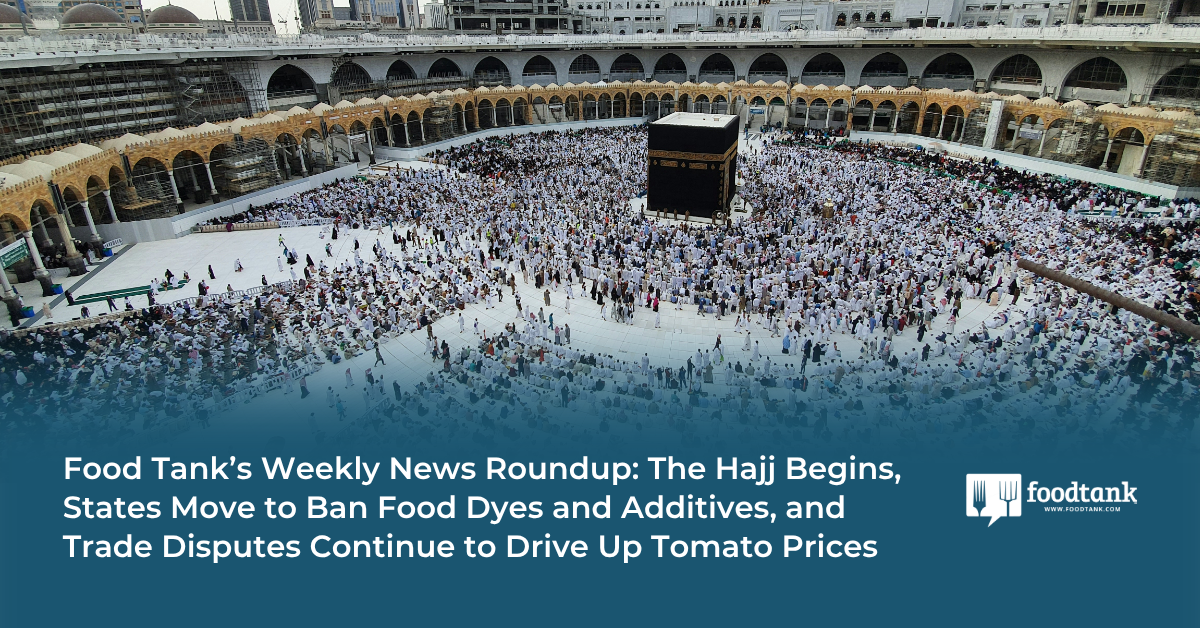
This week also marks the beginning of the annual Hajj pilgrimage to Mecca, one of the largest religious gatherings in the world. Millions of Muslims are traveling from across the globe to Saudi Arabia, bringing with them important food traditions, ingredients, and cooking styles from their communities.
Pilgrims this week will share foods including Indonesian rice dishes, Nigerian stews, South Asian biryanis, North African couscous, Turkish desserts, and so many more regional specialties.
Food safety, refrigeration, sanitation, and supply logistics become especially critical during the pilgrimage because of the scale of the gathering and the intense summer temperatures in Saudi Arabia.
This week, thousands of farmers, workers, volunteers, and aid organizations will work to get meals safely to millions of people participating in the Hajj.
At a time of such global division, the Hajj is a reminder that food remains one of the most powerful ways people connect across borders, languages, and traditions.
Articles like the one you just read are made possible through the generosity of Food Tank members. Can we please count on you to be part of our growing movement? Become a member today by clicking here.
Photo courtesy of Omer F. Arslan, Unsplash

Exploring Global Cuisine: 7 Must-Try Exotic Dishes Food: A Trip Through Culinary Delight Food, commonly referred to in scientific terms...

Mastering Video Games: Top 10 Strategies for Success The immense world of gaming has evolved into an intricate universe that...
Revolutionizing Profit: 10 Key Strategies in Business & Economy Business and Economy in a Global Context Today, the world is...
5 Essential Tips for Effortless World Travel The Value of Travel Travel is a transformative experience that evolves us from...
Discover Global News Panorama at news.mapworldnow.com — your universal gateway to comprehensive, international journalism. From politics and technology to culture and sports, we cover all news niches and all news categories from every corner of the world, all in one place.