- Latest
- Trending

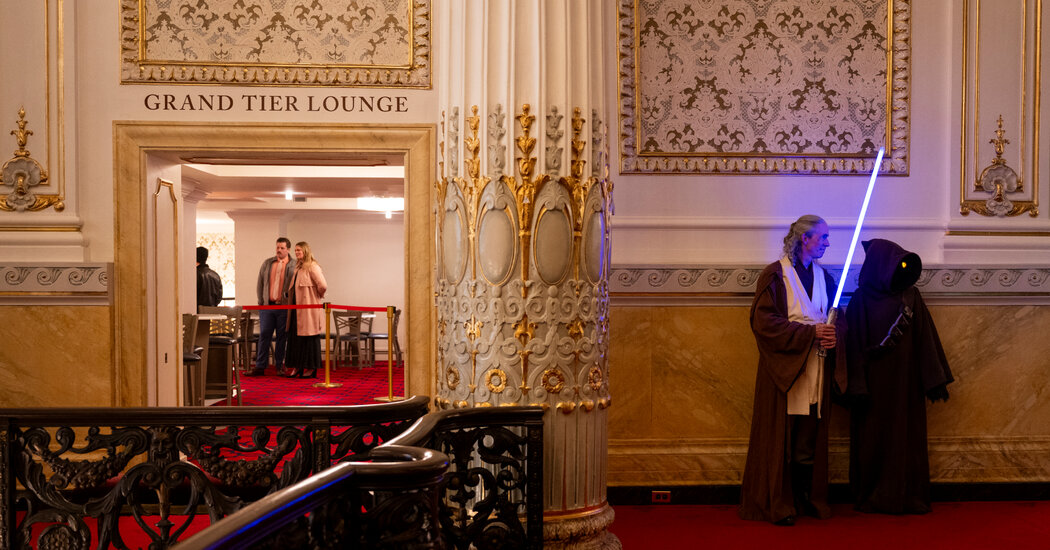
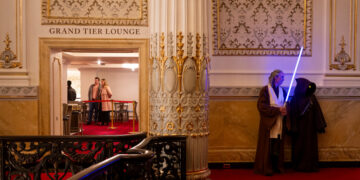
This summer, plenty of familiar scores will be heard at the biggest orchestras in the country. Of course, there will be symphonies by Mozart and Mahler. But even more famous, perhaps, will be the soundtracks for “Harry Potter” and “Star Wars.”
What used to be a novelty has now become a core staple of symphonic programming in the United States: live soundtracks, performances in which an orchestra plays while a movie screens overhead. As the classical music industry grapples with declining cultural relevance and mounting financial challenges, an evening of “How to Train Your Dragon” is no longer inconceivable.
Orchestra administrators say the programming shift attracts audiences that might not otherwise come to a typical concert. And because of technological advances, there are more films available for programming than ever. Melia Tourangeau, the president and chief executive of the Pittsburgh Symphony Orchestra, said in an interview that live soundtrack shows are the ensemble’s “fastest-growing product line.”
Still, there have been grumbles about the artistic merit of these concerts.
“Trying to get people to go to the symphony by presenting something that’s more familiar is not necessarily a bad thing,” Evan Shinners, a musician and the host of the podcast “W.T.F. Bach,” said in an interview. “It’s just not an effective thing.”
“Despite how lovely film music can be, it’s not classical music,” he added. “It just happens to be playable by the orchestra. What you do when you do present film music in an orchestra is, you reinforce people’s love for films. You don’t cause them to come back to want hear Beethoven.”
In the early 2010s, the Philadelphia Orchestra programmed one live soundtrack concert per season. In the last decade, it has typically done three. The Pittsburgh Symphony used to do three per season; now, it is doing five.
The Minnesota Orchestra is performing seven soundtracks next season, including “Harry Potter and the Prisoner of Azkaban” (by John Williams), Alfred Hitchcock’s “Vertigo” (by Bernard Herrmann) and “Home Alone” (also by Williams). That is almost double the number a decade ago. On average, 36 percent of film concert attendees are taking in a symphony concert for the first time, the orchestra said.
“The bottom line is that it’s an income generator, and it also brings in new audiences into the concert hall, which orchestras are always trying to accomplish,” said Sarah Hicks, the principal conductor of the Minnesota Orchestra’s Live at Orchestra Hall, a series focused on popular music that includes film concerts. The ensemble has found that 38 percent of those who attend the live soundtrack performances purchase ticket packages that include at least two other programs.
Performances like this have been around for decades, though it used to be much harder to strip the music out of films. Sergei Eisenstein’s battle film “Alexander Nevsky,” scored by Sergei Prokofiev, was performed by the National Symphony Orchestra in 1989 at Wolf Trap in Virginia. The next year, the ensemble accompanied another Eisenstein-Prokofiev film, “Ivan the Terrible.” Around that time, some orchestras presented “Bugs Bunny on Broadway,” a concert musical starring the famed cartoon rabbit.
There is also a long tradition of classical composers, like Prokofiev, writing film scores: Erich Wolfgang Korngold, the Viennese prodigy who penned many hit operas before fleeing Nazi rule and hitting it big in Hollywood, or Franz Waxman, the German composer who won two Oscars in the 1950s for “Sunset Boulevard” and “A Place in the Sun.” And film music has made its way into the concert hall; Prokofiev reworked “Nevsky” as a cantata, and Williams has regularly conducted suites based on his soundtracks.
In some ways, film scores can be more challenging than traditional symphonic works. Musicians typically have familiarity with the classics, having played them for many years, as opposed to the underscoring for the snowball fight in “Elf.”
During performances, orchestra musicians often wear ear pieces to monitor a click track, since the score needs to match the film exactly. (For older movies, there was an analog clock to synchronize the music.) There is “no margin for error,” said Bill Buchman, a bassoonist with the Chicago Symphony Orchestra, which 20 years ago performed music for Charlie Chaplin’s “City Lights” and some film excerpts but has programmed four full-length movies this season. And the scores can be technically difficult, too, while requiring a different sort of endurance; soundtracks aren’t recorded all at once, but in snippets.
“The vast majority of them were not intended to be performed live along with a screening of the movie,” Buchman said. “They were written to be recorded on a soundstage, and you had a chance to go back and do retakes of things that didn’t quite go right. Or they even had a chance in the editing room to slow things down, speed things up or cut things in order to make it fit with what they needed for the movie.”
Take Williams’s soundtracks for the “Star Wars” movies, “Jurassic Park” and many others. His compositions are filled with mixed meters, meaning the beat patterns change from measure to measure. In the back half of “Return of the Jedi,” there is nearly an hour of nonstop, fast-paced music without any break — an experience Jacob Joyce, an associate conductor with the Pittsburgh Symphony, called “the biggest roller coaster at the amusement park.”
“I remember preparing endlessly and being quite nervous for my first performance of this movie,” he said, “because you’re looking at this 50-minute stretch thinking, ‘OK, I have no room for error whatsoever.’”
In a situation like that, there is also a higher probability of technical issues. “I’ve had people kick a wire, and my monitor goes out in the midst of the most thrilling scene in ‘Harry Potter,’” Hicks, the Minnesota Orchestra conductor, said.
Within the past couple of decades, multitrack recording has made it easier to strip the music out of films; some companies, like Disney, started making movies more widely available for orchestras to perform. Concerts based on video game soundtracks, like the Final Fantasy series, have also emerged. As screens have become woven into nearly every aspect of life, orchestras have taken advantage.
“For audiences, it is a kind of wonderful synthesis of sensory inputs,” said Arvind Manocha, the president of Wolf Trap. “It’s kind of like when people go to the opera or musical theater. It is the visual and the aural coming together.”
Wolf Trap presents the National Symphony during the summer and has added more live soundtracks to its programming in recent years. The orchestra, housed at the Kennedy Center for the Performing Arts in Washington, has been in turmoil because of the center’s upheavals and uncertain future. But in Virginia this summer, it will be performing along to “Return of the Jedi,” “The Little Mermaid,” “Hook” and “Harry Potter and the Sorcerer’s Stone.”
Although live soundtrack performances bring in much-needed revenue for orchestras across the country, some, particularly the musicians, question whether the concerts devalue their art form.
“I’ll be perfectly honest,” said Ryan Fleur, the president and chief executive of the Philadelphia Orchestra. “We have some musicians that feel very strongly that this wasn’t the reason that they went to conservatory.”
Jim Nova, a trombonist with the Pittsburgh Symphony, said of film scores, “I don’t think anyone is as enthusiastic as I am. I mean, I love this music.”
“I have friends who live in Los Angeles who have played on a lot of film scores, and they say that film scoring is like 95 percent boredom and 5 percent terror,” Nova said. “You’ll be plugging along playing something, and it’s not really that hard, and then you turn the page and there’s something that’s basically almost unplayable.”
Hicks said that there used to be a “certain resistance” to performing live soundtracks because the musicians weren’t trained for them.
“There was some sort of attitude,” she said, “that soundtracks and score music was somehow lesser and orchestras still do have this curatorial responsibility to perform the great works of art.”
Some of the difference in opinion is generational. Younger musicians have grown up with these concerts and expect to perform them. “Half the brass players probably in the world would credit their desire to play trumpet, trombone and French horn to the ‘Star Wars’ soundtrack,” said Ben Dettelback, a 28-year-old trombonist in the Syracuse Orchestra. “You just listen to any John Williams. That’s real music.”
If there is any — to use “Star Wars” parlance — rebellion against film scores brewing among musicians, it may be futile. Live soundtrack concerts are reliable sellers, and there is now an industry that facilitates these shows by securing rights, creating orchestrations and printing sheet music.
Film performances, Hicks said, are going to “become an expected part of an orchestra’s offerings, rather than being viewed as a special or outlying concert event.”
In one sign of that future, excerpts from “The Imperial March” (Darth Vader’s theme in “Star Wars”) and selections from “Harry Potter” are beginning to pop up in some orchestra auditions. The reason, Nova said, is “because you’re much more likely to play those things nowadays in various concerts than you are to play some of the really heavy classical pieces.”

Brittany Barreto, Ph.D., is a podcaster, an entrepreneur, and a molecular and human geneticist. (In other words, she’s really smart.)...

A spyware firm has been targeting WhatsApp users with malicious links in contravention of a US court order forbidding it...
In November, a little-known American tech company announced a $115 million agreement to buy a little-known Dutch tech company.Deals like...
Discover Global News Panorama at news.mapworldnow.com — your universal gateway to comprehensive, international journalism. From politics and technology to culture and sports, we cover all news niches and all news categories from every corner of the world, all in one place.