- Latest
- Trending

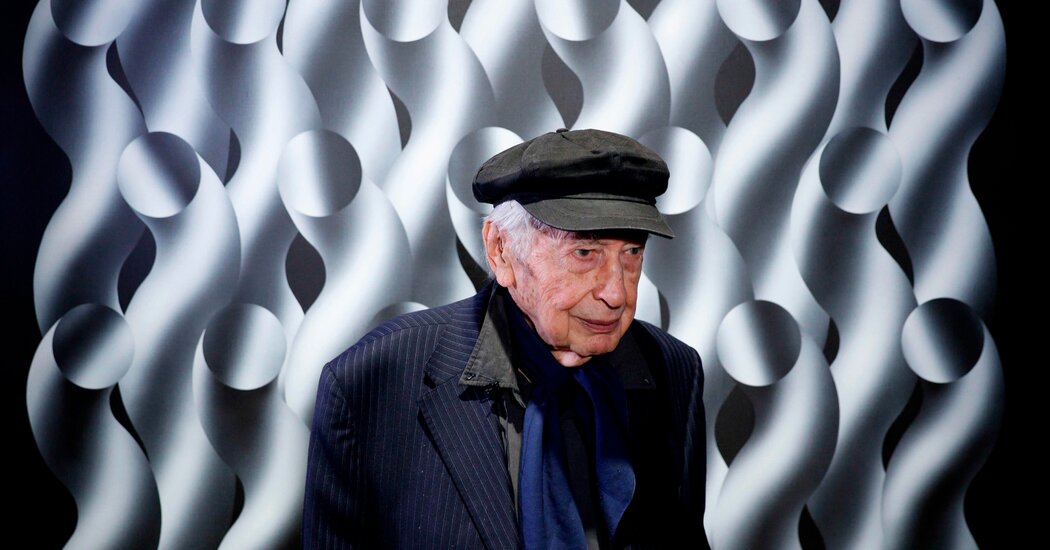
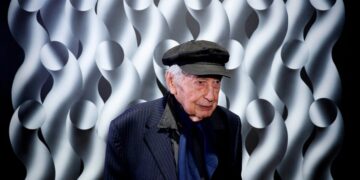
Julio Le Parc, an Argentine artist who over a 70-year career pioneered a form of socially conscious, audience-friendly sculpture and vibrantly colorful, politically engaged painting, died on May 30 in Cachan, France, a suburb of Paris where he had lived since the early 1970s. He was 97.
His son Yamil confirmed the death to La Nación, an Argentine newspaper.
Mr. Le Parc was among the leading Latin American artists who in the early 1960s embraced European and American movements that followed Abstract Expressionism. He focused on kinetic sculpture — sculpture that moves — and the geometric optical illusions of Op Art, infusing them with regional influences and often overtly political content.
He made working-class art for working-class people, using simple materials like plexiglass shards and nylon string. “The results are subtly ingenious,” the New York Times critic Holland Cotter wrote in 2019.
There was often a fun-house quality to his work, especially when it appeared grouped together in an exhibition. Mirrors reflected, motors whirred and mobiles twirled; one piece, “3 Games with Ping-Pong Balls” (1965), encouraged viewers to press a button that would toss up a pair of balls.
His work ranged from simple mobiles and illusions to elaborate contraptions involving buttons, electronics and motors.
“The real goal was to relate to the common person, because there was a big separation between them and art in galleries,” he told The Sun Sentinel of South Florida in 2016, when he had his first major solo show in the United States at the Pérez Art Museum in Miami. “The greatest prize is if a person walking into this exhibition had a little bit of optimism, and by the time they left, they had much more optimism.”
Some of his art was explicitly political: “Knock Down the Myths” (1969) is a booth in which viewers could throw balls at images of riot police and politicians.
Critics considered his work, while distinctive in its own right, something of a cross between the interactive whimsy of Red Grooms, the abstraction of Alexander Calder and the political engagement of Diego Rivera.
“It is a game,” he told The Financial Times in 2015, on the occasion of a show at the Serpentine in London. “The humor is important to break with the position of authority.”
After moving to Paris from Buenos Aires on a scholarship in 1958, he fell in with a group of like-minded French artists and Latin American expatriates. They formed the Groupe de Recherche d’Art Visuel, or GRAV — a play on the French word for “serious.”
The members rejected what they considered the cult of the individual artist and the divide between creator and viewer. They said their work was less about achieving a final product than it was about researching techniques and forms of engagement.
Despite their insistence on collectivity — they refused to sign their names to their work — Mr. Le Parc became the best-known of them after winning the top prize in painting at the 1966 Venice Biennale.
Critics praised him for creating art that was attuned to consumerist society and the budding high-tech world, as figures like Piet Mondrian had addressed industrialization in the early 20th century.
“As Mondrian had integrated the intuition of the industrial world into the rectitude of his squares of primary colors,” a critic for Le Monde wrote in 1966, “Julio Le Parc, who has taken over from the Dutch master, seems to be the artist of the computer era, with his numbered series and sequences of continuous progression.”
During the student protests of May 1968 in France, Mr. Le Parc led a group of artists in taking over a car plant. He was arrested and expelled to West Germany, and was only allowed back into France after the move was protested by Jean-Paul Sartre and Simone de Beauvoir.
Mr. Le Parc maintained a tense relationship with the European art world. After the Museum of Modern Art in Paris announced a major solo show of his work in 1972, he said he would decide whether to proceed by letting Yamil, then 5 years old, flip a coin. Heads, and he would go ahead with the exhibition; tails, he would cancel. It landed on tails. He canceled.
Though he never stopped making art, it was only around the early 2000s that the museum and gallery establishment began to embrace him again. Following large retrospectives in France, he was the subject of major shows in Argentina, Britain and the United States.
He remained conflicted about his late-in-life star status. In 2015, he allowed the luxury brand Hermès to create a limited-edition series of scarves based on his work, but he also criticized the way in which art had become captured by capitalism.
“The context of art has changed,” he told The Financial Times in 2015. “Art used to have to fulfill a different role. Now its value is seen in terms of the market. We should be considering other forms of value.”
Julio Le Parc was born on Sept. 23, 1928, in Palmira, a suburb of the western Argentine city of Mendoza. His parents were of modest means — his father was a railroad engineer, his mother a part-time seamstress — and their first home had no running water.
His earliest memories included the play of light cast by passing clouds against the vertiginous Andes mountain range, just west of the city.
After his parents separated, he moved with his mother and brothers to Buenos Aires. Encouraged by an art teacher, he began to study for admission to the School of Fine Arts while working in a leather-goods factory.
He left school in 1946 to travel the country and work, a period in which he developed a devotion to organized labor. He returned to his studies in 1955 and participated in demonstrations that led up to the overthrow of the dictator Juan Perón.
He and his wife, Martha, another Argentine artist, married in 1958. They later separated but remained close, and he was with her when she died last year. Along with their son, his survivors include two other sons from the marriage, Juan and Gabriel, and five grandchildren.
Mr. Le Parc continues to be revisited by major museums: An exhibition of his work in different mediums is opening at Tate Modern in London this month. Some viewers have engaged with him primarily as a painter; others, as a sculptor. To him, the difference was immaterial.
“Categories, in general, are reductive,” he told Wallpaper magazine in 2020. “I would prefer to be classified as an experimentalist.”


The Democratic Alliance (DA) conducted oversight at Alexandra Magistrates Court today, to see whether the situation has improved since our...
Hong Kong has taken a monumental step forward in expanding its global economic footprint. Last week, Chief Executive John Lee...
The San Antonio Spurs ruined the party at Madison Square Garden as they defeated the New York Knicks 115-111 in...
Discover Global News Panorama at news.mapworldnow.com — your universal gateway to comprehensive, international journalism. From politics and technology to culture and sports, we cover all news niches and all news categories from every corner of the world, all in one place.