- Latest
- Trending

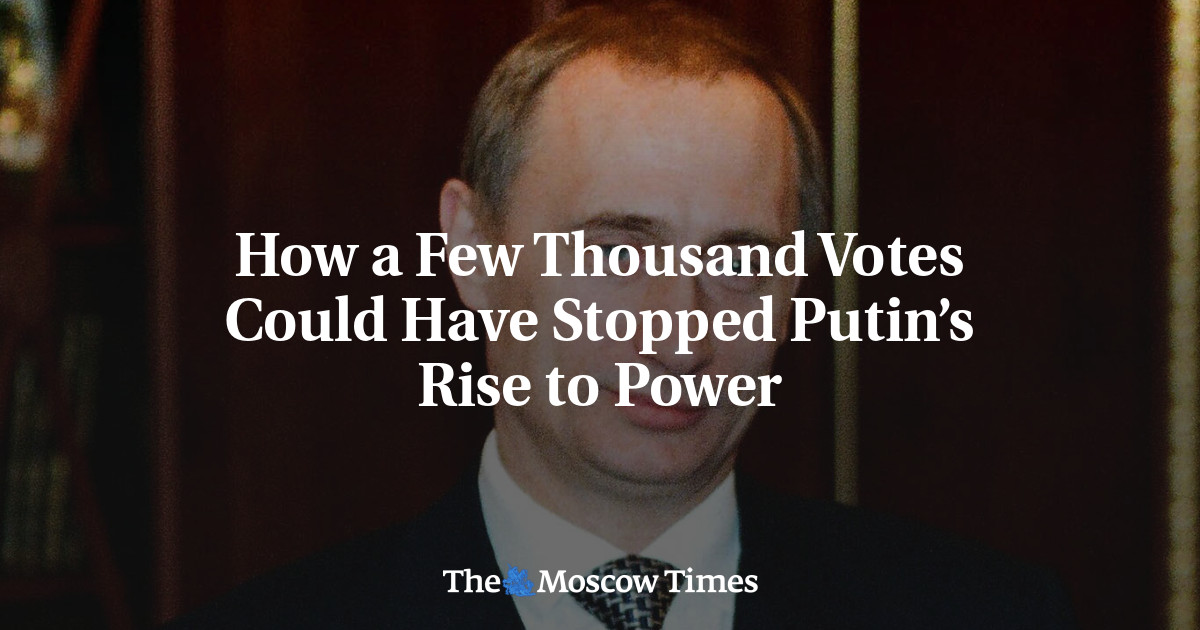
The history of Russia, and of humanity, was set on its current course 30 years ago, when then-St. Petersburg Mayor Anatoly Sobchak’s unexpected narrow electoral defeat propelled Vladimir Putin to Moscow.
Sobchak’s defeat was not a given. Anyone can easily find online, according to their taste, a suitable version of the story of the passions surrounding those fateful two-round elections in May and June 1996.
At the start of 1996, Sobchak, St. Petersburg’s first democratically elected mayor, did not realize how unpopular he had become and was certain that victory in the upcoming election was his by right.
But some of his subordinates were not so sure. One of his three first deputies, Vladimir Yakovlev, was already busy thinking about his own future in the Kremlin and had taken to flirting with Sobchak’s critics by decrying the state of the city. Another first deputy, Alexei Kudrin, saw this as a personal attack and, as it appeared to journalists at the time, was confused about what to do next. And then there was Putin, who avoided publicity as he had always done and appeared to act as though the election was none of his concern.
The 1996 mayoral vote was not Putin’s first encounter with electoral defeat. The previous year, as the regional boss of Prime Minister Viktor Chernomyrdin’s Our Home — Russia party, he nominally led the party’s State Duma campaign in St. Petersburg. There, the party won 13% of the vote — less than in Moscow, but a nationwide failure by any measure. Judging by all appearances, Putin treated that first electoral setback as a formality that had no bearing on his political future. He made no effort to actually campaign, instead hiring others who could do his job for him and ultimately take responsibility.
At first, he also did not see the gubernatorial election as something that could end his career. He began to share the fear of his more sensitive colleague Kudrin only later, when
It is often said that Putin served as the head of Sobchak’s campaign headquarters. That is not true. In those days, there were usually several headquarters, an amateurish arrangement that guaranteed chaos.
The details of the main HQ were never made public. It either didn’t exist, or it consisted of obvious crooks. Kudrin assembled some shifting groups; Lyudmila Narusova, Sobchak’s wife, assembled others.
Putin was similarly involved, but played no visible role. Indeed, it appears that he was in a panic. In his impressionable soul, all this commotion was imprinted as the final image of democracy: something ungovernable, unpredictable and humiliating for those in positions of authority.
Was Sobchak’s defeat inevitable? Not at all. Apart from the organizational weakness and electoral incompetence of Sobchak’s team, it simply had bad luck.
First, Sobchak, usually a renowned orator, unexpectedly lost the televised debate. He underestimated the supposedly dim-witted Yakovlev, who in fact was a talented performer and polemicist. Putin’s hatred of debates stems from this experience, which of course shook him.
Then, on the day of the runoff, Sobchak’s people received another surprise — the weather. A poll conducted the day before showed that the higher the turnout, the better Sobchak’s chances. But the weather on election day was beautiful and the public rushed out of town, resulting in 190,000 fewer voters coming to the polling stations than in the first round.
In the end, Yakovlev beat Sobchak by 28,000 votes and won by 47.5% to 45.8%. As the votes were being counted that evening, a deathly pale Putin wandered silently through the Mariinsky Palace. History had been made.
In Putin’s eyes, the defeat had not been inflicted on him as he’d kept out of the struggle. But everything he had achieved by that time rested on Sobchak’s victory. Had Sobchak won, he would have kept Putin as the chief among his first deputies and therefore as a candidate to succeed him.
There is nothing to prevent us from assuming that, in time, Putin would have been elected governor of St. Petersburg in roughly the same way and with the same aura of popularity with which he was elected president of Russia in 2000 and 2004.
But history chose another route for him. Let psychoanalysts judge the impact of the 1996 defeat on the inner world of Russia’s future leader.
The first success of Putin’s Moscow career was a byproduct of the elite infighting there, in which, only a couple of weeks after the St. Petersburg election, Anatoly Chubais’ reformist, technocratic clan prevailed over a loyal faction led by Alexander Korzhakov.
After Yeltsin won the 1996 presidential election despite the Xerox Affair having exposed his corruption a few weeks earlier, the technocrats gained decisive power, allowing them to shape the country’s leadership. Chubais himself became head of the presidential administration in mid-July 1996, becoming the second-most important man in the country
Crucially, Chubais’ circle was filled with St. Petersburgers who favored their own. Putin had connections to Korzhakov as well. Chubais was not fond of Putin. But it was most likely Kudrin, who had just moved to Moscow, who helped Putin get a job in the presidential property management department in August 1996.
Later, when he moved to the Finance Ministry in March 1997, Kudrin moved Putin into his old position as head of the agency in charge of overseeing and auditing the presidential administration. It was in this role that Putin first became an important player in Russian elite intrigues. Unlike his previous posts, this position really could serve as a launchpad toward the top of the power vertical.
Putin only became a contender to succeed Yeltsin in 1998, when the Chubais clan and the patronage network it had built two years earlier collapsed. Like the fall of the Sobchak regime, that failure was not inevitable. But the alumni of the security services emerged as the people best placed to build a new autocracy.
Putin showed that he had learned the lesson of his earlier St. Petersburg failure. He then managed to distance himself in time from his disgraced Chubaisite friends. The time had come for people like him, and he sensed it.
As a man of the security services who was also loyal to Yeltsin, Putin turned out to be the right man in the right place. Within just a year and a half, he climbed four or five rungs of office until on Dec. 31, 1999, he was Russia’s acting president.
If the stars had aligned a little differently, Putin may not have had to look beyond St. Petersburg. If he had never started climbing the ladder of power, perhaps another man from the security services would have become Russia’s ruler by the dawn of the 21st century.
Whatever his surname might have been — Primakov, Stepashin, anyone — his political baggage would not have differed much from Putin’s. Russia would still have spent the late 1990s and beyond sliding into a long-lasting dictatorship.
But I am not sure that, 30 years later, that dictatorship would be waging a full-scale war on Ukraine. Not every autocrat is capable of going that far. Only someone with Putin’s experience and temperament is.
The views expressed in opinion pieces do not necessarily reflect the position of The Moscow Times.
A Message from The Moscow Times:
Dear readers,
We are facing unprecedented challenges. Russia’s Prosecutor General’s Office has designated The Moscow Times as an “undesirable” organization, criminalizing our work and putting our staff at risk of prosecution. This follows our earlier unjust labeling as a “foreign agent.”
These actions are direct attempts to silence independent journalism in Russia. The authorities claim our work “discredits the decisions of the Russian leadership.” We see things differently: we strive to provide accurate, unbiased reporting on Russia.
We, the journalists of The Moscow Times, refuse to be silenced. But to continue our work, we need your help.
Your support, no matter how small, makes a world of difference. If you can, please support us monthly starting from just $2. It’s quick to set up, and every contribution makes a significant impact.
By supporting The Moscow Times, you’re defending open, independent journalism in the face of repression. Thank you for standing with us.
Continue

Not ready to support today?
Remind me later.
×
Thank you! Your reminder is set.

Brittany Barreto, Ph.D., is a podcaster, an entrepreneur, and a molecular and human geneticist. (In other words, she’s really smart.)...

A spyware firm has been targeting WhatsApp users with malicious links in contravention of a US court order forbidding it...
In November, a little-known American tech company announced a $115 million agreement to buy a little-known Dutch tech company.Deals like...
Discover Global News Panorama at news.mapworldnow.com — your universal gateway to comprehensive, international journalism. From politics and technology to culture and sports, we cover all news niches and all news categories from every corner of the world, all in one place.