- Latest
- Trending
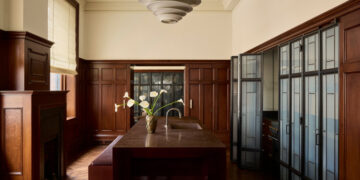


Earlier this year, the interior designer and influencer Athena Calderone debuted her new home, a TriBeCa apartment she had meticulously designed. Previously, Ms. Calderone lived in a Brooklyn brownstone and her kitchen, with its marble countertops and navy Shaker cabinets, became a blueprint for fellow designers and renovators. So when she revealed her latest kitchen, it came as a shock — it was less a kitchen and more of a room, featuring a central, unadorned island, with the cooking range contained in a recessed niche that could be hidden behind folding opaque glass doors. Ms. Calderone said that her design “blur[s] the lines between what is a kitchen and what is just a beautiful space for entertaining.”
In the country’s wealthiest enclaves, like New York City and Miami, concealment has become the defining aspect of the contemporary kitchen. What began with “appliance garages” and refrigerators and dishwashers that look like cabinets has evolved into a far more ambitious practice of disguise, with custom millwork and technology obscuring everything from sinks and cooktops to electrical outlets and small appliances.
Sharon Dranko, the former chief executive of Isla Porter cabinetry and a consultant for kitchen brands including Nobilia, said the rise of open-plan living has helped fuel the trend. “Kitchens are more open and visible than they used to be, so people want all the capability without every appliance becoming part of the aesthetic.”
The result is often a space that feels largely neutral: a minimalist design of stone paired with frameless cabinetry that even eschews visible door hardware in favor of push-to-open mechanisms.
Nero Cucine, a New York-based company founded in 2015 that manufactures in Italy, has built its business around culinary concealment. Its “hyper kitchens” pair minimalist forms with elaborate engineering. Its most popular offering is a marble island with a mechanized sliding countertop that glides open to reveal a sink and induction cooktop. Other pieces include cabinetry with retractable panels that completely obscure shelving, storage or appliances.
“It’s not just about hiding the kitchen and making it look like furniture,” said Bartolomeo Bellati, Nero Cucine’s co-founder and president. “We’re taking it a step further, making it look sculptural, almost like a monolith within the space, so it becomes a piece of art.”
The company’s latest concept, the NU, developed in collaboration with the New York architecture and design firm Gabellini Sheppard, pushes concealment into a Kubrickian realm. The kitchen consists of two parts. The island portion features a sink and cooktop hidden by a retractable winged countertop that lifts and disappears into its body; the piece also incorporates A.I.-controlled lighting and voice activation. The refrigerator, oven and dishwasher are housed in a separate component: a massive box coated in metallic black lacquer. The effect may be slightly terrifying, but there’s a market for it.
The firm’s architect and interior designer Michael Gabellini attributes the growing demand for these features to clients’ desires for highly custom, high-performance homes, comparing many of his commissions to couture fashion.
He added that luxury hospitality has become an important influence on residential design. Clients encounter this kind of design in five-star hotels, he said, and want similar levels of functionality in their homes.
Of course, this level of design comes with added costs, which can reach hundreds of thousands, if not millions, of dollars.
Even seemingly simpler concealments add up quickly, said Ms. Dranko, referencing modifications like hidden paper towel holders, knife storage built into drawers, integrated trash and recycling, and charging drawers. “Storage inserts can easily drive 30 percent of the cost of a custom kitchen,” she said.
The irony, some designers say, is that the people commissioning these complicated kitchens may rarely cook in them.
“Unfortunately, a lot of my clients make me do incredible kitchens that they never use,” lamented Stefano Venier, the other co-founder and design director of Nero Cucine. He noted that many of these highly streamlined designs end up in second or third homes — getting used for mere weeks out of a year.
In some cases, the kitchen’s primary purpose is purely presentational. Mr. Gabellini said some of his clients build multiple kitchens on a single site, adding catering kitchens, warming kitchens and secondary prep spaces that handle much of the actual cooking. The main kitchen becomes a “show kitchen.”
But not every designer embracing concealment is interested in turning the kitchen into an ultramodern showboat.
Ms. Calderone, an avid cook, crafted her Tribeca kitchen for use. The folding doors “are always open for the most part,” she said. And while she appreciates the ability to hide away certain elements, she is skeptical of the hyper-minimalist aesthetic that often accompanies such features. “It feels too modern, it feels too try-hard,” she said. “I think I have an aversion to things that just feel too slick, too tricked out.”
Instead, designers of Ms. Calderone’s mind-set are increasingly incorporating concealment into kitchens in ways that feel more layered, decorative and even playful. The Los Angeles-based designer Jake Arnold recently finished a Beverly Hills guesthouse kitchen contained behind decorative mirrored paneling, complete with gas burners installed directly into a marble countertop.
Yasmine Ghoniem, director of the Australia-based YSG Studio, says her clients are “asking to conceal kitchen sinks, especially if they regularly entertain.” In one project, she created a partially hidden scullery behind the main kitchen.
In the same space, Ms. Ghoniem also disguised a refrigerator by repeating the wheat-colored micro-cement used on the walls and adding custom chrome-and-leather handles to mirror the rest of the kitchen’s design.
Plain English, a British cabinetry outfit with showrooms in New York and Los Angeles, offers a larder fridge integration, which reads more like an antique hutch than appliance container.
The question is whether these concealments will trickle down into mainstream kitchen design.
At the very least, there’s an appetite for appliances that don’t look like appliances. Take the popularity of the Rocco — a beverage fridge that looks more like a free standing cabinet — which has sold out multiple times. And in 2024, the architect and product designer Patricia Urquiola teamed up with Signature Kitchen Suite to design a series of refrigerators clad in concrete tiles, transforming them into sculptural furnishings.
As for the more high-tech integrations, Miele, the German appliance maker, partnered with Hettich, the furniture fittings manufacturer, to present a “concept in response to limited living space” at this year’s Milan Design Week. The setup featured a multifunctional unit with rotating appliances that disappear from view and a cooktop integrated directly into the countertop surface.
While the exhibition focused on solutions for apartment dwellers of middle class means, the design is aspirational, with no current plans for implementation.
For now, the fully concealed kitchen remains in the territory of the wealthy. Yet it raises a question about the future of kitchen design: One day, will our kitchens stop looking like, well, kitchens?

Bitcoin (BTC) starts the third week of June with a spring in its step as the US-Iran peace deal sends...

Bitbank, one of Japan’s largest cryptocurrency exchanges, warned users that transactions linked to prediction market platforms such as Polymarket could...
Table of Contents England’s Test captain and star all-rounder Ben Stokes is once again making headlines because of his off-field...
NEWYou can now listen to Fox News articles! Toronto Tempo forward Isabelle Harrison pulled out a move on Atlanta Dream...
Discover Global News Panorama at news.mapworldnow.com — your universal gateway to comprehensive, international journalism. From politics and technology to culture and sports, we cover all news niches and all news categories from every corner of the world, all in one place.