- Latest
- Trending

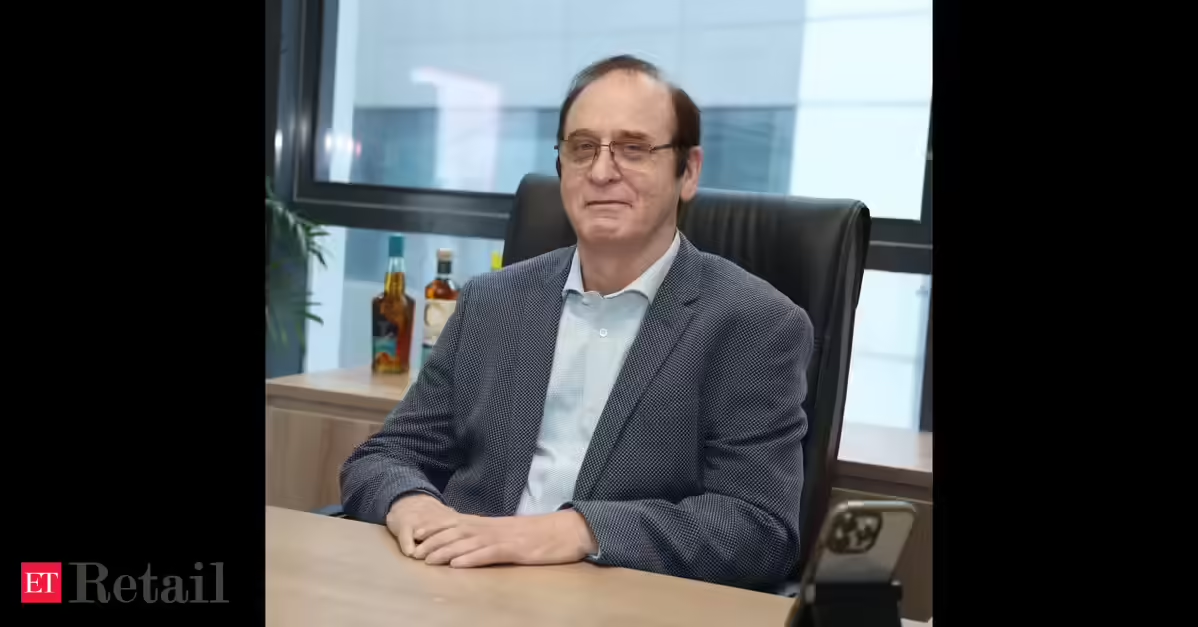

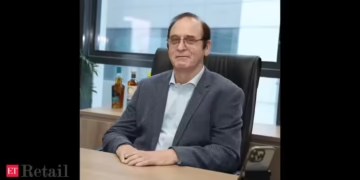
As Indian single malts continue to make strides, Alcobrew Distilleries India, a major Indian-made foreign liquor (IMFL) company, recently forayed into the luxury segment with the launch of the Gamber Valley brand. Gamber Valley is an Indian single malt whiskey range distilled, matured, and bottled at Alcobrew’s facility in Solan, Himachal Pradesh. In a freewheeling chat with The Economic Times Digital, Romesh Pandita, Chairman and Managing Director, Alcobrew Distilleries India, talks about the uniqueness behind Indian single malts, the challenges that beset the industry, and how India is ready to experience luxury in this segment. Edited excerpts:
The Economic Times (ET): Tell us the story behind Gamber Valley. What made you start an Indian single malt whisky brand?
Romesh Pandita (RP): The seeds of Gamber Valley were planted long before we announced it. When we set up our Solan facility in the Himachal highlands, we weren’t thinking about it as just another production unit. We were thinking about it as a long-term bet on geography. The altitude, the Himalayan air, and the temperature swings between day and night—these were not incidentals. We recognised very early that these conditions were extraordinary for maturation. But patience in this business is not optional; it is mandatory. You cannot rush a single malt. So, we waited, we observed, we refined—and what you see with Gamber Valley today is the result of years of quiet conviction. I have always believed that India has a story to tell in the world of spirits that is entirely its own. Not borrowed from Scotland, not imitative of Japan—distinctly Indian. Gamber Valley is that story, told through the language of the Himalayas.ET: What sets Indian single malts apart, and how do they stack up against their international counterparts, more specifically the renowned Scottish whiskies?
RP: With the deepest respect for Scotland—and Scotland deserves every ounce of it—the comparison is increasingly less relevant as a benchmark and more interesting as a contrast. Scottish whisky is defined by centuries of tradition, and that heritage is irreplaceable. But Indian single malts are defined by something equally powerful: geography with no historical precedent in the world of whisky.
When you mature spirits in the Scottish Highlands, you are working with a slow and gentle climate. In the Himalayas, you are working with a far more dynamic environment. The altitude creates unique barometric pressure conditions, the diurnal temperature variation is significant, and the interaction between cask and spirit is accelerated and intensified in ways that simply cannot be replicated elsewhere. The result is a flavour development that is genuinely its own—richer, often more textured, with complexity that builds differently. There is a natural orientation toward warmth, depth, and spice—and the best Indian single malts carry that instinctively. The world is noticing. In 2024, Indian single malts crossed 53% of total single malt case sales in India, surpassing imported Scotch in volume for the first time. That is not a statistical anomaly. That is a structural shift.
ET: What is the size of the Indian whisky market?
RP: India’s whisky market was valued at approximately Rs 1,61,000 crore in FY24, constituting roughly 70% of the country’s total IMFL market by value. Whisky is not just a category here; it is the backbone of the entire spirits industry. Within that, the single malts segment is projected to reach Rs 13,000 crore by FY30, expanding at a compound annual growth rate (CAGR) of around 20%. Globally, India is already the largest whisky-consuming nation by volume. We account for nearly half the world’s whisky consumption. Yet our share of the global premium and luxury single malt conversation has historically been disproportionately small relative to that consumption base. That gap is closing rapidly and therein lies the opportunity. Indian single malts are still a fraction of the global premium malt market, but the trajectory is unmistakable. The question is not whether India will matter globally in this segment—it already does.
ET: What is your FY27 revenue target for Alcobrew, and how much do you expect Gamber Valley to contribute to the company’s overall portfolio? What are your expectations for Gamber Valley in the first year?
RP: The number that genuinely reflects the health of our underlying business is revenue net of excise duty—and on that basis, the trajectory is clear: Rs 634.3 crore in FY23, Rs 779.9 crore in FY24, and Rs 787.4 crore in FY25. That is consistent, compounding growth—which tells you that we are not just moving volume, we are moving value.
Regarding Gamber Valley’s contribution, I want to be honest and measured here. This is a luxury, craft segment. We are not building a brand to generate a short-term revenue spike. We are building a brand to endure. In the first year, the focus is on establishing presence and building credibility in key markets like Haryana, Uttar Pradesh, Chandigarh, and Delhi, among others, and ensuring that the consumer who picks up a bottle of Gamber Valley for the first time becomes a lifetime advocate. The revenue will follow the brand-building. What I will say is this: a category growing at 20% annually, with price points between Rs 4,000 and Rs 16,000 a bottle, has significant revenue potential even at moderate volumes. We have entered this segment not to participate marginally—we have entered it to own it over time.
ET: Indian single malt producers, despite global acclaim and outselling international brands locally, face unique challenges like strict state regulations and shifting global tariffs. What is the way forward for the industry in such a scenario?
RP: The challenges are real and structural. But I would argue that every significant industry in India has been built despite regulatory complexity, not in the absence of it. The IMFL industry operates under the most fragmented regulatory framework imaginable—alcohol is a state subject, which means you are effectively running 28+ different businesses simultaneously. Distribution controls are tight. Advertising is severely restricted. These are not new problems—they are the terrain.
ET: How has the West Asia crisis impacted the overall whisky market, particularly in terms of ingredient sourcing, raw material costs, and supply chain operations? As a company, how did you navigate these challenges?
RP: The West Asia situation has created turbulence across supply chains—and the spirits industry has not been insulated from that. Ingredient sourcing, particularly for packaging materials, glass, and certain imported inputs, has seen both pricing pressure and availability challenges. Shipping routes and logistics costs have been impacted as well. Within our own operations, we have managed this by deepening our domestic sourcing relationships wherever possible and by forward planning our procurement cycles more rigorously than earlier. The Solan facility gives us a significant advantage here—our core raw materials for the single malt are sourced domestically, and our maturation is entirely on-site. The challenge has been more on cost management than on production continuity, and our team has handled that well. I am confident in our ability to navigate supply chain complexity—it is a capability we have built over two decades.
ET: You have largely operated in the mass-premium and prestige categories. What made you venture into the luxury segment with this launch? Do you think the price-sensitive Indian market is ready for such a splurge?
RP: Every business has a natural evolution if it is being run with vision rather than just with targets. We have built Alcobrew over 23 years into a company that understands the full spectrum of the Indian spirits consumer—from the person buying Golfer’s Shot 18 Hole Whisky to the person who now wants to spend upwards of Rs 4,000 on a bottle that tells a story. These are not disconnected consumers; they are often the same consumer at different moments in their life journey. The premiumisation of India is not a theory—it is what we see in our own data, in our own markets.
Today, India has a large and growing cohort of millennial and Gen Z consumers who are globally travelled, globally informed, and who have shed any residual deference to imported labels. They want the best—and they are increasingly convinced that the best can come from India. The price sensitivity argument was relevant a decade ago. Today’s consumer in this segment is not asking, ‘Is it worth Rs 13,000?’ —they are asking, ‘Does this have a story I want to be part of?’ Gamber Valley has that story. The Himalayan provenance, the end-to-end craft, the integrity of process—these resonate deeply with this consumer.
ET: How is India positioned in the single malts market globally, and how can this segment grow further in the coming time?
RP: India is at an inflection point that comes once in a generation for any industry. We have the geography, we have the talent, we have the consumer base, and we now have the global recognition. The question is whether the ecosystem will evolve fast enough to match the ambition.
What can accelerate this further is the continued focus on quality over volume. The moment Indian single malts start chasing volume at the cost of craft, the story changes. The strength of this category globally is built on the fact that the liquid is genuinely exceptional. We must never compromise that.
I am deeply optimistic. The brands being built in India today—Gamber Valley, among others—will, within a decade, be spoken of in the same breath as the most respected single malts in the world. Not because we claim it, but because the liquid will earn it.

Jennifer Lopez’s love don’t cost a thing, but a man must be willing to put in the work to get...

By TeeJay Small | Published 6 seconds ago By now, most audiences are aware of Liam Neeson’s status as an...
According to Luke's post, the elaborate and nutritiou meal plan was prepared by him along with Natashya Phillips, Gautam Kapadi,...
NewsFeedVenezuelan workers, students and opposition party members marched to the US Embassy in Caracas to demand free presidential and parliamentary...
Discover Global News Panorama at news.mapworldnow.com — your universal gateway to comprehensive, international journalism. From politics and technology to culture and sports, we cover all news niches and all news categories from every corner of the world, all in one place.